
What Is the Annualized Return (CAGR) Calculator?
This calculator finds the Compound Annual Growth Rate (CAGR) of a deposit or investment. CAGR is the steady yearly rate that would grow your starting amount into your ending amount over a given number of years. Unlike a simple total return, it smooths out the bumps and lets you compare investments held for different time periods on an equal, per-year basis.
How to Use It
Enter three values: the start value (the amount you originally deposited or invested), the end value (what it is worth now), and the number of years the money was invested. The calculator returns the annualized return as a percentage, plus the total return and total gain for context. Years can be a decimal — use 1.5 for eighteen months.
The Formula Explained
The core formula is:
$$\text{CAGR} = \left(\left(\frac{\text{End Value}}{\text{Start Value}}\right)^{\frac{1}{\text{Years}}} - 1\right) \times 100\%$$
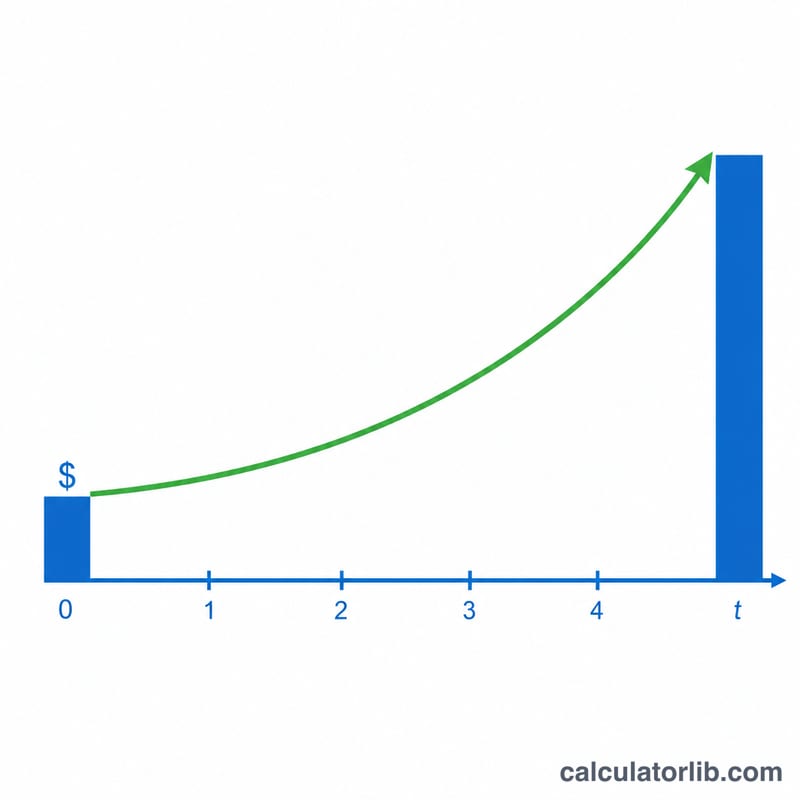
The ratio of end to start value gives the growth multiple. Raising it to the power of \(\frac{1}{\text{years}}\) converts that total growth into an equivalent per-year growth factor, and subtracting 1 turns the factor into a rate. Multiply by 100 to express it as a percentage.
Worked Example
Suppose you deposited $10,000 and it grew to $15,000 over 5 years. The growth multiple is \(15{,}000 / 10{,}000 = 1.5\). Raising to the power \(\frac{1}{5}\) gives \(1.5^{0.2} \approx 1.0845\). Subtracting 1 leaves 0.0845, or about 8.45% per year. The total return over the period is 50%, and the total gain is $5,000.
Interpreting Your CAGR Result
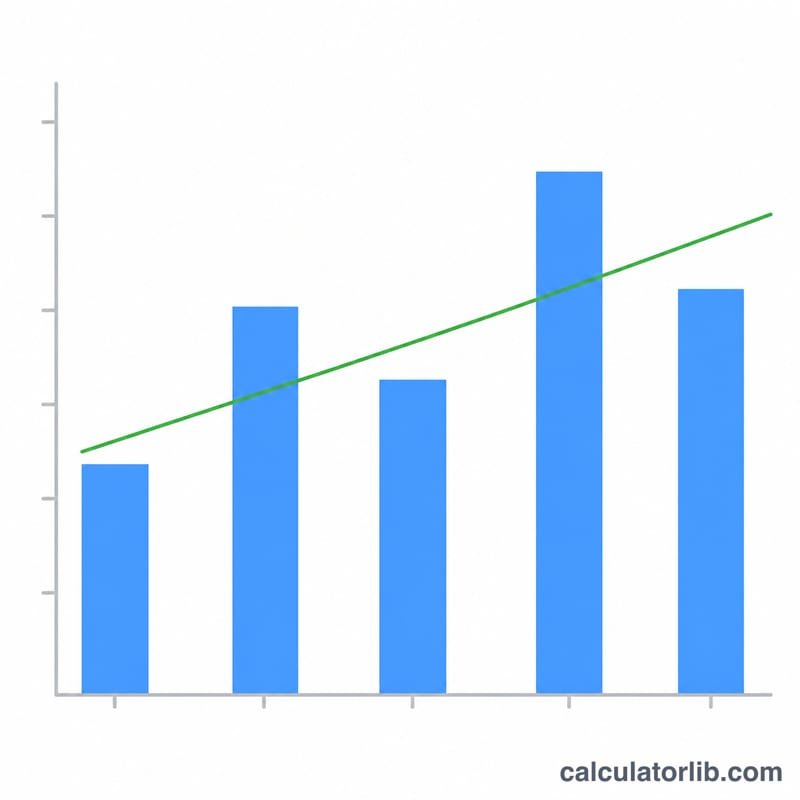
CAGR is a smoothed geometric rate. It answers a single question: at what constant annual rate would your start value have to grow, compounding each year, to reach your end value over the holding period? Because it works backward from only two data points — the beginning and ending balances — it deliberately erases everything that happened in between.
- It hides volatility and interim swings. A deposit that rose sharply, crashed, and recovered can show the exact same CAGR as one that drifted smoothly upward. Two investments with identical CAGRs can have very different risk profiles, so CAGR says nothing about the bumpiness of the journey or the largest drawdown along the way.
- It ignores deposits and withdrawals during the period. The simple two-value formula assumes a single lump sum left untouched. If you added or removed money between the start and end dates, the result is distorted — for cash flows during the period, a money-weighted return (IRR) or a time-weighted return is more appropriate.
- It is historical, not a forecast. A past CAGR describes what already happened. It is not a guaranteed or expected future rate; markets, interest rates and conditions change, and past performance does not predict future results.
To judge whether a CAGR is "good," compare it against relevant benchmarks rather than in isolation:
- Inflation: Subtract the average annual inflation rate over the same period to estimate your real (purchasing-power) return. A 4% CAGR during a 3% inflation environment is only about 1% in real terms.
- Risk-free and savings rates: Compare against what a high-yield savings account, term deposit or government bond would have paid over the same horizon.
- A market index: Compare an equity investment's CAGR against a broad index total return over the identical start and end dates, since timing strongly affects the comparison.
When comparing two investments, always use the same time period and the same start/end dates — CAGR is only meaningful when the holding periods line up.
This is general educational information, not personal financial advice. Consider your own circumstances and consult a qualified professional before making investment decisions.
FAQ
Is CAGR the same as average annual return? No. A simple average ignores compounding; CAGR accounts for it, so it reflects the true geometric growth rate.
Can I use it for any currency? Yes — the calculation is purely mathematical, so any currency or unit works as long as start and end values use the same one.
What if my investment lost money? CAGR will simply be negative, correctly showing the annualized rate of decline.