What is the Speed Calculator?
This calculator finds average speed from a known distance and the time taken to cover it. Average speed is simply how much ground you cover per unit of time, expressed by the classic physics relationship \(v = d / t\). It works for cars, runners, cyclists, walking, swimming, or any moving object, and instantly shows the result in kilometers per hour, miles per hour, meters per second, and feet per second.
How to use it
Enter the total distance traveled and pick its unit (km, miles, or meters). Then enter the elapsed time and choose hours, minutes, or seconds. The calculator converts everything to a common base, divides distance by time, and presents the speed in four common units so you can use whichever you need.
The formula explained
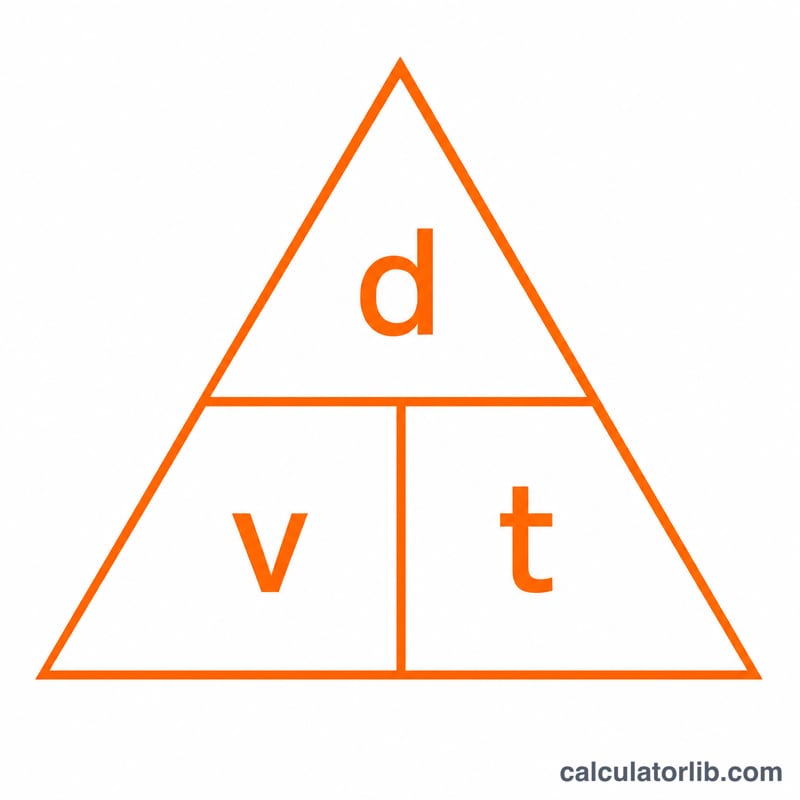
Speed (\(v\)) is the rate of change of distance over time: $$v = \frac{d}{t} = \frac{\text{Distance}}{\text{Time}}$$ If the distance is in meters and time in seconds, the result is meters per second (m/s). To convert m/s to km/h, multiply by 3.6; to convert to mph, multiply by about 2.23694. This is average speed — it does not account for acceleration or stops along the way.
Worked example
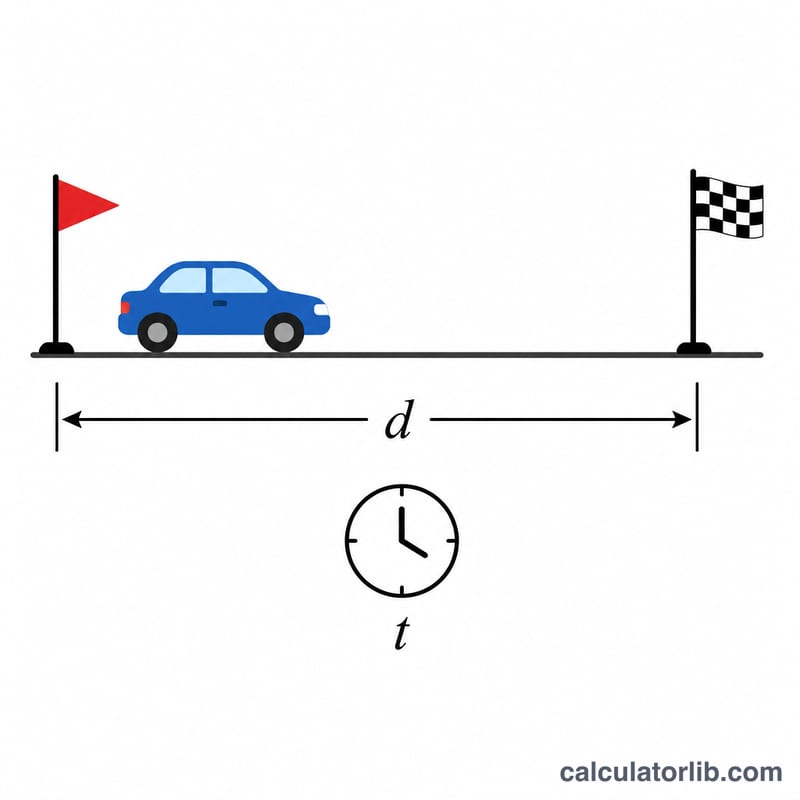
Suppose you drive 100 km in 2 hours. $$\text{Speed} = 100 \div 2 = 50 \text{ km/h}$$ In other units that is about 13.89 m/s, 31.07 mph, and 45.57 ft/s.
Speed Unit Conversion Table
Exact conversion factors: 1 m/s = 3.6 km/h = 2.23694 mph = 3.28084 ft/s, and 1 mph = 1.609344 km/h = 0.44704 m/s = 1.46667 ft/s. The table below converts common km/h values (rounded to two decimals).
| km/h | mph | m/s | ft/s |
|---|---|---|---|
| 1 | 0.62 | 0.28 | 0.91 |
| 5 | 3.11 | 1.39 | 4.56 |
| 10 | 6.21 | 2.78 | 9.11 |
| 30 | 18.64 | 8.33 | 27.34 |
| 50 | 31.07 | 13.89 | 45.57 |
| 60 | 37.28 | 16.67 | 54.68 |
| 100 | 62.14 | 27.78 | 91.13 |
| 120 | 74.56 | 33.33 | 109.36 |
To convert km/h to m/s, divide by 3.6. To convert km/h to mph, divide by 1.609344 (or multiply by 0.621371).
Typical Speeds Reference
These are approximate typical figures, not exact values. Real speeds vary with person, vehicle, terrain and conditions.
| Activity / object | km/h | mph | m/s |
|---|---|---|---|
| Walking | ≈ 5 | ≈ 3.1 | ≈ 1.4 |
| Jogging | ≈ 8–10 | ≈ 5.0–6.2 | ≈ 2.2–2.8 |
| Cycling | ≈ 15–25 | ≈ 9.3–15.5 | ≈ 4.2–6.9 |
| Car in urban traffic | ≈ 50 | ≈ 31 | ≈ 13.9 |
| Car on a highway | ≈ 100–120 | ≈ 62–75 | ≈ 27.8–33.3 |
| Commercial jet (cruise) | ≈ 900 | ≈ 559 | ≈ 250 |
| Speed of sound in air at 20 °C | ≈ 1,235 | ≈ 767 | ≈ 343 |
Conventions and edge cases
Each case below was run through this calculator; the result column is what it actually returns.
| Case | Input | Result |
|---|---|---|
| Negative distance | -100, 2 | The time must be greater than 0, and the distance cannot be negative. |
| 100 in 2 hours | 100, 2 | Speed: 50 |
| Zero time | 100, 0 | The time must be greater than 0, and the distance cannot be negative. |
Checked on 2026-11-08
FAQ
Is this average or instantaneous speed? It gives average speed over the whole trip, not the speed at any single moment.
Can I mix units? Yes — choose distance in miles and time in minutes, for example. The tool converts automatically.
What if time is zero? Division by zero is undefined, so the calculator returns zero. Enter a positive time value for a meaningful result.