
What Is the 66-Day Habit Rule?
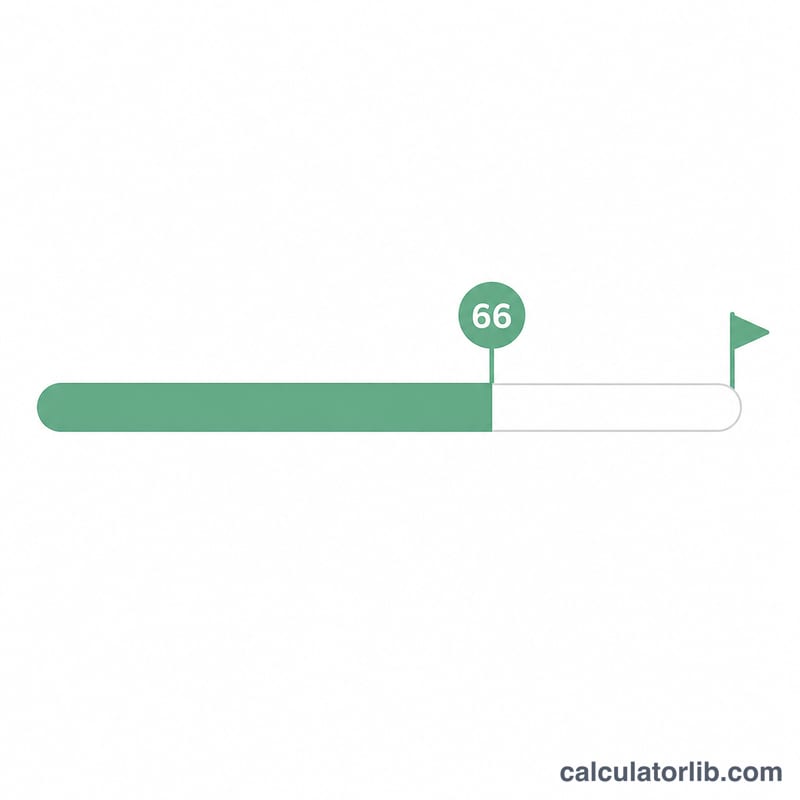
You may have heard it takes 21 days to form a habit, but research from University College London (Phillippa Lally et al., 2009) found that, on average, it takes about 66 days for a new behaviour to become automatic. This calculator uses that 66-day benchmark to show how far along you are with a new routine — whether it's a daily gratitude journal, a workout, meditation, or drinking more water — and exactly how many days remain.
How to Use It
Enter the number of days you have already completed the habit (your current streak), then read off two results: the days remaining until you hit the 66-day mark, and your overall progress percentage. Use it as a daily motivation check-in to keep your streak alive.
The Formula Explained
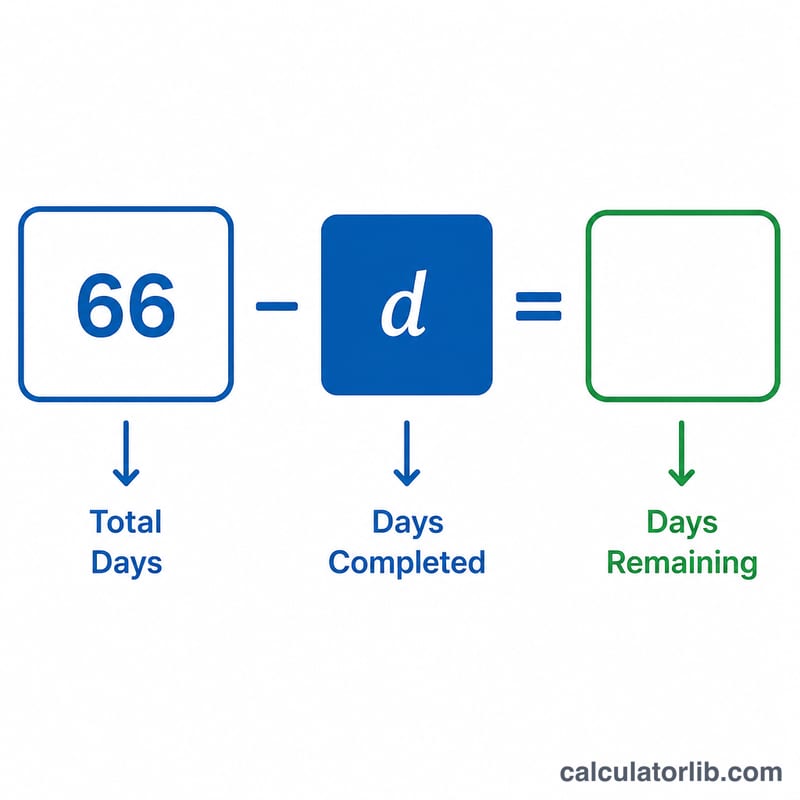
The math is simple. Days remaining is the target minus your progress:
$$\text{days\_remaining} = 66 - \text{days\_completed}$$
Your progress percentage is your completed days as a share of the full target:
$$\text{percent} = \frac{\text{days\_completed}}{66} \times 100$$
If you have completed 66 or more days, the calculator caps the result at zero days remaining and 100% — congratulations, the habit should now feel automatic.
Worked Example
Suppose you have journalled gratitude every day for 22 days. Days remaining = \(66 - 22 = 44\) days. Progress = \(22 \div 66 \times 100 = 33.33\%\) . You are one third of the way to making the habit stick.
FAQ
Is the 66-day number exact? No. The 2009 study found a wide range (18 to 254 days) depending on the person and the habit. 66 days is the average and a useful, motivating benchmark.
What if I miss a day? A single missed day did not significantly derail habit formation in the research. Just reset your "days completed" to your current consistent streak and carry on.
Does this work for any habit? Yes — it's a general guide. Simpler habits (drinking a glass of water) tend to become automatic faster than complex ones (a 30-minute exercise routine).