What Is the Sunscreen Calculator?
This tool estimates three things that matter for proper sun protection: how much sunscreen you should apply, how many times you need to reapply during your time outdoors, and roughly how long your chosen SPF can theoretically protect you. It is based on the dermatology standard application rate of 2 mg of sunscreen per square centimeter of skin — the same density used when SPF is measured in the lab.
How to Use It
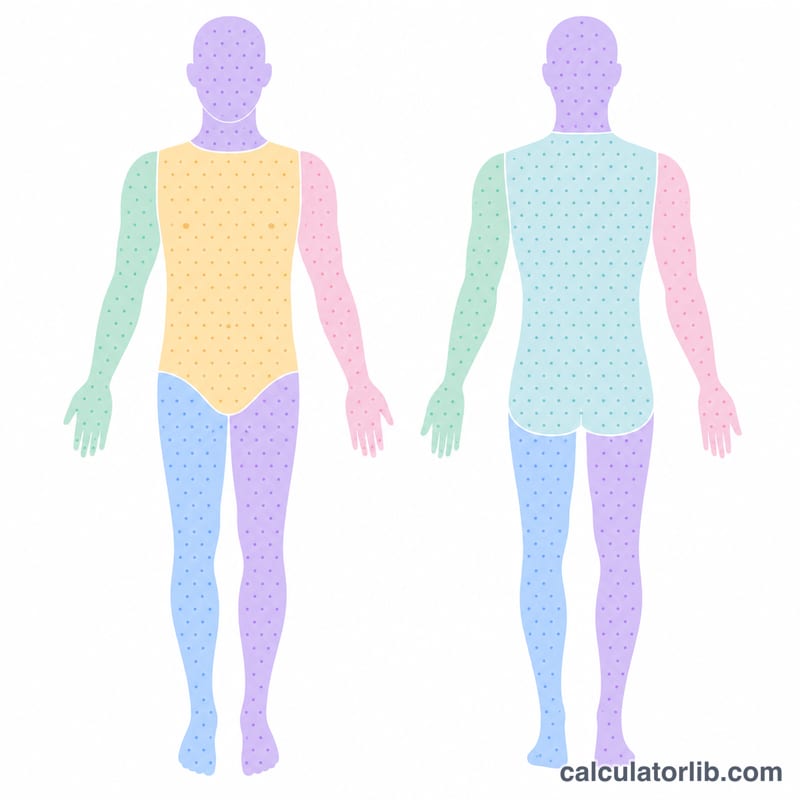
Enter the total skin surface area you plan to cover in square centimeters. As a reference, an average adult's whole body is roughly 16,000–18,000 cm², while the face, neck and ears together are about 600 cm². Then enter how many hours you'll be outside, your sunscreen's SPF rating, and your baseline burn time — the number of minutes your bare skin takes to redden in the sun (often 10 minutes for fair skin).
The Formula Explained
The amount per application is \(\text{Area} \times 2\ \text{mg/cm}^2\), converted to grams by dividing by 1000. Because sunscreen degrades and rubs off, you should reapply every two hours, so the number of applications is \(\left\lceil \text{hours} \div 2 \right\rceil\). Total product needed is the per-application amount multiplied by that count. Finally, theoretical protection time is \(\text{SPF} \times \text{baseline burn time}\).
$$\text{Total} = \frac{2 \cdot \text{Area (cm}^2\text{)}}{1000} \times \left\lceil \frac{\text{Hours}}{2} \right\rceil$$
$$\text{Protection} = \text{SPF} \times \text{Burn Time (min)}$$
Worked Example
For a full body (16,000 cm²), 4 hours outside, SPF 30 and a 10-minute baseline: amount = \(16{,}000 \times 2 = 32{,}000\ \text{mg} = \) 32 g per application. Reapplications = \(\left\lceil 4 \div 2 \right\rceil = \) 2. Total = \(32 \times 2 = \) 64 g. Protection time = \(30 \times 10 = \) 300 minutes in ideal conditions.
Approximate Body Area Reference Values for Sunscreen
The surface areas below are approximations based on the "rule of nines" (a burn-assessment convention that splits the body into regions of about 9% or multiples of 9%), applied to an average adult with a total skin area of roughly 17,000 cm². Real body areas vary with height, weight and build. The grams per application use the standard test dose of 2 mg/cm² (2 mg/cm² × area ÷ 1000 = grams).
| Body region | Approx. area (cm²) | Sunscreen per application (g) |
|---|---|---|
| Face, neck and ears | ~600 | ~1.2 |
| Each arm (shoulder to fingertips) | ~1,500 | ~3.0 |
| Each leg (hip to toes) | ~3,000 | ~6.0 |
| Chest and abdomen (front torso) | ~3,000 | ~6.0 |
| Back (upper and lower) | ~3,000 | ~6.0 |
| Each hand (both sides) | ~400 | ~0.8 |
| Each foot (top and sole) | ~500 | ~1.0 |
| Whole body | ~16,000–18,000 (about 17,000 typical) | ~32–36 (about 34) |
Regions overlap: the arm figure already includes the hand, and the leg figure includes the foot, so do not add them together. These are rough planning values, not measurements of any individual.
Sunscreen Needed in Different Scenarios
Each row uses 2 mg/cm², reapplication every 2 hours (applications = ⌈hours ÷ 2⌉), and theoretical protection = SPF × baseline burn time. Body areas come from the approximate reference table above.
| Scenario | Area (cm²) | Hours | Applications | Grams per application | Total grams | SPF × burn time (min) | Theoretical protection (min) |
|---|---|---|---|---|---|---|---|
| Face only | 600 | 2 | 1 | 1.2 | 1.2 | 30 × 10 | 300 |
| Face + both arms | 3,600 | 4 | 2 | 7.2 | 14.4 | 30 × 15 | 450 |
| Full body | 17,000 | 4 | 2 | 34 | 68 | 50 × 10 | 500 |
| Full body | 17,000 | 8 | 4 | 34 | 136 | 50 × 10 | 500 |
Worked check for the full-body, 4-hour row:
$$\text{Per application} = \frac{2 \times 17000}{1000} = 34\ \text{g}, \qquad \text{Total} = 34 \times \left\lceil \frac{4}{2} \right\rceil = 34 \times 2 = 68\ \text{g}$$
Note that reapplying does not extend the theoretical protection time in this model; it is used to maintain the coating you applied originally.
Interpreting Your Results
- What SPF means: SPF is a laboratory measure of protection against UVB. The share of UVB blocked is approximately \(1 - \frac{1}{\text{SPF}}\): about 93% for SPF 15, 97% for SPF 30 and 98% for SPF 50. Higher numbers add progressively smaller gains.
- The time figure is a theoretical maximum: multiplying SPF by baseline burn time gives an idealised estimate. It assumes the full tested dose, even coverage, no rubbing off and constant UV intensity. It is not a guarantee against sunburn or skin damage. Burn time itself varies with skin type, UV index, time of day, altitude and reflective surfaces.
- Reapplication: A commonly cited guideline is to reapply about every 2 hours when outdoors, and also after swimming, heavy sweating or towel drying, even if the product is labelled water-resistant. Water-resistance claims are time-limited and vary by regulator.
- Under-application: SPF is tested at 2 mg/cm². Studies of everyday use commonly find people apply considerably less than this, which lowers the real-world protection well below the number on the label. The grams in this calculator show the amount the label rating is based on.
- UVB versus UVA: SPF addresses UVB only. Protection against UVA requires a product labelled broad-spectrum (or the equivalent UVA marking used in your region). Labelling rules differ by country.
This is general information, not medical advice. Sunscreen is generally considered one part of sun protection alongside shade, clothing and avoiding peak sun hours.
FAQ
Why 2 mg/cm²? That's the lab density used to certify SPF labels. Most people apply only a quarter to half of that, getting far less protection than the label implies.
Does SPF × burn time mean I'm safe that long? No — it's a theoretical maximum. Sweat, water, and rubbing reduce it, so always reapply every two hours.
How much is a shot-glass of sunscreen? About 30 ml, which is the commonly cited full-body adult dose and matches the ~32 g this calculator estimates.