
What is the 8-Hour Shift Calculator?
The 8-Hour Shift Calculator works out exactly how many hours you actually worked during a shift once your unpaid break is removed, and converts that into gross pay using your hourly rate. A classic "8-hour shift" usually spans more than 8 clock hours because of a lunch or rest break — this tool shows the true paid figure.
How to use it
Enter your start and end times in 24-hour decimal format (for example, 9:00 = 9, 5:30 PM = 17.5). Add the length of your unpaid break in minutes and your hourly pay rate. The calculator returns the total shift span, the net hours worked after the break, and your gross pay.
The formula explained
First the shift span is found by subtracting the start time from the end time. If the end is earlier than the start (an overnight shift), 24 hours are added. The break, given in minutes, is divided by 60 to convert to hours and subtracted from the span. Multiplying the result by your hourly rate gives gross pay before tax.
$$\text{Worked} = (\text{End} - \text{Start}) - \frac{\text{Break}_{min}}{60}$$$$\text{Pay} = \text{Worked} \times \text{Rate}$$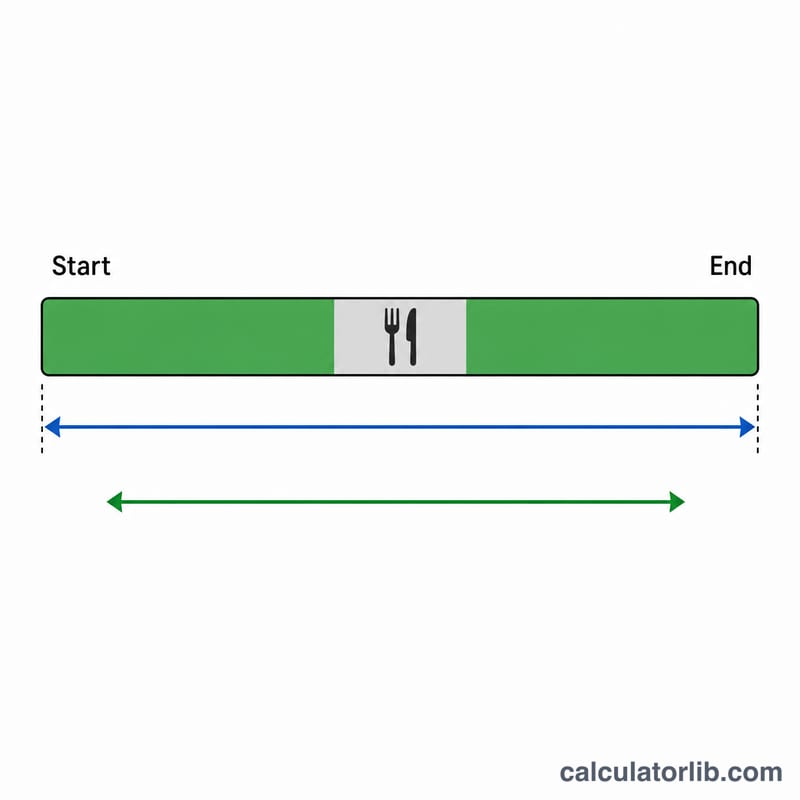
Worked example
Suppose you start at 9:00 (9), finish at 17:30 (17.5), take a 30-minute break and earn 20 per hour. The span is \(17.5 - 9 = 8.5\) hours. Subtract 0.5 hours of break to get 8 net hours. Multiply by 20 → gross pay of 160.
$$\text{Worked} = (17.5 - 9) - \frac{30}{60} = 8$$$$\text{Pay} = 8 \times 20 = 160$$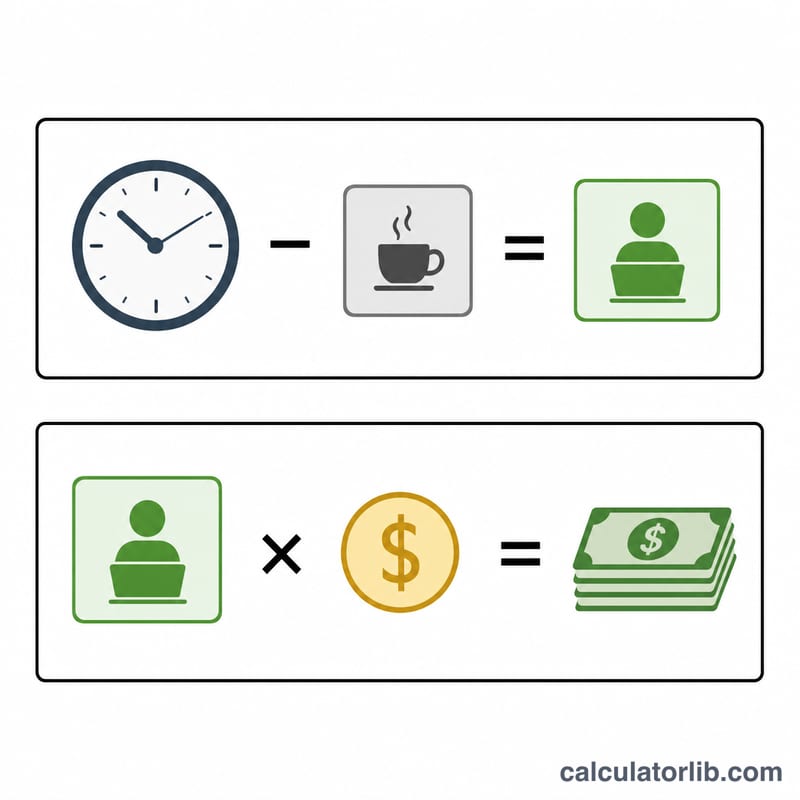
Shift Pay Across Common Scenarios
The table below shows how net worked hours and gross pay change with start/end times and break length. Worked hours are computed as \(\text{Worked} = (\text{End} - \text{Start}) - \dfrac{\text{Break}}{60}\), and gross pay as \(\text{Worked} \times \text{Rate}\). Times are written in 24-hour decimal form (for example 17:30 = 17.5). Overnight shifts add 24 to the end time so the subtraction stays positive (6:30 next day = 30.5).
| Scenario | Start → End | Span (h) | Break (min) | Net hours | Gross @ $18/h | Gross @ $25/h |
|---|---|---|---|---|---|---|
| Day shift, short break | 9 → 17.5 | 8.5 | 30 | 8.0 | $144.00 | $200.00 |
| Day shift, lunch hour | 8 → 16.5 | 8.5 | 60 | 7.5 | $135.00 | $187.50 |
| Standard 9–5, half-hour | 9 → 17 | 8.0 | 30 | 7.5 | $135.00 | $187.50 |
| Overnight shift | 22 → 30.5 | 8.5 | 30 | 8.0 | $144.00 | $200.00 |
| Long day, no break | 7 → 16 | 9.0 | 0 | 9.0 | $162.00 | $225.00 |
Note that a worked total above 8 hours in a day (or 40 in a week) may qualify for overtime in some jurisdictions; use a dedicated overtime tool for those calculations.
Clock Time to Decimal Time Conversion
This calculator takes start and end times as 24-hour decimal numbers, not as HH:MM. To convert a clock time, keep the hour and divide the minutes by 60. For example 14:45 becomes \(14 + \tfrac{45}{60} = 14.75\). The quarter-hour values are the most common.
| Minutes past the hour | Decimal fraction | Example clock time | Decimal value |
|---|---|---|---|
| :00 | .00 | 9:00 | 9.00 |
| :15 | .25 | 9:15 | 9.25 |
| :30 | .50 | 9:30 | 9.50 |
| :45 | .75 | 9:45 | 9.75 |
For any other minute, divide by 60. A selection of per-minute conversions:
| Minutes | Decimal | Minutes | Decimal | Minutes | Decimal |
|---|---|---|---|---|---|
| 5 | .083 | 25 | .417 | 45 | .750 |
| 10 | .167 | 30 | .500 | 50 | .833 |
| 15 | .250 | 35 | .583 | 55 | .917 |
| 20 | .333 | 40 | .667 | 60 | 1.000 |
For overnight shifts that cross midnight, add 24 to the end time. A shift ending at 6:30 AM is entered as \(6.5 + 24 = 30.5\), and one ending at 1:00 AM is entered as 25.
Key Terms Explained
- Shift span
- The total elapsed time between the start and end of the shift before any deductions, equal to \(\text{End} - \text{Start}\). A 9:00 to 17:30 shift has a span of 8.5 hours.
- Net (worked) hours
- The paid time after subtracting unpaid breaks from the span: \(\text{Worked} = (\text{End} - \text{Start}) - \tfrac{\text{Break}}{60}\). This is the figure multiplied by your hourly rate to get pay.
- Unpaid break
- Time during the shift — typically a meal period — for which you are not paid. Entered in minutes and converted to hours by dividing by 60. Paid rest breaks are not subtracted.
- Hourly rate
- The amount you earn for each hour worked, in dollars. Multiplying it by net hours gives gross pay for the shift.
- Gross pay
- Earnings for the shift before taxes and deductions: \(\text{Gross} = \text{Worked} \times \text{Rate}\). Take-home (net) pay will be lower after withholding.
- Overnight shift
- A shift that crosses midnight, where the end time falls on the next calendar day. To compute it correctly, add 24 to the end time so the subtraction yields a positive span — for example 22:00 to 6:30 becomes \(30.5 - 22 = 8.5\) hours of span.
FAQ
Why is my shift longer than 8 hours? Because most "8-hour" shifts include an unpaid break, so the clock span is typically 8.5 hours for 8 paid hours.
Does this handle overnight shifts? Yes. If your end time is smaller than your start time, the tool adds 24 hours automatically.
Is the pay before or after tax? It is gross pay (before tax and deductions). Use your country's tax rules to estimate take-home pay.