What is the UV Index Sunburn Time Calculator?
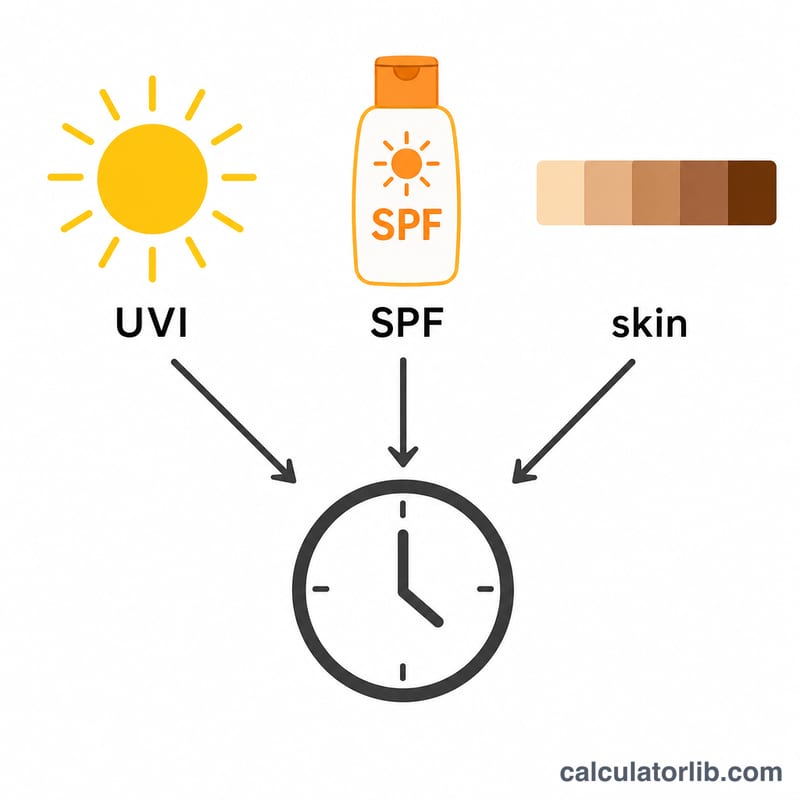
This tool estimates how many minutes of sun exposure it may take before your skin starts to burn. It combines three factors: the current UV Index (UVI), your sunscreen SPF, and your skin type. The higher the UV Index and the fairer your skin, the faster you burn; a higher SPF extends the time before damage occurs. Use it as a general sun-safety guide — it is an estimate, not medical advice.
How to use it
Enter the UV Index for your location (weather apps and forecasts publish this, typically 0–11+). Enter your sunscreen SPF, or use 1 if you are wearing none. Pick the skin type that best matches you, from Type I (very fair, always burns) to Type VI (deeply pigmented, almost never burns). The calculator returns an estimated time to sunburn in minutes, plus a base reference time for unprotected fair skin.
The formula explained
The main estimate is $$\text{Time} = \frac{200 \times \text{SPF}}{\text{UVI} \times \text{skin}}$$ The constant 200 represents minimal-erythema exposure for reference skin; SPF multiplies the protected duration; dividing by the UV Index accounts for stronger radiation burning faster; and the skin factor (2.5 for Type I up to 8 for Type VI) reflects natural tolerance. The base time, $$\frac{60}{\text{UVI} / 2}$$ shows roughly how quickly unprotected reference skin reacts at that UV level.
Worked example
Suppose the UV Index is 7, you use SPF 30, and you have Type II skin (factor 3). $$\text{Time} = \frac{200 \times 30}{7 \times 3} = \frac{6000}{21} \approx 286 \text{ minutes}$$ The base time $$= \frac{60}{7/2} = \frac{60}{3.5} \approx 17 \text{ minutes}$$ — meaning bare fair skin would react in about 17 minutes at UVI 7.
UV Index Categories and Exposure Levels
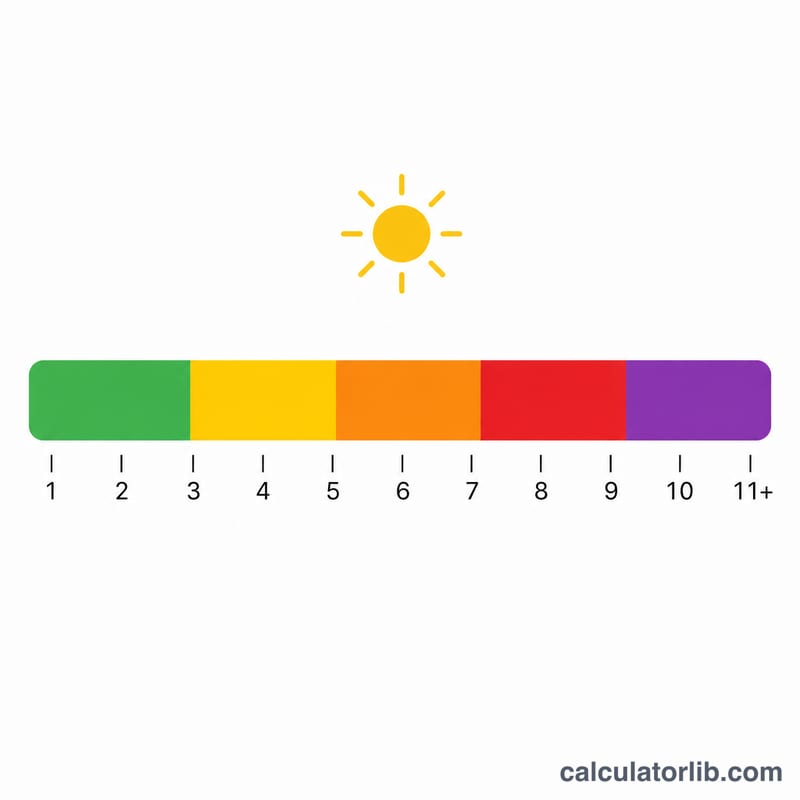
The UV Index is an international standard scale developed by the WHO together with partner agencies. The US EPA uses the same categories and colors. The table below summarizes the general protection guidance from those agencies for each category.
| UV Index | Category | Color | General protection guidance |
|---|---|---|---|
| 0 to 2 | Low | Green | Little danger for most people. Sunglasses on bright days are enough. Take extra care on snow, which reflects UV. |
| 3 to 5 | Moderate | Yellow | Protection is recommended. Seek shade around midday and wear a hat, sunglasses, protective clothing and sunscreen. |
| 6 to 7 | High | Orange | Protection is required. Reduce time in the sun between about 10 a.m. and 4 p.m. Use shade, clothing, a hat and SPF 30 or higher sunscreen. |
| 8 to 10 | Very High | Red | Extra protection is needed. Unprotected skin can burn quickly. Minimize midday sun and use all protective measures. |
| 11 or more | Extreme | Violet (purple) | Take every precaution. Unprotected skin can burn in minutes. Avoid midday sun, stay in shade and cover up. |
The UV Index is usually highest around solar noon and varies with latitude, season, altitude, cloud cover and ozone. Check the local forecast for the value in your area, then enter it into the calculator.
FAQ
Is this exact? No. Individual response varies with sweat, water, altitude, reflection off snow or sand, and how thickly you apply sunscreen. Reapply every two hours.
Why use 1 for SPF? SPF 1 represents no sunscreen, so the formula gives your unprotected burn time.
What UV Index is dangerous? Values of 3+ warrant protection; 8+ is very high — seek shade and reapply often.