
What is the Discomfort Index?
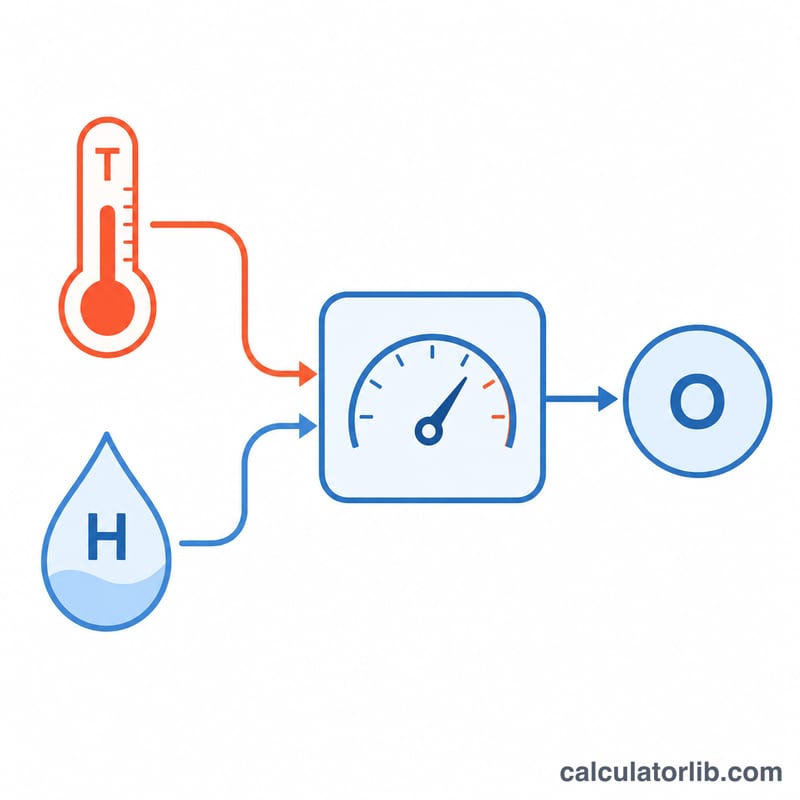
The Discomfort Index (DI), also called the Temperature-Humidity Index (THI), is a single number that estimates how uncomfortable people feel given the combination of air temperature and humidity. It was introduced by E.C. Thom in 1959 and is widely used in weather reporting because high humidity makes a hot day feel far worse than the thermometer alone suggests. This is a universal meteorological formula with no country-specific rules.
How to use this calculator
Enter the air temperature, pick its unit (Celsius, Fahrenheit or Kelvin), and enter the relative humidity as a percentage from 0 to 100. The calculator converts the temperature to Celsius if needed, computes the DI, and shows the matching comfort sensation category. Although DI looks like a temperature, it is dimensionless — do not read it as degrees.
The formula explained
The index is computed as $$\text{DI} = 0.81 \times T + 0.01 \times H \times (0.99 \times T - 14.3) + 46.3$$ where \(T\) is temperature in °C and \(H\) is humidity in percent. The 0.01 factor already scales the humidity, so you supply 70 for 70% rather than 0.7. At low temperatures the bracket term can go negative, which correctly lowers the index for cold conditions.
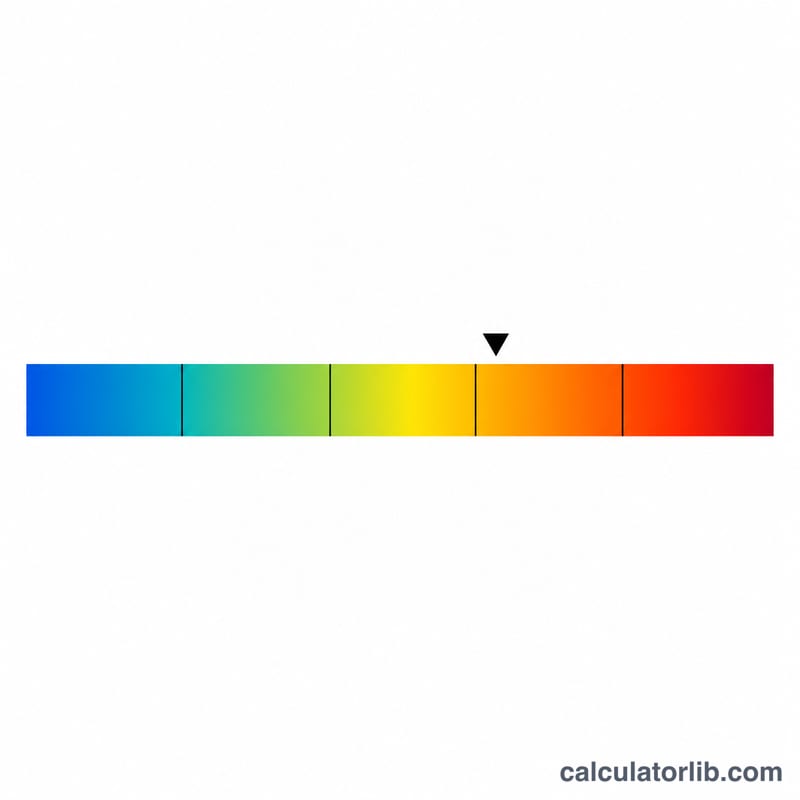
Comfort thresholds: below 55 Cold; 55–60 Chilly; 60–65 Comfortable; 65–70 Pleasant; 70–75 Slightly warm; 75–80 Slightly hot, some discomfort; 80–85 Hot, most uncomfortable; 85 and above Very hot, unbearable.
Worked example
For 30°C and 70% humidity: $$\text{DI} = 0.81 \times 30 + 0.01 \times 70 \times (0.99 \times 30 - 14.3) + 46.3 = 24.3 + 0.7 \times 15.4 + 46.3 = 24.3 + 10.78 + 46.3 = 81.38 \approx 81.4$$ which falls in the "Hot, most feel discomfort" band.
FAQ
Is DI measured in degrees? No. Even though it numerically resembles a temperature, DI is dimensionless and should not carry a °C label.
Why does humidity matter so much? Sweat cools us by evaporating; high humidity slows evaporation, so the same temperature feels hotter and the index rises.
What humidity value should I enter? Use the plain percentage (e.g. 65 for 65%). Values outside 0–100% are physically invalid and are clamped to that range.