
What the Heat Index Calculator Does
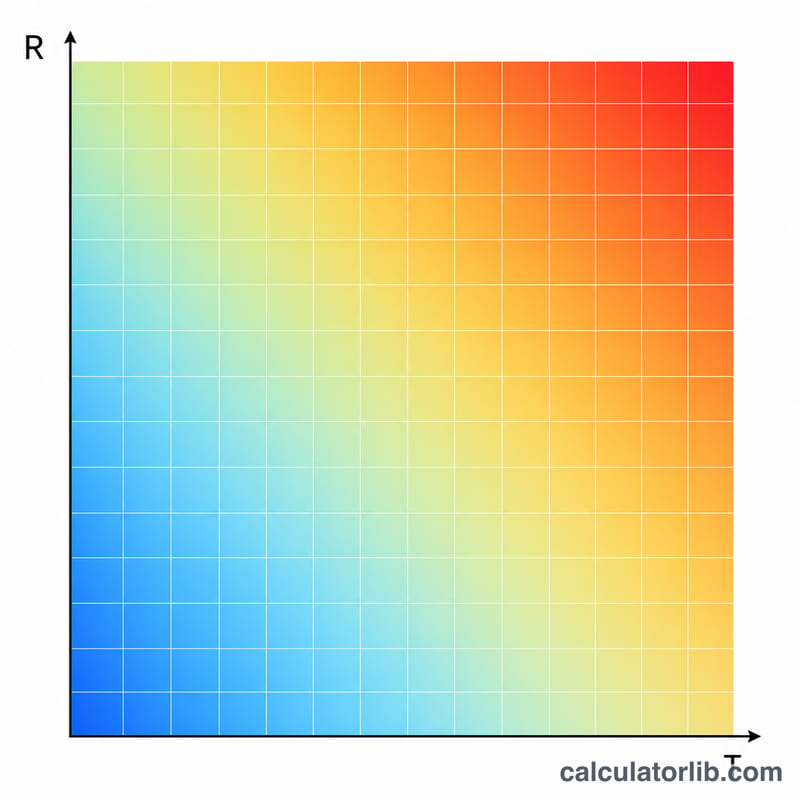
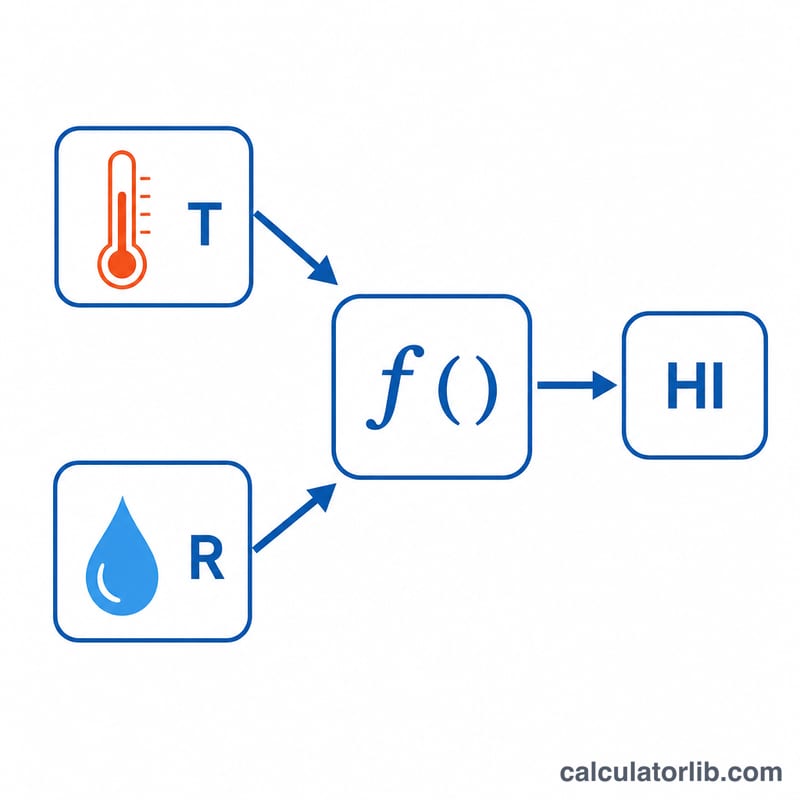
The heat index (or "feels-like" temperature) tells you how hot it actually feels to the human body when humidity is combined with the air temperature. When the air is humid, sweat evaporates more slowly, so your body cools less efficiently and the heat feels more intense than the thermometer suggests. This calculator uses the standard formula adopted by the US National Weather Service to convert the raw temperature and humidity into a single feels-like figure, and it works in both Fahrenheit and Celsius.
How to Use It
- Temperature – Enter the current air temperature.
- Relative Humidity (%) – Enter the humidity as a percentage (0–100).
- Temperature Unit – Choose Fahrenheit or Celsius. The calculator converts internally and returns the result in the same unit you selected.
The result is your heat index plus a risk category: Comfortable, Caution, Extreme Caution, Danger, or Extreme Danger, with a short note on what that means for outdoor activity.
The Formula Explained
The tool first converts your temperature to Fahrenheit if you entered Celsius, then applies the NWS Rothfusz regression equation:
$$\begin{gathered} \text{HI} = -42.379 + 2.04901523\,T + 10.14333127\,\text{RH} - 0.22475541\,T\cdot\text{RH} - 0.00683783\,T^2 \\ -\,0.05481717\,\text{RH}^2 + 0.00122874\,T^2\cdot\text{RH} + 0.00085282\,T\cdot\text{RH}^2 - 0.00000199\,T^2\cdot\text{RH}^2 \end{gathered}$$Here \(T\) is temperature in °F and \(\text{RH}\) is relative humidity in percent. If you chose Celsius, the final result is converted back to °C. The category is determined from the Fahrenheit value: under 80°F is Comfortable, 80–89°F Caution, 90–104°F Extreme Caution, 105–129°F Danger, and 130°F or above Extreme Danger.
Worked Example
Suppose it is 90°F with 70% relative humidity. Plugging these into the equation gives a heat index of roughly 106°F — that's in the "Danger" range, even though the thermometer only reads 90°F. The extra 16 degrees of perceived heat comes entirely from the high humidity slowing your body's evaporative cooling. The calculator would flag this and advise limiting strenuous outdoor activity.
FAQ
Is the heat index accurate at low temperatures or humidity? The formula is designed for hot, humid conditions (roughly above 80°F). At cooler or very dry conditions it is less meaningful, and the result will simply read close to the actual temperature.
Does the heat index account for sun and wind? No. The standard calculation assumes shade and light wind. Direct sunlight can add up to about 15°F to the perceived temperature, so real-world conditions may feel even hotter.
Why does humidity make heat feel worse? Your body cools by evaporating sweat. High humidity means the air already holds a lot of moisture, so sweat evaporates slowly and you retain more heat — raising the feels-like temperature.