
What the IAAF Score Calculator Does
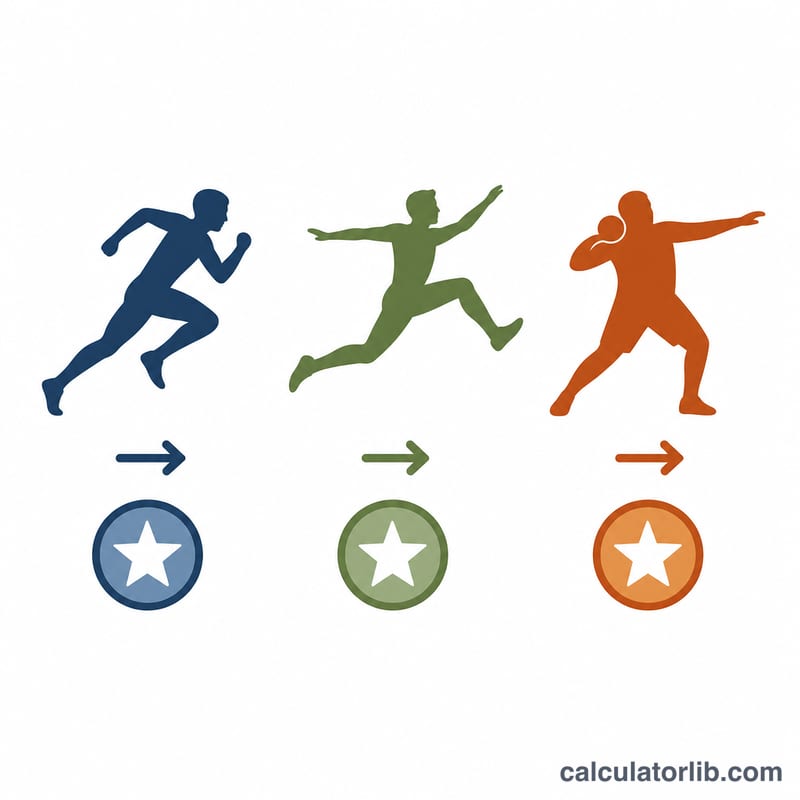
The IAAF Score Calculator (now used under World Athletics scoring tables) converts a track and field performance into a single points value. Points let you compare results across different events — for example, whether a 10.5-second 100m is "worth more" than a 7.50m long jump. This tool supports three events (100m sprint, long jump and shot put), separate male and female tables, and turns your raw mark into an objective score used in combined events and athlete rankings worldwide.
The Inputs You Provide
- Event – choose 100m, Long Jump or Shot Put.
- Gender – Male or Female, since each event uses different coefficients.
- Performance – your result: seconds for the 100m, metres for long jump, and metres for shot put.
The Formula Explained
The scoring follows the standard form:
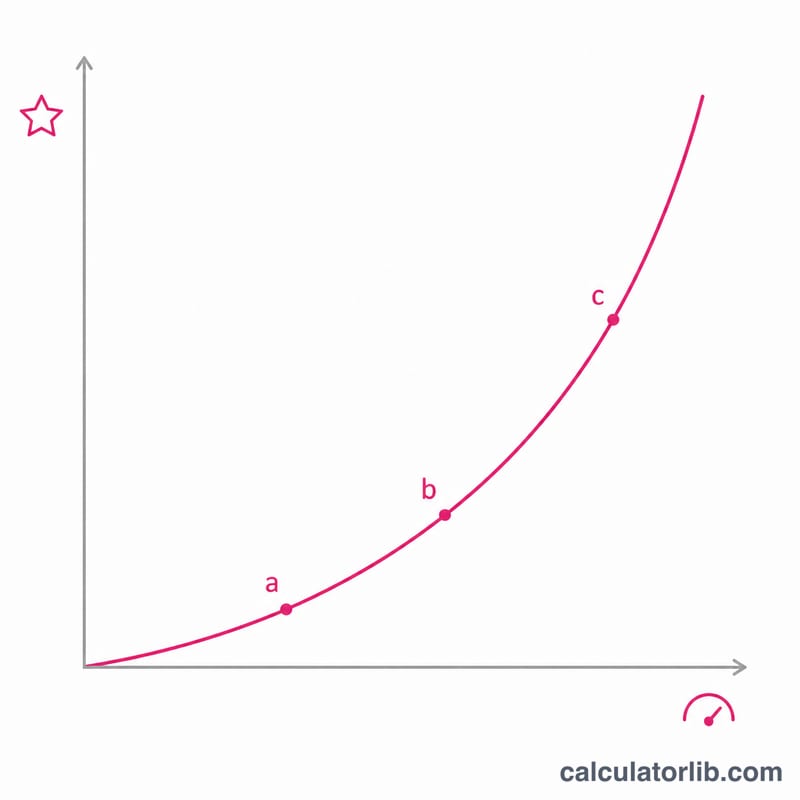
\(\text{IAAF Score} = A \times (B - \text{Performance})^C\)
Each event/gender pair has its own A, B and C constants. The key difference is direction. For running events (100m), a smaller time is better, so the calculation uses (B − Performance). For field events (long jump, shot put), a bigger mark is better, so it flips to (Performance − B). Long jump performance is first converted from metres to centimetres before scoring. The final number is rounded down (floor) to whole points.
- 100m Male: A=25.4347, B=18, C=1.81
- 100m Female: A=17.857, B=21, C=1.81
- Long Jump Male: A=0.14354, B=220, C=1.40
- Long Jump Female: A=0.188807, B=210, C=1.41
- Shot Put Male: A=51.39, B=1.5, C=1.05
- Shot Put Female: A=56.0211, B=1.5, C=1.05
Worked Example
Suppose a male athlete runs the 100m in 11.00 seconds. Using A=25.4347, B=18, C=1.81:
Score = 25.4347 × (18 − 11.00)1.81 = 25.4347 × 71.81 ≈ 25.4347 × 33.94 ≈ 863 points (after rounding down).
For a female long jumper reaching 6.00m, the mark becomes 600 cm: 0.188807 × (600 − 210)1.41 ≈ 0.188807 × 4427 ≈ 835 points.
FAQ
What units should I enter? Seconds for the 100m, and metres for long jump and shot put. The tool converts long jump to centimetres internally, so always enter metres (e.g. 6.50).
Why do men and women get different points for the same mark? Each gender has its own A, B and C coefficients, reflecting different performance baselines, so identical raw results produce different scores.
Can I get a negative or zero score? Yes — if your performance is worse than the B threshold (e.g. a 100m slower than 18 seconds for men), the result rounds to a very low or zero value, since you're below the scored range.