Connect via MCP →

Enter Calculation

Track Events
Typical range for elite athletes: 10-11 seconds
Typical range for elite athletes: 48-52 seconds
Typical range for elite athletes: 13.5-15 seconds
Typical range for elite athletes: 240-270 seconds (4-4.5 minutes)
Field Events
Typical range for elite athletes: 7-8 meters
Typical range for elite athletes: 14-16 meters
Typical range for elite athletes: 2-2.2 meters
Typical range for elite athletes: 45-55 meters
Typical range for elite athletes: 4.8-5.5 meters
Typical range for elite athletes: 65-75 meters

Formula

Formula: Decathlon Score Calculator
Show calculation steps (10)
  1. 100 meters

    100 meters: Decathlon Score Calculator

    Track event: A=25.4347, B=18, C=1.81; P = time in seconds.

  2. Long Jump

    Long Jump: Decathlon Score Calculator

    Field event: A=0.14354, B=220, C=1.40; P = distance in cm (meters x 100).

  3. Shot Put

    Shot Put: Decathlon Score Calculator

    Field event: A=51.39, B=1.5, C=1.05; P = distance in meters.

  4. High Jump

    High Jump: Decathlon Score Calculator

    Field event: A=0.8465, B=75, C=1.42; P = height in cm (meters x 100).

  5. 400 meters

    400 meters: Decathlon Score Calculator

    Track event: A=1.53775, B=82, C=1.81; P = time in seconds.

  6. 110 meters Hurdles

    110 meters Hurdles: Decathlon Score Calculator

    Track event: A=5.74352, B=28.5, C=1.92; P = time in seconds.

  7. Discus Throw

    Discus Throw: Decathlon Score Calculator

    Field event scoring with P = distance in meters.

  8. Pole Vault

    Pole Vault: Decathlon Score Calculator

    Field event scoring with P = height in cm (meters x 100).

  9. Javelin Throw

    Javelin Throw: Decathlon Score Calculator

    Field event scoring with P = distance in meters.

  10. 1500 meters

    1500 meters: Decathlon Score Calculator

    Track event scoring with P = time in seconds.

Advertisement

Results

Total Decathlon Score
7774
77.74%
Event Performance Score
100 meters 11 seconds 861
Long Jump 7.5 meters 935
Shot Put 13 meters 667
High Jump 2 meters 803
400 meters 50 seconds 815
110 meters Hurdles 15 seconds 850
Discus Throw 40 meters 665
Pole Vault 4.5 meters 760
Javelin Throw 60 meters 738
1500 meters 280 seconds 680

What the Decathlon Score Calculator Does

The decathlon is the men's combined-events competition contested under World Athletics (formerly IAAF) rules used worldwide at the Olympics and World Championships. Instead of ranking athletes by raw times and distances, every performance is converted into points using official scoring tables, and the ten point totals are added together. This calculator does exactly that: you enter your result for each of the ten events and it returns the points for each one plus your overall total.

The Ten Events You Enter

The tool is split into track and field events, matching the official decathlon programme:

  • Track (lower is better): 100 m, 400 m, 110 m hurdles and 1500 m — all entered in seconds.
  • Field (higher is better): Long jump, shot put, high jump, discus, pole vault and javelin — entered in metres.

Each field jump/vault and the long jump are internally converted from metres to centimetres before scoring, because the official tables use centimetre coefficients for those events.
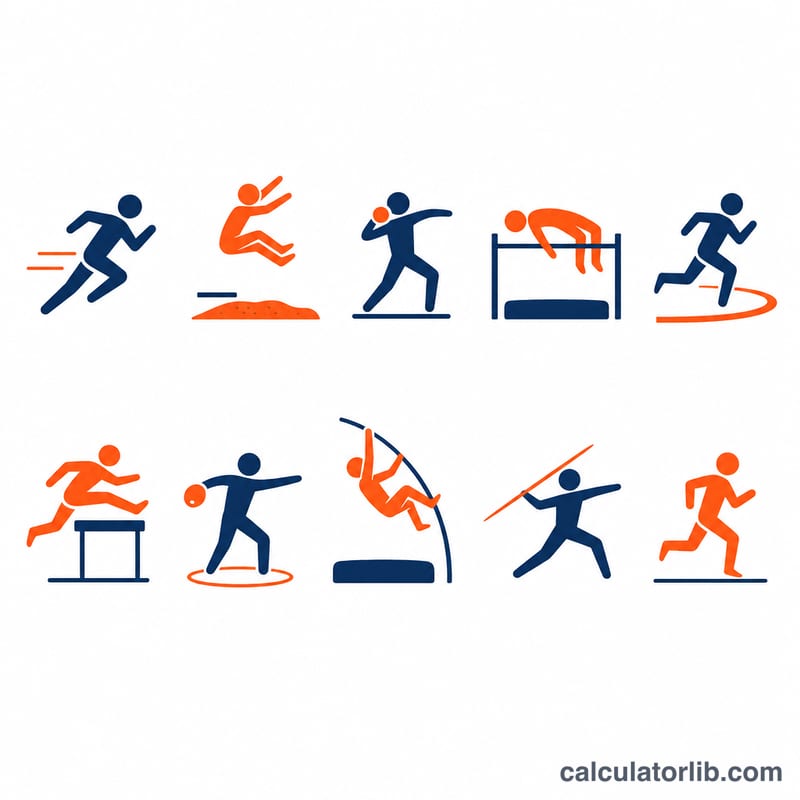
Flat icons of the ten decathlon events arranged in a grid
The ten decathlon events: 100 m, long jump, shot put, high jump, 400 m, 110 m hurdles, discus, pole vault, javelin, and 1500 m.

The Scoring Formula

World Athletics uses two power-law formulas:

  • Track events: \( \text{Points} = \left\lfloor A\,(B - P)^{C} \right\rfloor \), where P is your time. A faster (smaller) time gives more points.
  • Field events: \( \text{Points} = \left\lfloor A\,(P - B)^{C} \right\rfloor \), where P is your distance/height. A bigger result gives more points.

A, B and C are fixed constants unique to each event. For example, the 100 m uses \(A = 25.4347\), \(B = 18\), \(C = 1.81\), and the long jump uses \(A = 0.14354\), \(B = 220\) (cm), \(C = 1.40\).
Advertisement
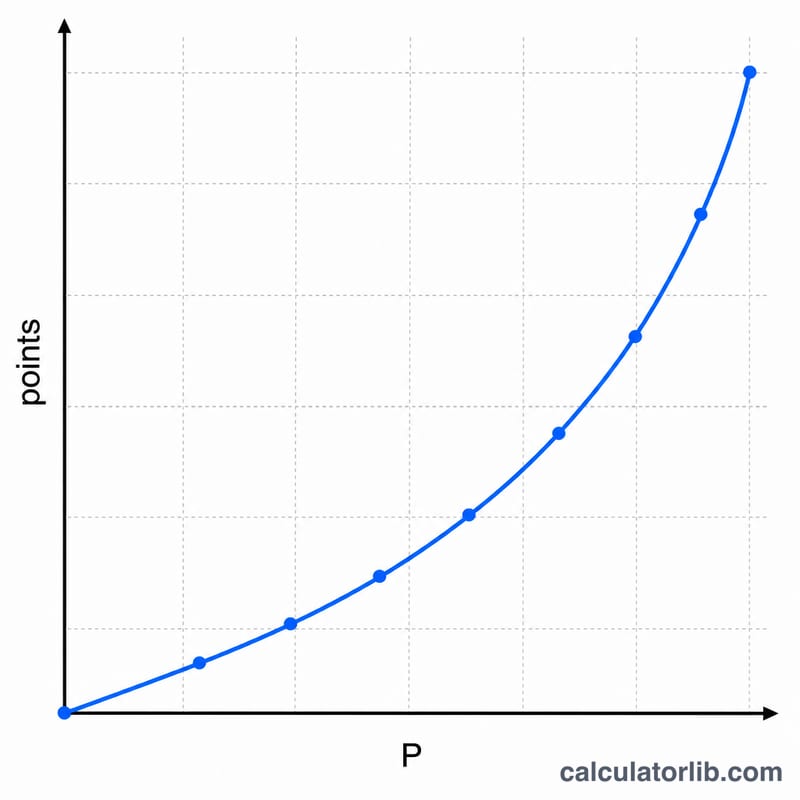
Curved scoring graph showing points rising with better performance
Points rise non-linearly with performance via the formula's exponent C.

Worked Example

Suppose you run the 100 m in 10.5 seconds. The calculation is:

$$\left\lfloor 25.4347 \times (18 - 10.5)^{1.81} \right\rfloor = \left\lfloor 25.4347 \times 7.5^{1.81} \right\rfloor \approx \left\lfloor 25.4347 \times 41.6 \right\rfloor \approx \mathbf{1058 \text{ points}}.$$

For a 7.50 m long jump (750 cm): \( \left\lfloor 0.14354 \times (750 - 220)^{1.40} \right\rfloor \approx \mathbf{938} \) points. Repeat for all ten events and sum the results for your final decathlon score.

Frequently Asked Questions

What is a good decathlon score? Around 8,000 points is national-class, 8,500+ is world-class, and the world record sits above 9,000 points.

Why is my time better but my points lower? Because track events use \((B - P)\): a smaller time produces a larger value, so points rise as your time falls.

Does this match official competition results? Yes — it uses the same World Athletics coefficients and the same floor (round-down) rule, so scores align with official tables.

Last updated: