
What the Dew Point Calculator Does
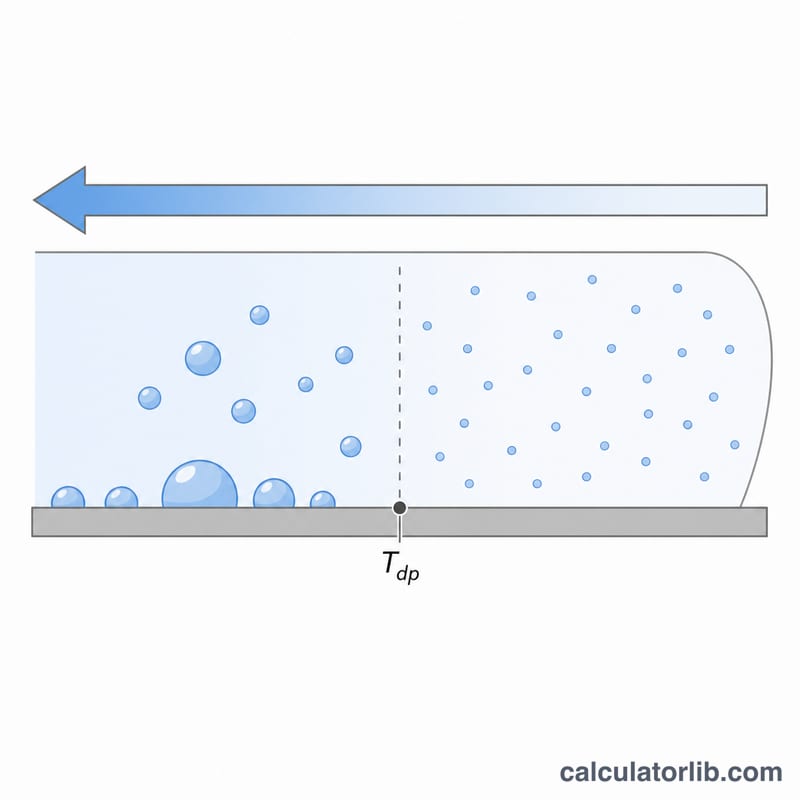
The dew point is the temperature at which air becomes saturated with water vapour and moisture begins to condense. This calculator works out that temperature from just two values: the current air temperature and the relative humidity. You can enter the temperature in either Celsius or Fahrenheit by selecting the matching unit, and the result is returned in the same unit you chose. It's a practical tool for meteorology, HVAC sizing, condensation prevention, and general climate-control work.
Inputs You Provide
- Temperature — the measured air (dry-bulb) temperature.
- Relative Humidity (%) — the moisture content as a percentage, from 1 to 100.
- Temperature Unit — choose Celsius or Fahrenheit; the calculator converts internally and returns the answer in your selected unit.
The Formula Explained
The calculator uses the widely accepted Magnus formula. If you enter Fahrenheit, the temperature is first converted to Celsius. Then it computes an intermediate value:
$$\alpha = \frac{a\cdot T}{b + T} + \ln\!\left(\frac{\text{RH}}{100}\right)$$
$$\text{Dew point} = \frac{b\cdot \alpha}{a - \alpha}$$
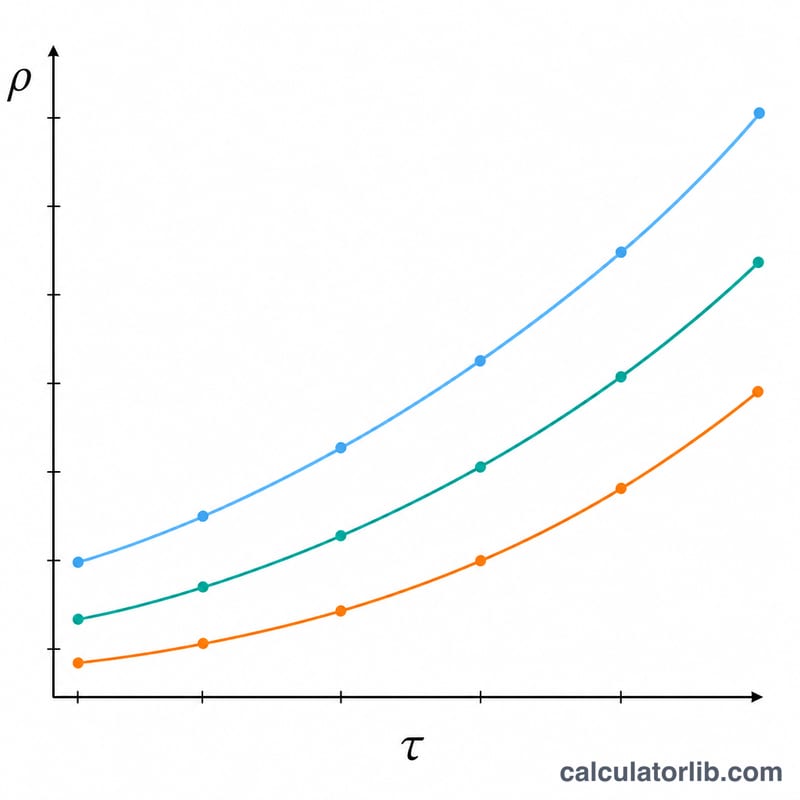
where \(a = 17.27\), \(b = 237.7\), \(T\) is temperature in °C, and RH is relative humidity. If you originally entered Fahrenheit, the result is converted back to Fahrenheit. The lower the humidity, the larger the gap between air temperature and dew point.
Worked Example
Suppose the temperature is 25 °C with 60% relative humidity. First, $$\alpha = \frac{17.27 \times 25}{237.7 + 25} + \ln(0.60) = 1.6435 - 0.5108 = 1.1327.$$ Then $$\text{dew point} = \frac{237.7 \times 1.1327}{17.27 - 1.1327} \approx \mathbf{16.7\ ^\circ C}.$$ So moisture would start condensing on any surface cooled to about 16.7 °C.
Frequently Asked Questions
What is a comfortable dew point? Dew points below about 16 °C (60 °F) feel comfortable, while values above 21 °C (70 °F) feel muggy and oppressive to most people.
Can the dew point be higher than the air temperature? No. At 100% humidity the dew point equals the air temperature; it can never exceed it.
Why does dew point matter for HVAC? Knowing the dew point helps prevent condensation on cold surfaces, pipes, and windows, reducing mould risk and helping size cooling and dehumidification systems correctly.