
What Is the P Wave Travel Time Calculator?
This calculator estimates how long it takes a primary seismic wave (P wave) to travel from an earthquake's source to a recording station. You enter the epicentral distance in kilometres and the average P wave velocity in kilometres per second, and the tool returns the travel time in seconds, minutes, and hours. It also offers a quick reference to the likely seismic zone and crust type for the velocity you choose. The method applies globally and is useful for students, geology enthusiasts, and anyone curious about how seismologists time earthquake arrivals.
How to Use It
- Enter the epicentral distance (km) — the straight-line distance from the quake's origin to the measuring point.
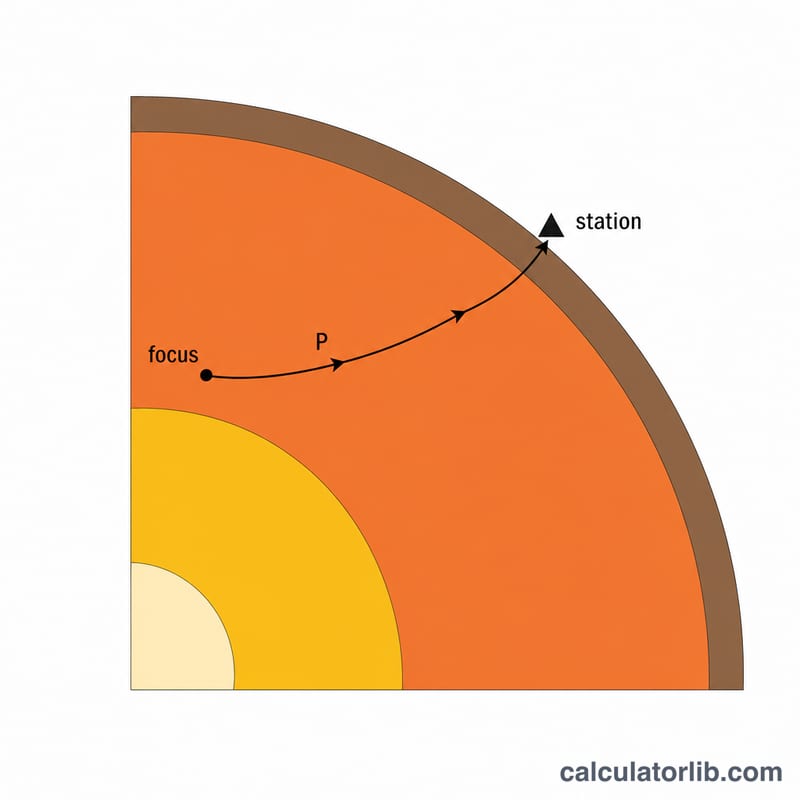
- Enter the P wave velocity (km/s). Typical crustal values range from about 5–7 km/s, rising to roughly 8 km/s in the upper mantle and higher in the deep Earth.
- Read the travel time in seconds, minutes, and hours.
The Formula Explained
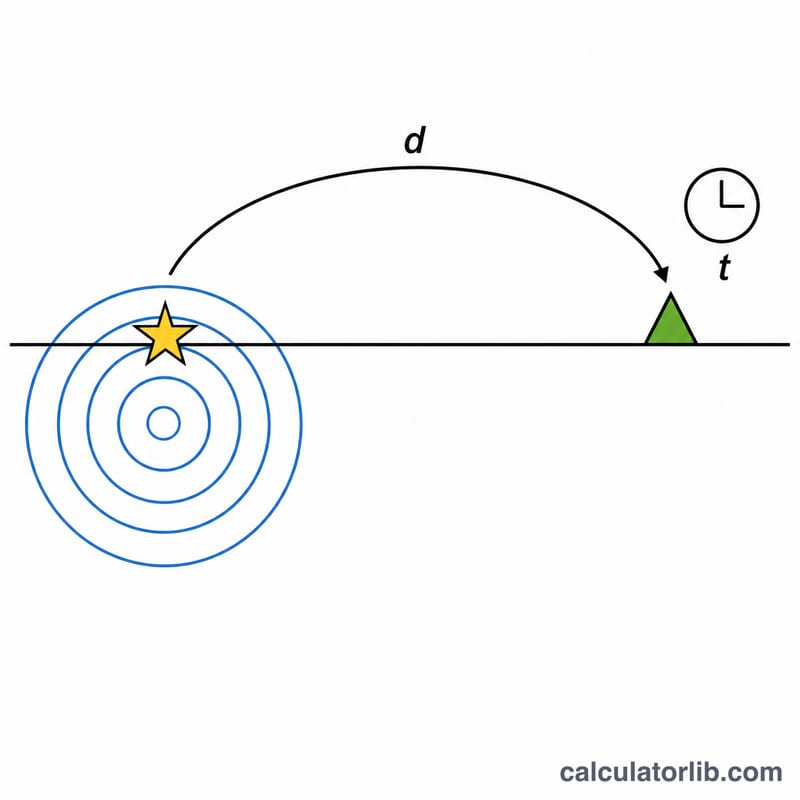
P wave travel time uses the simple relationship between distance, speed, and time:
$$t = \frac{\text{Distance (km)}}{\text{P Wave Velocity (km/s)}}$$P waves are the fastest seismic waves and the first to arrive at any station, which is why they are named "primary." Velocity changes with rock type and depth, so the figure you enter should match the layer the wave actually travels through. For long distances, waves dive deeper into faster material, so this single-velocity model is an approximation rather than a full travel-time curve.
Worked Example
Suppose an earthquake is 600 km from a seismograph and the average P wave velocity along the path is 8 km/s:
- Travel time = $$600 \div 8 = 75 \text{ seconds}$$
- That equals 1.25 minutes, or about 0.0208 hours.
So the P wave would register on the instrument roughly 75 seconds after the rupture occurred.
FAQ
Why are P waves faster than S waves? P waves are compressional and can pass through solids and liquids, while slower S waves are shear waves that only travel through solids. P waves typically move about 1.7 times faster.
What velocity should I enter? Use around 6 km/s for shallow continental crust, 8 km/s for the upper mantle, or a path-averaged value for deeper events.
Is this exact? No. Real travel times follow curved paths and changing velocities. This tool gives a clear, quick estimate for learning and rough planning.