
What this calculator does
This tool solves the most basic kinematics problem of uniform (constant-velocity) motion: given a distance and a steady speed, how long does the trip take? It applies the relationship \(t = d / v\), where t is time, d is distance and v is speed. Because it is pure physics, it works the same everywhere, with no region-specific rules.
How to use it
Enter the speed and pick its unit (km/h, m/min or m/s). Enter the distance and pick its unit (km or m). The calculator converts both values to SI base units (meters and meters per second), divides distance by speed, and shows the elapsed time formatted as hours:minutes:seconds, plus the raw total in seconds.
The formula explained
First each input is normalized: speed in m/s = entered speed times its unit factor (km/h uses 1000/3600, m/min uses 1/60, m/s uses 1), and distance in meters = entered distance times its factor (km uses 1000, m uses 1). Then t (seconds) = distance_SI / speed_SI. Finally the seconds are decomposed: hours = floor(t / 3600), minutes = floor((remaining) / 60), and the leftover is the seconds value.
$$t = \frac{d_{\text{SI}}}{v_{\text{SI}}} = \frac{\text{Distance }d \times f_d}{\text{Speed }v \times f_v}$$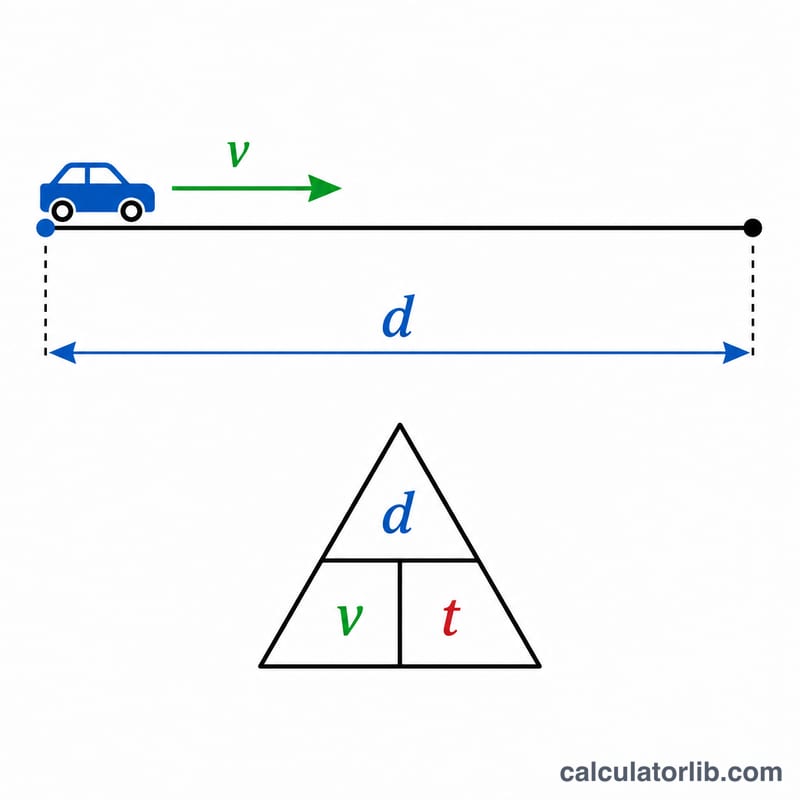
Worked example
Speed 15 km/h over a distance of 20 km. Speed_SI = 15 x 1000/3600 = 4.1667 m/s. Distance_SI = 20 x 1000 = 20000 m. t = 20000 / 4.1667 = 4800 s = 1 hour 20 minutes, shown as 1:20:00. A quick sanity check: 20 km / 15 km/h = 1.333 h = 1 h 20 min.
$$\text{Speed}_{\text{SI}} = 15 \times \frac{1000}{3600} = 4.1667 \ \text{m/s}$$$$\text{Distance}_{\text{SI}} = 20 \times 1000 = 20000 \ \text{m}$$$$t = \frac{20000}{4.1667} = 4800 \ \text{s} = 1 \text{ hour } 20 \text{ minutes}$$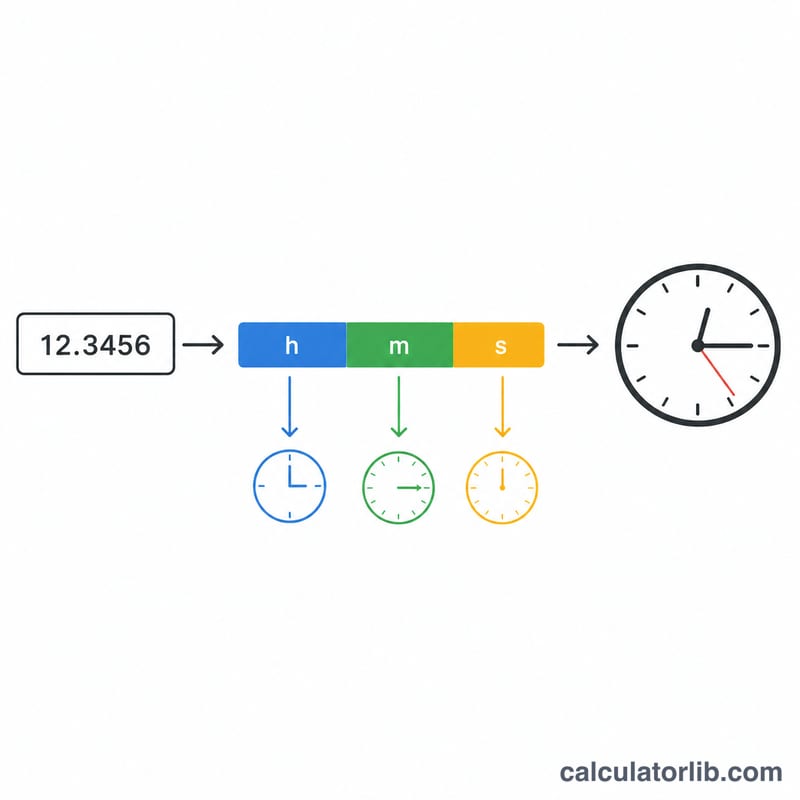
FAQ
What if I set speed to zero? Travel time would be infinite, so the calculator reports an invalid input instead of dividing by zero.
Can I mix units? Yes. Speed and distance units are independent; each is converted to SI before the division, so any combination works.
Why are there fractional seconds sometimes? When the distance does not divide evenly by speed, the seconds component can be a decimal. The result is rounded to two decimal places for a tidy display.