
What is relativistic velocity addition?
In everyday (Galilean) physics you simply add velocities: if you walk at 5 km/h on a train moving at 100 km/h, your ground speed is 105 km/h. But at speeds approaching the speed of light this breaks down. Special relativity replaces straight addition with the velocity-addition formula, which guarantees that no combination of sub-light speeds can ever produce a result faster than light, \(c = 299792.458\) km/s. This calculator composes two collinear (same-line) velocities and returns the true combined velocity.
How to use it
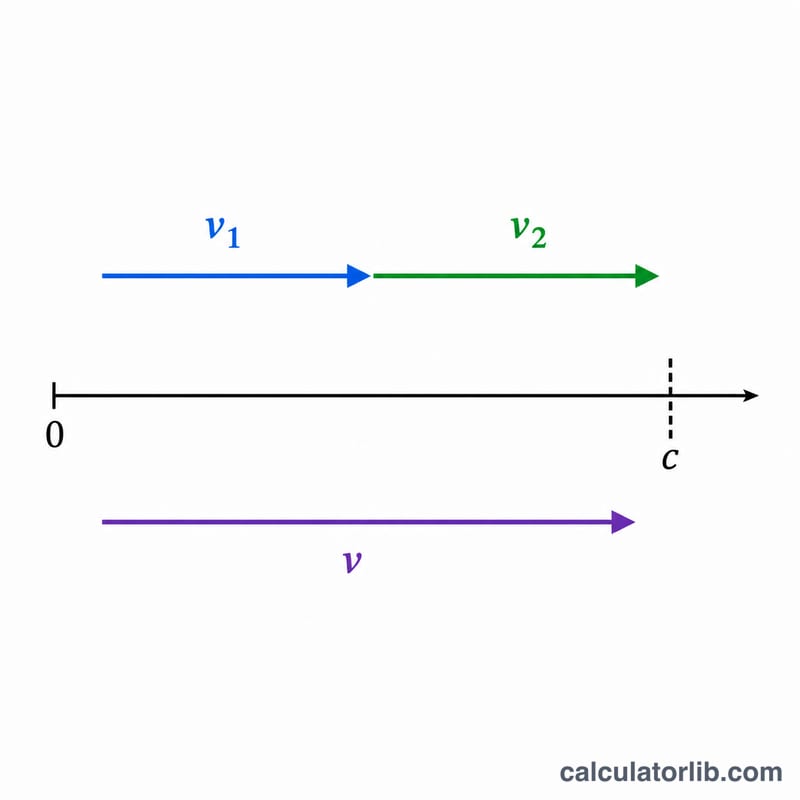
Enter the velocity of object A (v1) and object B (v2) directly in km/s. Velocities may be negative to represent opposite directions. Both must satisfy |v| ≤ c. The calculator returns the combined velocity v, its value as a fraction of c, and echoes the exact speed-of-light constant it used.
The formula explained
The relativistic composition of two collinear velocities is:
$$u = \frac{\text{v}_1 + \text{v}_2}{1 + \dfrac{\text{v}_1 \cdot \text{v}_2}{c^{2}}}$$
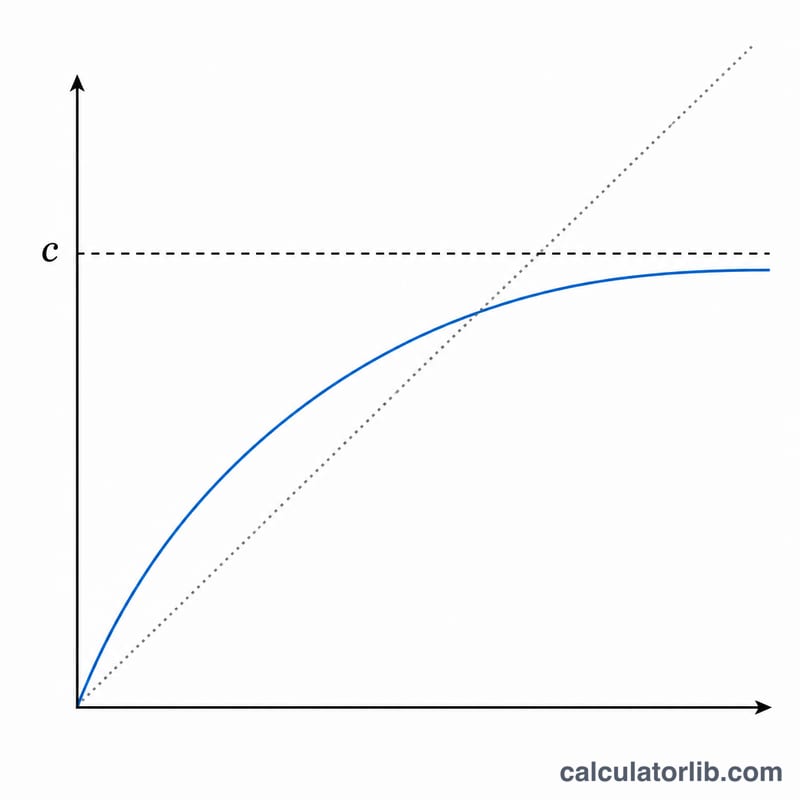
The numerator is the ordinary sum, while the denominator divides it down. When v1 and v2 are tiny compared with c, the term \(\text{v}_1 \cdot \text{v}_2 / c^2\) is nearly zero and the formula reduces to plain addition. When either speed equals c, the result is exactly c. Because v1, v2 and c all share the same unit, the \(\text{v}_1 \cdot \text{v}_2 / c^2\) term is dimensionless, so working entirely in km/s is perfectly valid — no SI conversion needed.
Worked example
Let \(\text{v}_1 = 250000\) km/s and \(\text{v}_2 = 280000\) km/s. Numerator: \(250000 + 280000 = 530000\). Product: \(250000 \times 280000 = 70{,}000{,}000{,}000\). With \(c^2 = 89{,}875{,}517{,}873.68\), the ratio \(\text{v}_1 \cdot \text{v}_2 / c^2 = 0.778843\), so the denominator is \(1.778843\). Thus $$v = \frac{530000}{1.778843} \approx 297{,}946.6 \text{ km/s}$$ — still below c, as required.
FAQ
Why not just use c = 300000 km/s? The exact value 299792.458 km/s matters. In the example v1 = 270000, v2 = 180000, the precise constant gives \(\approx 292{,}065\) km/s, while the rounded 300000 gives \(\approx 292{,}207\) km/s — a difference of about 140 km/s.
Can the combined speed exceed c? No. For any inputs with \(|\text{v}_1| \le c\) and \(|\text{v}_2| \le c\) the formula keeps \(|v| \le c\). This is the defining feature of relativistic velocity addition.
Does it work for opposite directions? Yes. Enter one velocity as negative; the formula handles the signs correctly and the denominator stays positive within the physical range.