
What this calculator does
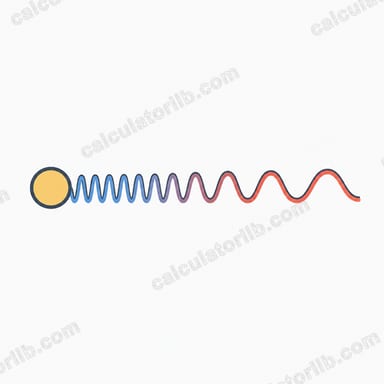
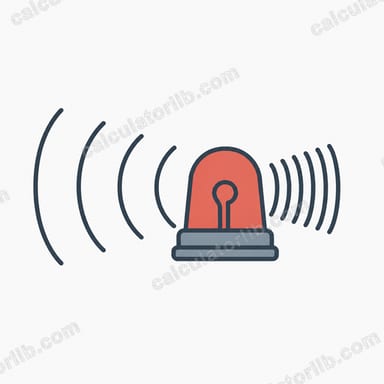
The Doppler effect is the change in pitch you hear when a sound source moves toward or away from you - the familiar rise and fall in the siren of a passing ambulance. This calculator computes the frequency an observer actually hears, given the source's emitted frequency, the relative speeds of source and observer, and the air temperature (which sets the speed of sound).
How to use it
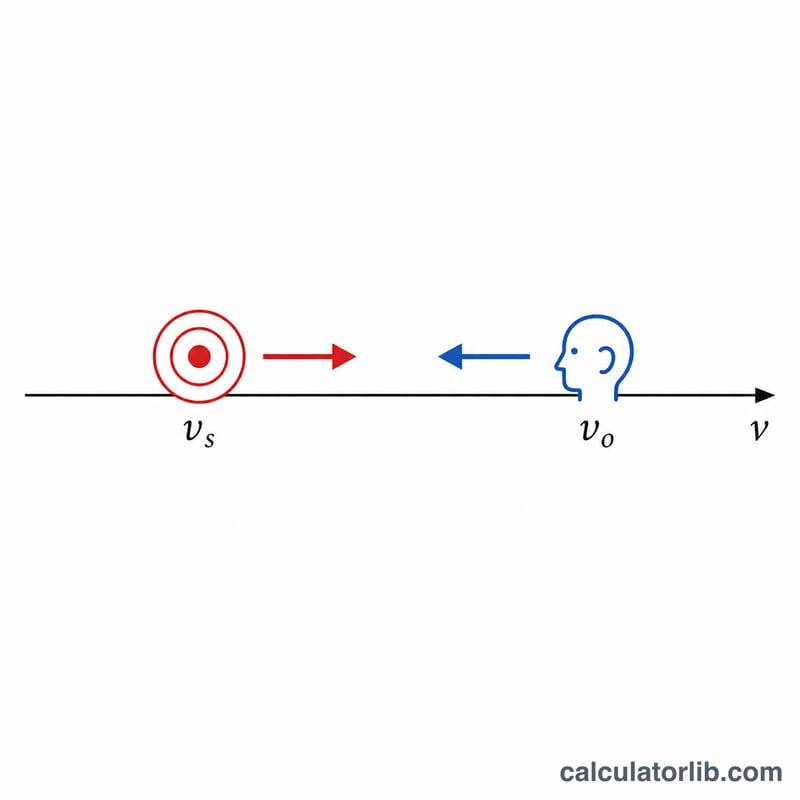
Enter the source frequency f0 in hertz, the air temperature in degrees Celsius, and the two speeds in km/h. Use the sign convention carefully: the source speed Vs is positive when the source approaches the observer and negative when it recedes; the observer speed Vo is positive when the observer moves away from the source and negative when approaching. Speeds are converted internally to metres per second before the formula is applied.
The formula explained
First the speed of sound is found from the temperature: \(v = 331.5 + 0.61\,T\) (about 343.7 m/s at 20 C). Then the observed frequency is \(f = f_0\,(v - v_o) / (v - v_s)\). When the source approaches, the denominator shrinks and the pitch rises; when the observer recedes, the numerator shrinks and the pitch falls.
$$f = f_0 \cdot \frac{v - V_o}{v - V_s}$$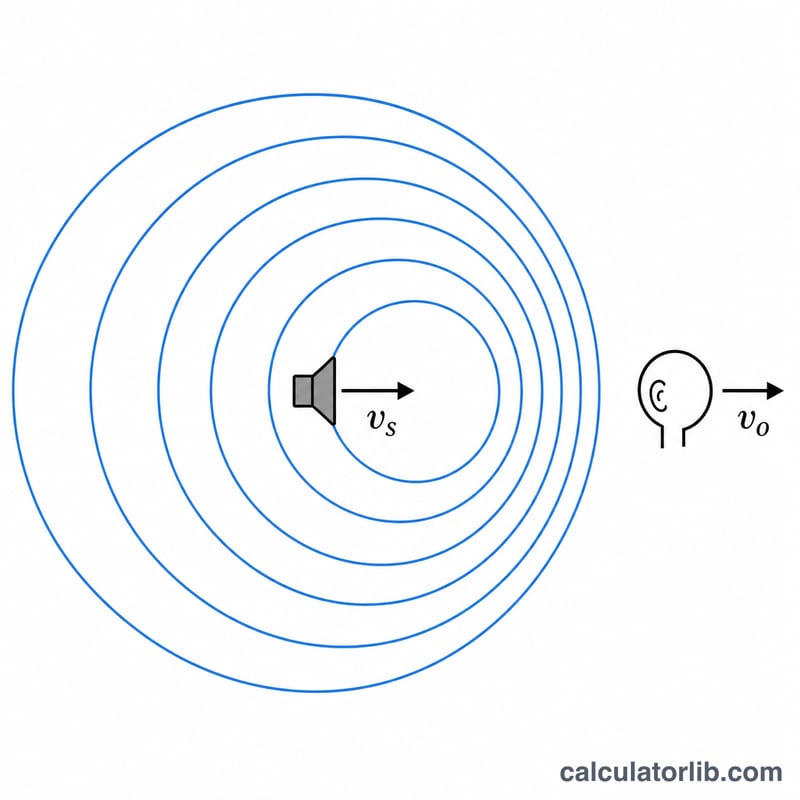
Worked example
A car horn sounds f0 = 440 Hz, air at 20 C, the car approaches at Vs = 135 km/h while you stand still (Vo = 0). The speed of sound is \(331.5 + 0.61 \times 20 = 343.7\) m/s, and \(V_s = 135 \times 0.2777778 = 37.5\) m/s. So $$f = 440 \times \frac{343.7}{343.7 - 37.5} = 440 \times \frac{343.7}{306.2} \approx 493.89 \text{ Hz}$$ the 440 Hz "A" rises to nearly a "B", a clear step up in pitch.
FAQ
Why does the heard pitch drop after the source passes? Once the source is moving away, Vs becomes negative, the denominator grows, and f falls below f0.
What if the source reaches the speed of sound? The denominator \((v - v_s)\) goes to zero and the formula diverges - this is the shock-front / sonic-boom regime, so the tool flags it as out of range.
Why include temperature? The speed of sound in air depends on temperature; warmer air carries sound faster, slightly changing the Doppler shift.