
What this calculator does
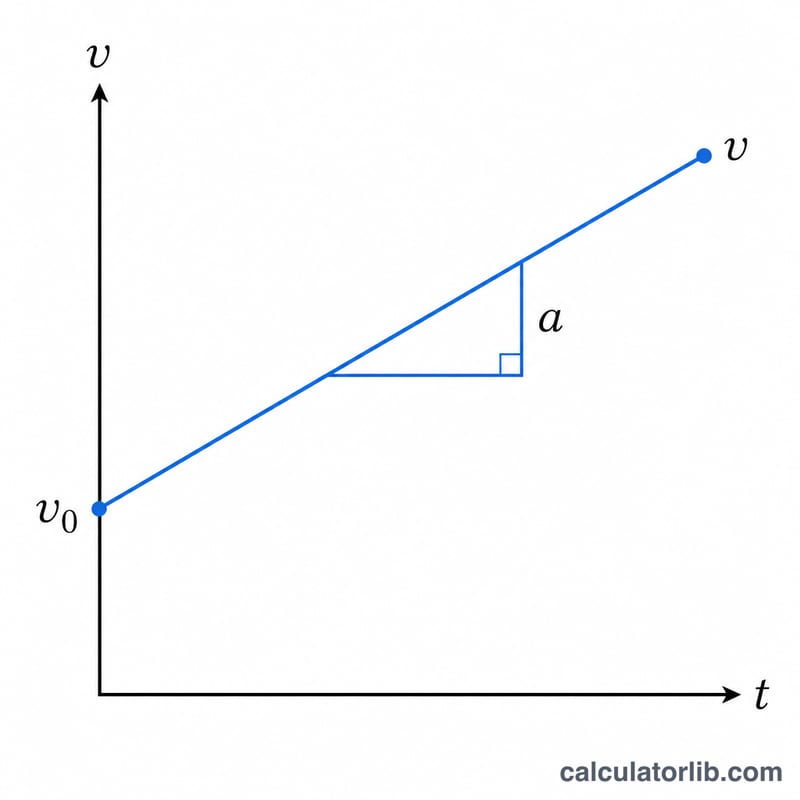
This tool solves a classic uniform (constant) acceleration problem. An object speeds up or slows down steadily from an initial velocity v0 to a final velocity v over an elapsed time t. From these three numbers it computes the constant acceleration a and the distance d the object travels. The physics is universal, so the results apply anywhere in the world with no region-specific assumptions.
How to use it
Enter the elapsed time t in seconds, pick a single velocity unit (km/h, m/min, or m/s) that applies to both velocities, then type the initial velocity v0 and the final velocity v. If the object speeds up, v is larger than v0 and acceleration is positive. If it slows down, v is smaller than v0 and acceleration is negative (deceleration), which is perfectly valid.
The formula explained
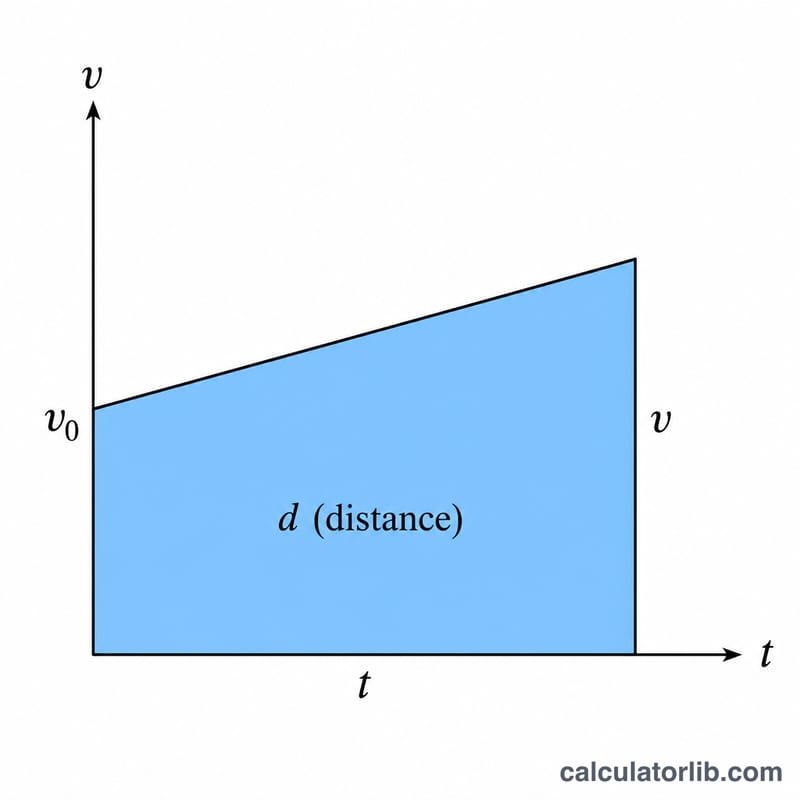
First both velocities are converted to SI units (m/s). For km/h the factor is \(1000/3600 = 0.2778\), for m/min it is \(1/60\), and for m/s it is \(1\). Acceleration is then $$a = \frac{\text{v} - \text{v}_0}{\text{t}}\ \text{in m/s}^2.$$ The same value can be shown as the change in km/h per second by multiplying by \(3.6\), or as a multiple of standard gravity by dividing by \(1\,g = 9.80665\ \text{m/s}^2\). Distance uses the average-velocity rule: $$d = \frac{\text{v}_0 + \text{v}}{2} \times \text{t},$$ which is identical to \(d = \text{v}_0 \cdot \text{t} + \tfrac{1}{2} \cdot a \cdot \text{t}^2\) for constant acceleration.
Worked example
Take \(t = 5\ \text{s}\), \(\text{v}_0 = 0\ \text{km/h}\), \(\text{v} = 20\ \text{km/h}\). Converting, $$\text{v} = 20 \times 0.2778 = 5.556\ \text{m/s}.$$ Then $$a = \frac{5.556 - 0}{5} = 1.111\ \text{m/s}^2,$$ which is \(4.0\) km/h per second and \(0.1133\ g\). The distance is $$d = \frac{0 + 5.556}{2} \times 5 = 13.889\ \text{m},$$ or about \(0.0139\ \text{km}\).
FAQ
Why does t = 0 give an error? Acceleration divides by time, so a zero elapsed time makes acceleration mathematically undefined.
Can acceleration be negative? Yes. If the final velocity is lower than the initial velocity the object is decelerating, and the result is negative.
What is the "in g" output? It expresses the acceleration relative to standard gravity (\(1\,g = 9.80665\ \text{m/s}^2\)), which is handy for comparing to the pull you feel on Earth.