
What is the Displacement, Velocity & Time Calculator?
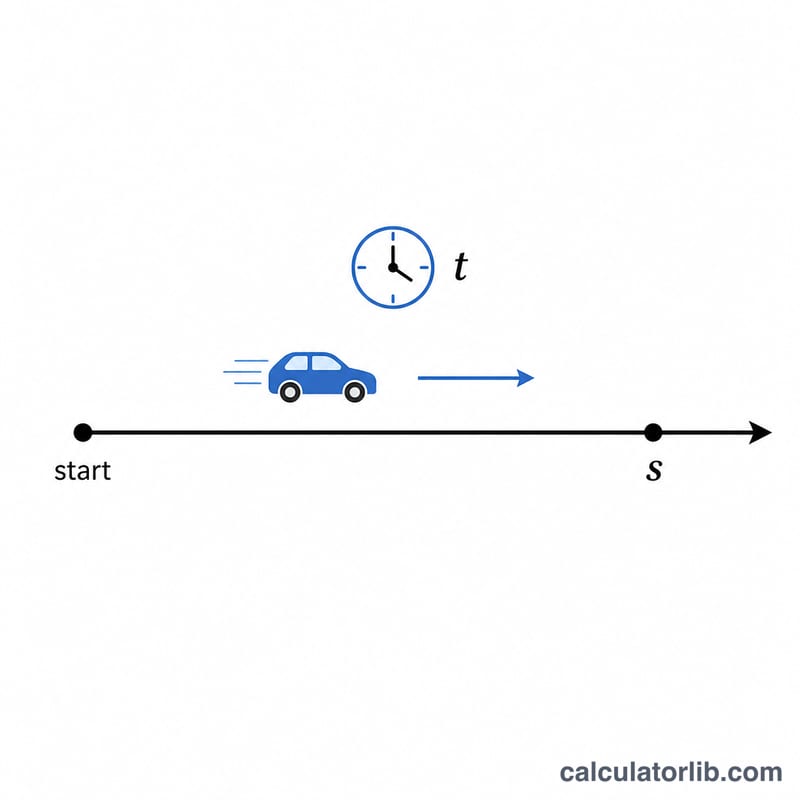
This tool solves the fundamental kinematics relationship displacement = average velocity x time (\(s = \bar{v} \cdot t\)). Choose which of the three quantities you want to find, enter the other two, and the calculator returns the unknown. It doubles as an average-speed, distance, or travel-time calculator and supports many units of length, velocity, and time.
How to use it
Pick what to solve for in the "Solve for" dropdown. Enter the two known values, selecting the unit for each from its dropdown. Optionally set the number of significant figures for the displayed answer (or leave it on "auto" for full precision). The result is shown in the unit you selected for the output quantity.
The formula explained
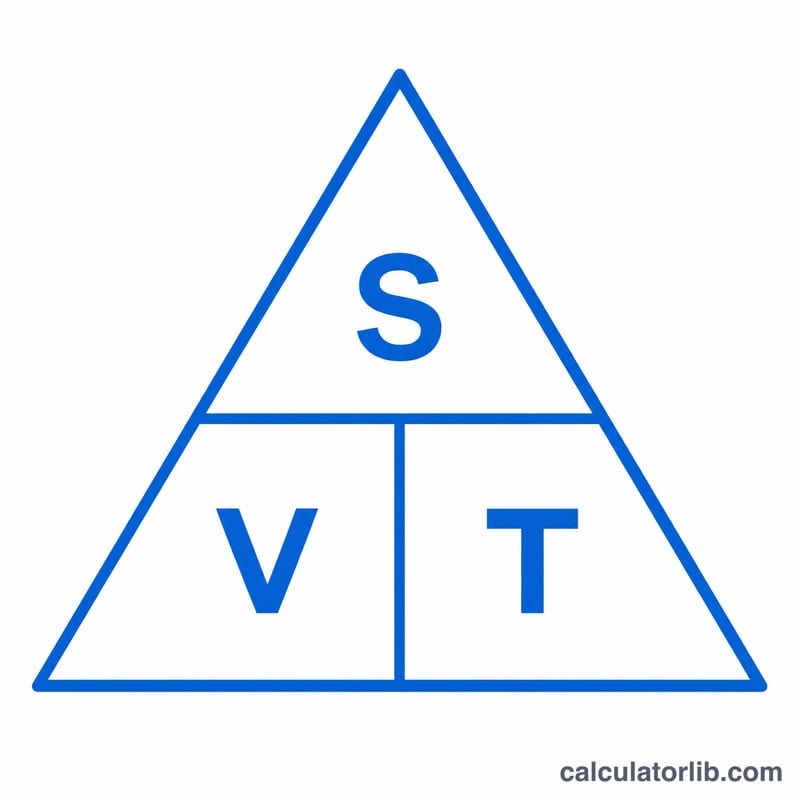
The core relation is $$s = \bar{v} \cdot t.$$ Rearranged: \(\bar{v} = s / t\) and \(t = s / \bar{v}\). Internally every input is converted to SI units (meters, meters per second, seconds) using its unit scale factor, the chosen formula is applied, and the SI result is converted back into your chosen output unit by dividing by that unit's scale factor.
Worked example
Solve for displacement with an average velocity of 60 km/h over 30 minutes, displayed in kilometers. First convert: 60 km/h = 16.6667 m/s and 30 min = 1800 s. Then $$s = 16.6667 \times 1800 = 30000 \text{ m},$$ which is 30 km.
FAQ
What is the difference between speed and velocity? Velocity is a vector (it has direction); here it is treated as average speed magnitude, and signed values are allowed so a negative velocity yields a negative displacement.
Why do I get a division-by-zero error? When solving for velocity, time must be non-zero; when solving for time, velocity must be non-zero. A zero denominator makes the result undefined.
What does "auto" significant figures mean? It shows the raw, unrounded computed value. Choosing 3-9 rounds the displayed answer to that many significant figures without affecting the internal computation.