
What is the work rate (combined job) problem?
This is the classic "work problem" from arithmetic: two teams can each finish the same job alone in a known number of days, and you want to know how fast they finish if they work together. It applies universally to any job that two workers, machines, or pipes share — painting a wall, filling a tank, or completing a project.
How to use it
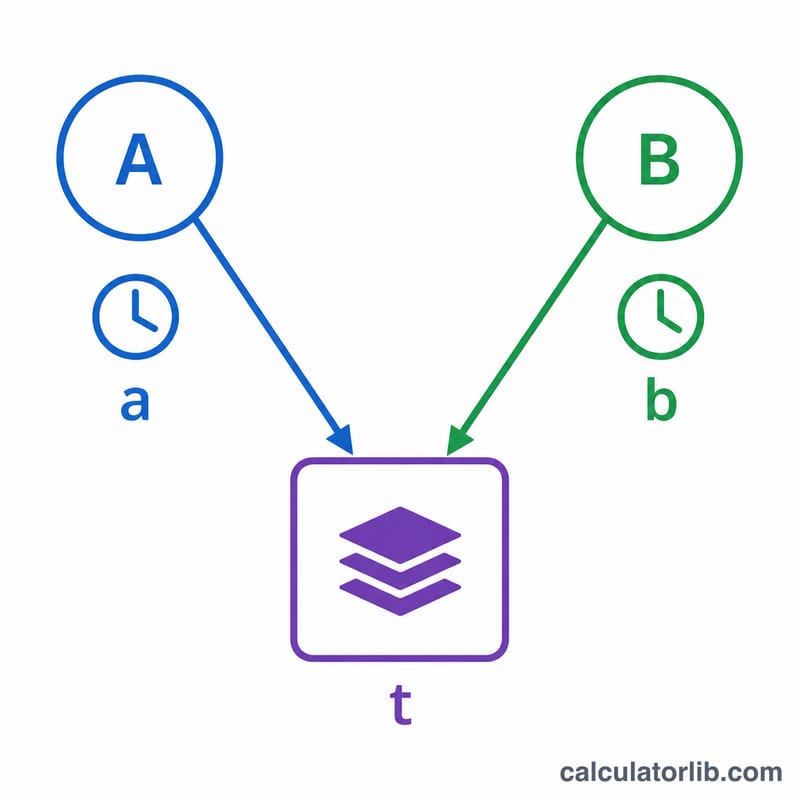
Enter Team A's required days (how long Team A needs alone) and Team B's required days (how long Team B needs alone) using the same time unit. The calculator returns each team's per-day work rate, the combined rate, and the number of days needed when both work together. If you measure in hours instead of days, the answer comes out in hours — just keep both inputs in the same unit.
The formula explained
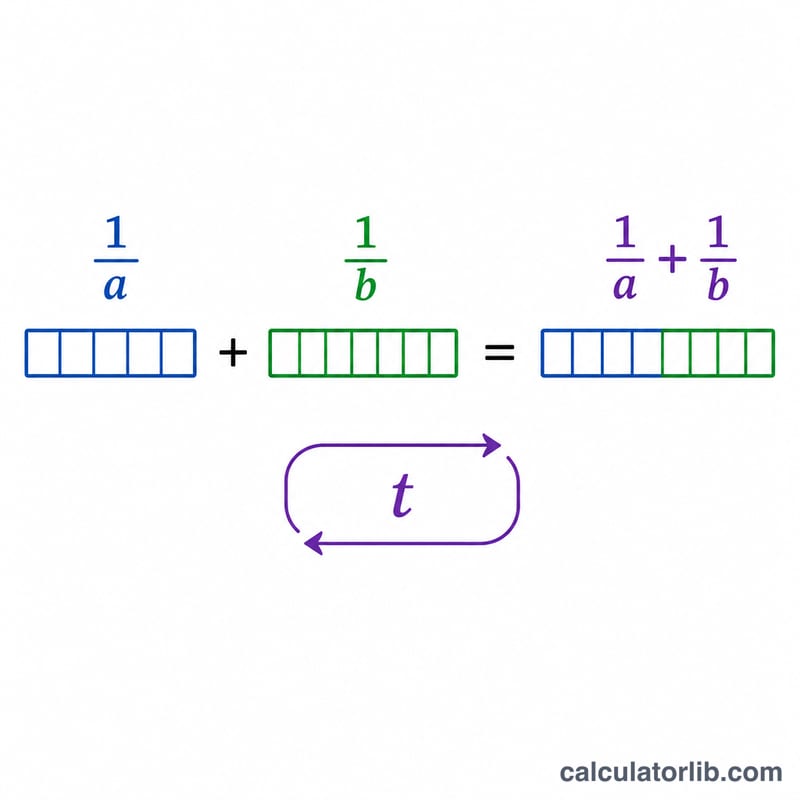
Treat the whole job as 1 unit of work. Team A completes a fraction \(1/a\) of the job per day, and Team B completes \(1/b\) per day. When they work side by side their rates add, giving a combined rate of $$\frac{1}{a} + \frac{1}{b} = \frac{a + b}{a \cdot b}.$$ The time to finish is the reciprocal of that rate, so $$t = \frac{a \cdot b}{a + b}.$$ Because adding help only speeds things up, the answer is always smaller than the faster team's solo time.
Worked example
Suppose Team A needs 16 days and Team B needs 10 days. Team A's rate is \(1/16 = 0.0625\) job/day and Team B's is \(1/10 = 0.1\) job/day. The combined rate is \(0.1625\) job/day, so together they finish in $$\frac{1}{0.1625} = \frac{16 \times 10}{16 + 10} = \frac{160}{26} \approx 6.15 \text{ days}$$ — about 6 days and 3.7 hours.
FAQ
Why is the result less than both inputs? Two teams together are never slower than the faster one alone, so the combined time is always below the smaller of the two solo times.
Does swapping A and B change the answer? No. The formula is symmetric in \(a\) and \(b\), so the order does not matter.
Can I use hours or weeks? Yes. The math is unit-agnostic; just make sure both inputs use the same unit and read the answer in that unit.