

What is the Work Rate Calculator?
This tool solves the classic "work rate" arithmetic word problem (in Japanese math education called shigotozan). Given how much work needs to be done in total, how productive a single worker is per day, and how many workers are on the team, it tells you how many days the group needs to finish the job. The math is universal elementary arithmetic and applies the same way everywhere.
How to use it
Enter three values: the total work amount (an abstract quantity such as units, pages, or area), the number of workers, and the work done by one person per day. The total work and the per-person rate must be expressed in the same work unit so the division yields a day count. The calculator returns the days required, the combined daily output of the team, and the rounded-up calendar days.
The formula explained
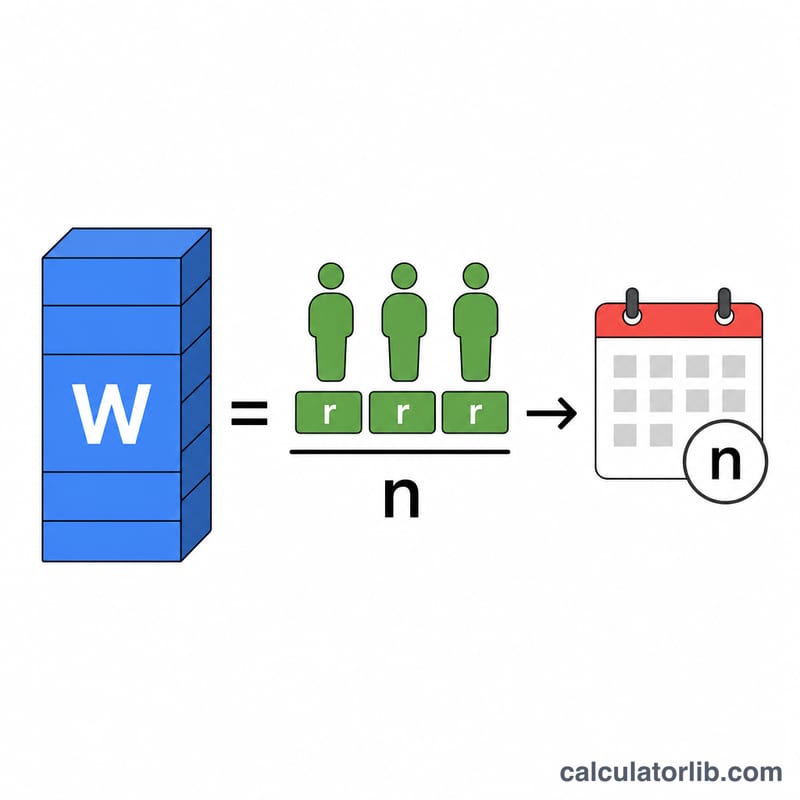
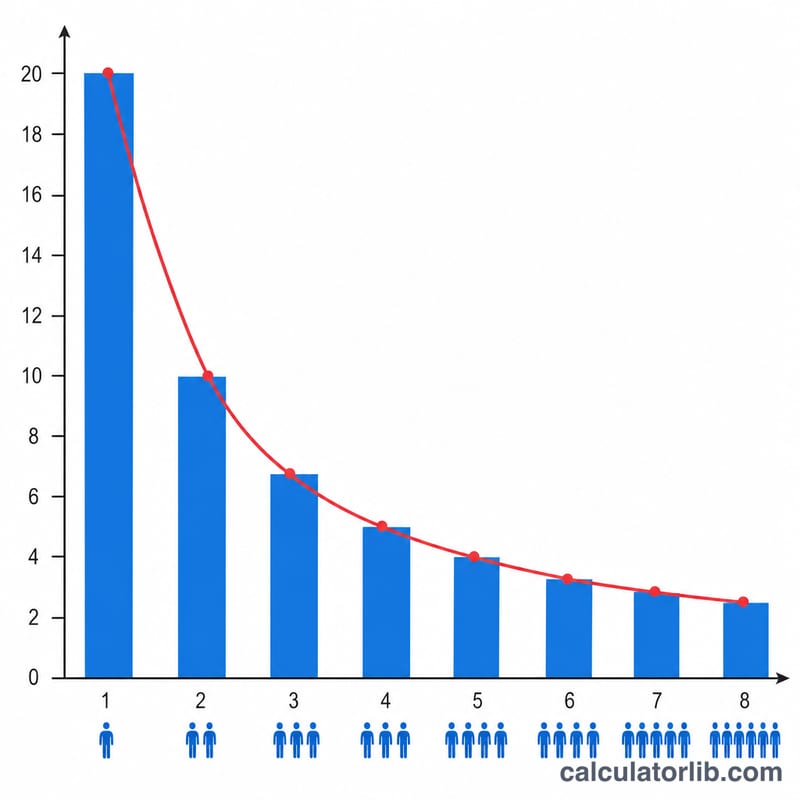
A job is finished when the team's accumulated output equals the total work: $$n \times r \times \text{days} = W$$ Rearranging gives $$\text{days} = \frac{W}{n \times r}$$ where \(W\) is total work, \(n\) is the number of workers, and \(r\) is one worker's daily output. The product \(n \times r\) is the combined output per day. The bigger the team or the faster each worker, the fewer days are needed.
Worked example
Suppose a job needs 100 units of work, you have 5 workers, and each completes 4 units per day. Combined output is \(5 \times 4 = 20\) units/day. Days required: $$\text{days} = \frac{100}{20} = 5 \text{ days}$$ With 4 workers at 3 units/day on a 90-unit job: output = 12 units/day, so $$\frac{90}{12} = 7.5 \text{ days}$$ — rounded up to 8 calendar days.
FAQ
What if the answer is fractional? A result like 7.5 days means the team needs part of an eighth day; since a partial day still requires showing up, round up to 8 calendar days when scheduling.
Why can't workers or the rate be zero? If either is zero, no work gets done, the denominator is zero, and the answer is infinite/undefined. The calculator guards against this.
What units should I use? Any consistent unit works — units of product, pages, square meters — as long as total work and per-person daily rate use the same unit.