
What this calculator does
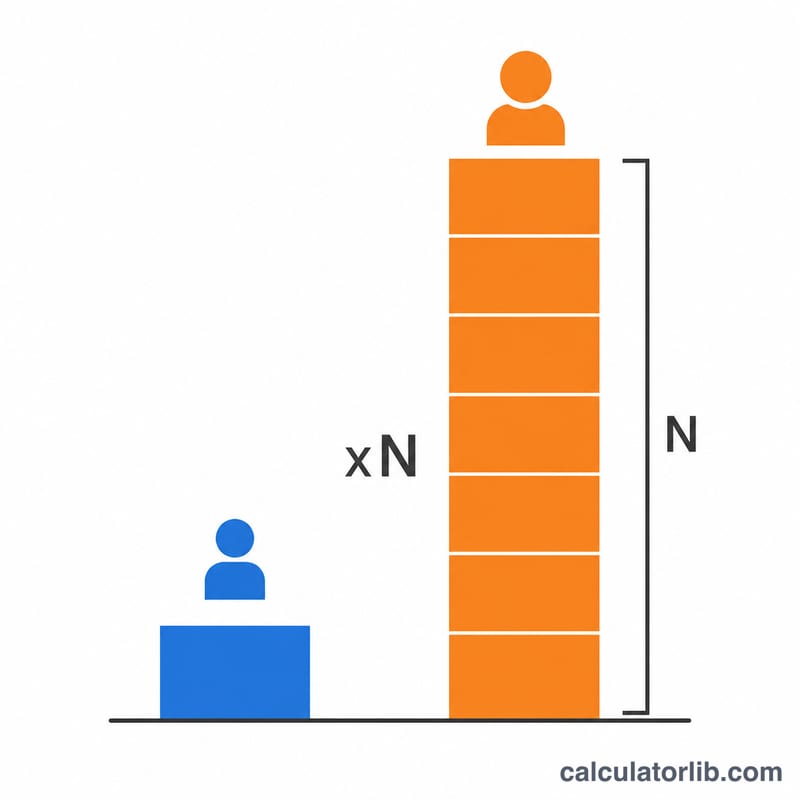
This is a solver for a classic arithmetic "age word problem": given a parent's current age, a child's current age, and a target multiple N, it finds how many years from now the parent's age will be exactly N times the child's age. It also tells you what each person's age will be at that moment. The result can be negative, meaning the event happened that many years in the past.
How to use it
Enter the parent's current age, the child's current age, and the multiple N (for example 2 means "twice as old"). The calculator returns the number of years from now, the child's age and the parent's age at that time, and the constant age difference. A negative "years from now" simply means the moment already passed.
The formula explained
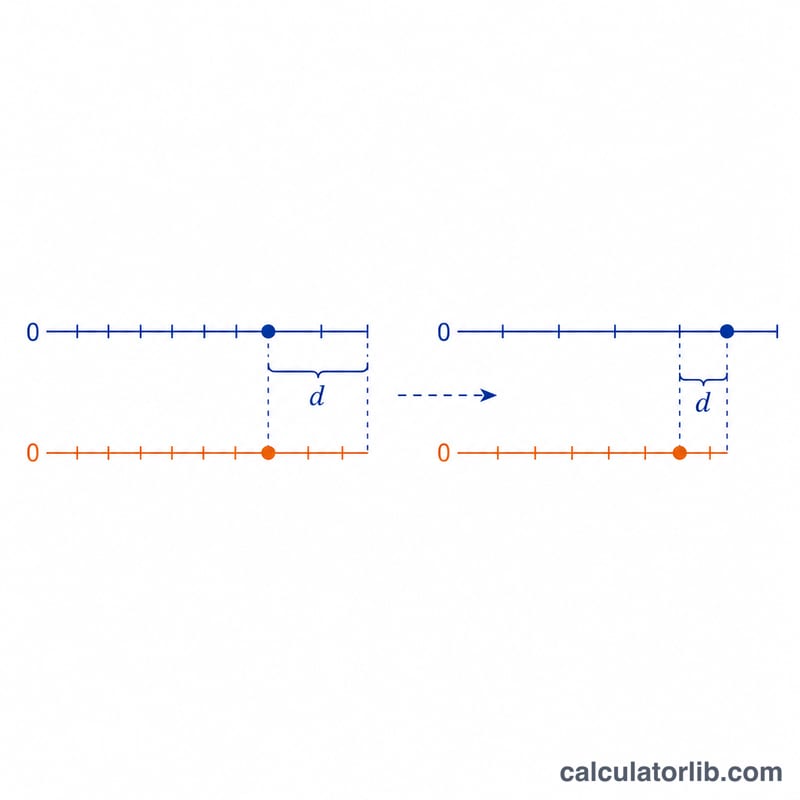
The key insight is that the age difference between two people never changes: \(D = \text{parentAge} - \text{childAge}\) stays the same forever. At the target time we want \(\text{futureParentAge} = N \times \text{futureChildAge}\) while the difference is still \(D\). Substituting gives \(\text{futureChildAge} \times (N - 1) = D\), so:
$$\text{futureChildAge} = \frac{\text{parentAge} - \text{childAge}}{N - 1}$$, then $$\text{futureParentAge} = N \times \text{futureChildAge}$$, and $$\text{yearsFromNow} = \text{futureParentAge} - \text{parentAge}$$. If \(N = 1\) the formula divides by zero (two people can never share the same age while keeping a constant nonzero difference), so there is no solution.
Worked example
Parent 41, child 13, \(N = 2\). The difference $$D = 41 - 13 = 28.$$ $$\text{futureChildAge} = \frac{28}{2 - 1} = 28.$$ $$\text{futureParentAge} = 28 \times 2 = 56.$$ $$\text{yearsFromNow} = 56 - 41 = 15.$$ So in 15 years the child will be 28 and the parent 56, and \(56 = 2 \times 28\).
FAQ
Why can the answer be negative? Because the relationship may have been true in the past. For example, parent 40, child 10, \(N = 5\) gives \(-2.5\) years: 2.5 years ago the parent (37.5) was 5 times the child (7.5).
What if I enter N = 1? There is no solution. Two people with a fixed nonzero age gap can never be equal in age.
Can the ages be fractional? Yes. The math is exact, so the child's and parent's future ages may be decimals such as 7.5 years.