
What this tool does
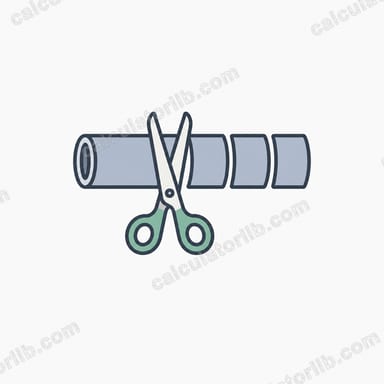
This is a practice and self-checking tool for a classic division word problem: a tube (or rope, board, ribbon) of a known total length must be cut into a number of equal pieces, and you must work out how long each piece will be. You type your own answer, and the tool tells you whether it is correct and shows the complete worked solution so you can learn the method.
How to use it
Enter the total length of the tube in feet, the number of equal pieces you want to cut, and your own answer for the length of each piece. Press Calculate. You will see a green "Correct!" or red "Incorrect — try again" verdict, the exact correct length, and a line-by-line solution. Teachers can change the total length and piece count to create new problems.
The formula explained
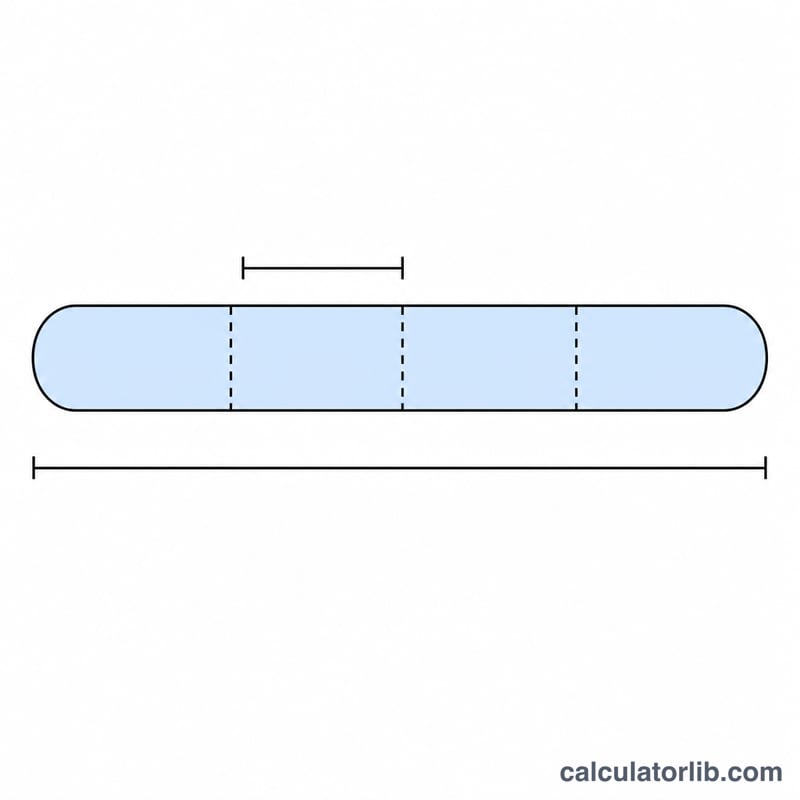
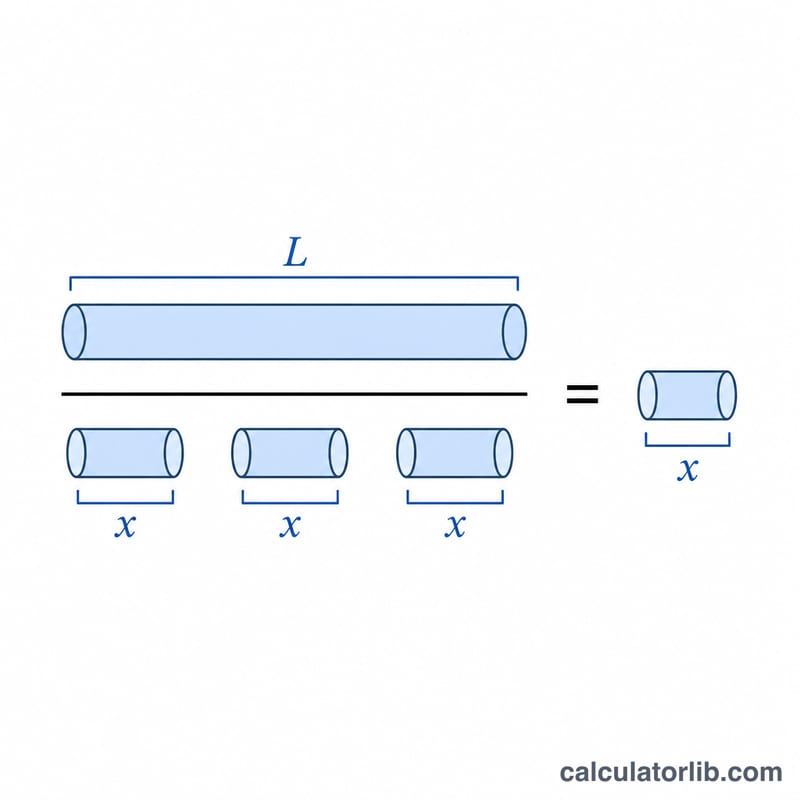
Division shares a total equally among a number of groups. Here the total length is shared among the pieces, so the length of each piece equals the total length divided by the number of pieces: $$L = \dfrac{T}{n}$$ The units work out as feet ÷ pieces = feet per piece. Your typed answer is judged correct when it differs from the true quotient by less than 0.0001, which absorbs small rounding: \(\left| g - L \right| < 0.0001\).
Worked example
A tube is 125 feet long and must be cut into 25 equal pieces. Divide: $$125 \div 25 = 5$$ Each piece is 5 feet long. If you typed 5 you get "Correct!"; if you typed 4 you get "Incorrect — try again", but the worked solution still shows \(125 \text{ feet} \div 25 \text{ pieces} = 5 \text{ feet per piece}\). Another example: \(306 \div 18 = 17\) feet per piece.
FAQ
Does the answer have to be a whole number? No. If the total length does not divide evenly, the correct length is a decimal and is shown to four decimal places.
What if I enter 0 pieces? You cannot cut something into zero pieces, so the tool guards against division by zero by treating the count as at least 1; always enter a count greater than zero.
Does it only work for feet? The math is the same for any length unit or any "total ÷ count = amount per group" problem; only the labels say feet.