
What is the Work Rate Calculator?
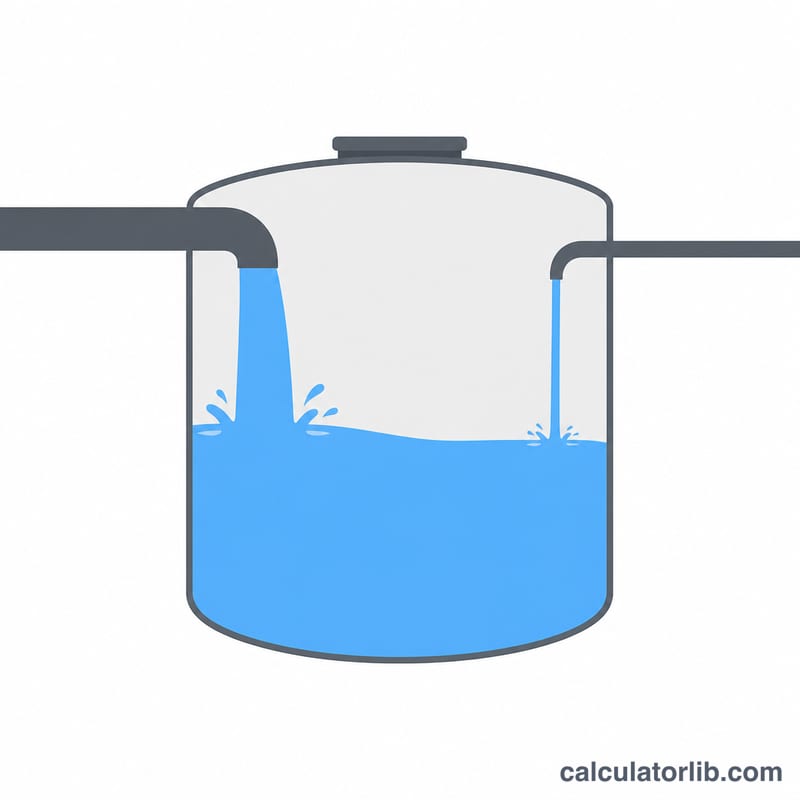
The Work Rate (Combined Work) Calculator solves the classic "if A can do a job in a hours and B can do it in b hours, how long does it take together?" word problem. It works for two or three workers, machines, pipes, or pumps that contribute to the same task at the same time.
How to use it
Enter the time each worker needs to complete the whole job alone. Leave worker C blank if only two workers are involved. The calculator returns the time they take working together, both in hours and minutes, plus the combined rate in jobs per hour.
The formula explained
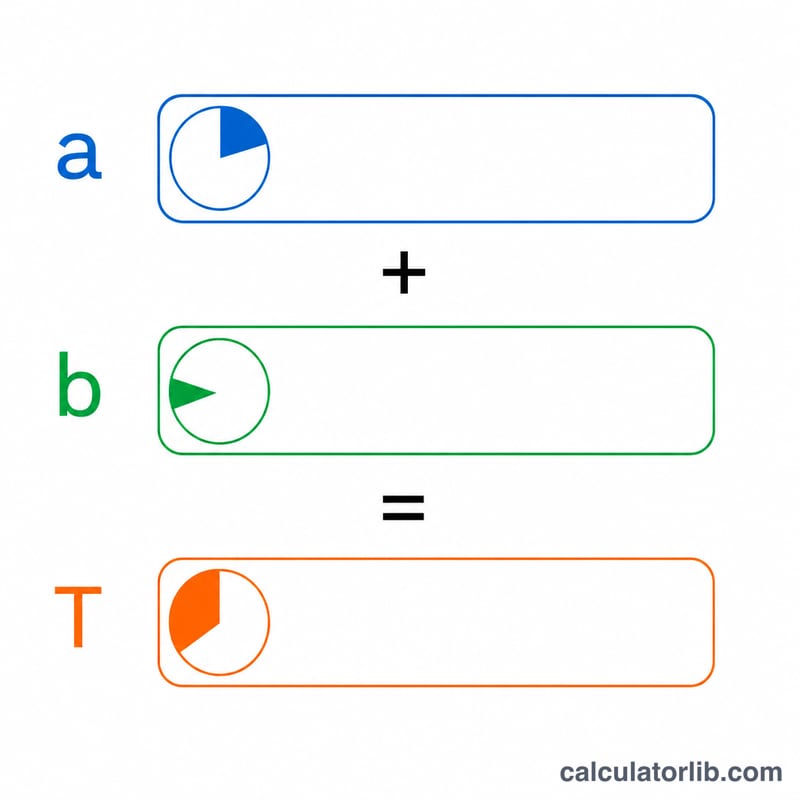
If a worker finishes a job in a hours, their rate is \(1/a\) of the job per hour. Rates add when people work simultaneously, so the combined rate is \(1/a + 1/b + 1/c\). The time to finish one whole job is simply the reciprocal of that total rate: $$T = \cfrac{1}{\dfrac{1}{a} + \dfrac{1}{b} + \dfrac{1}{c}}$$.
Worked example
Alice paints a room in 4 hours and Bob paints it in 6 hours. Their combined rate is $$\frac{1}{4} + \frac{1}{6} = \frac{3}{12} + \frac{2}{12} = \frac{5}{12}$$ of a room per hour. The time together is \(\frac{12}{5} = 2.4\) hours, which is 2 hours and 24 minutes.
FAQ
Can I use minutes instead of hours? Yes — just keep the units consistent. If you enter minutes, the result is in minutes (the "hours" label simply reflects your chosen unit).
What if one worker is much slower? A slow worker adds only a small amount to the combined rate, so the team is always faster than the fastest single worker but never twice as fast unless rates are equal.
Does it handle workers who slow each other down? No. This model assumes independent, additive rates with no interference.