
What Is the Work Calculator?
This calculator finds the mechanical work done when a constant force acts over a distance. In physics, work is the transfer of energy that occurs when a force moves an object. The result is expressed in joules (J), where one joule equals one newton-metre.
How to Use It
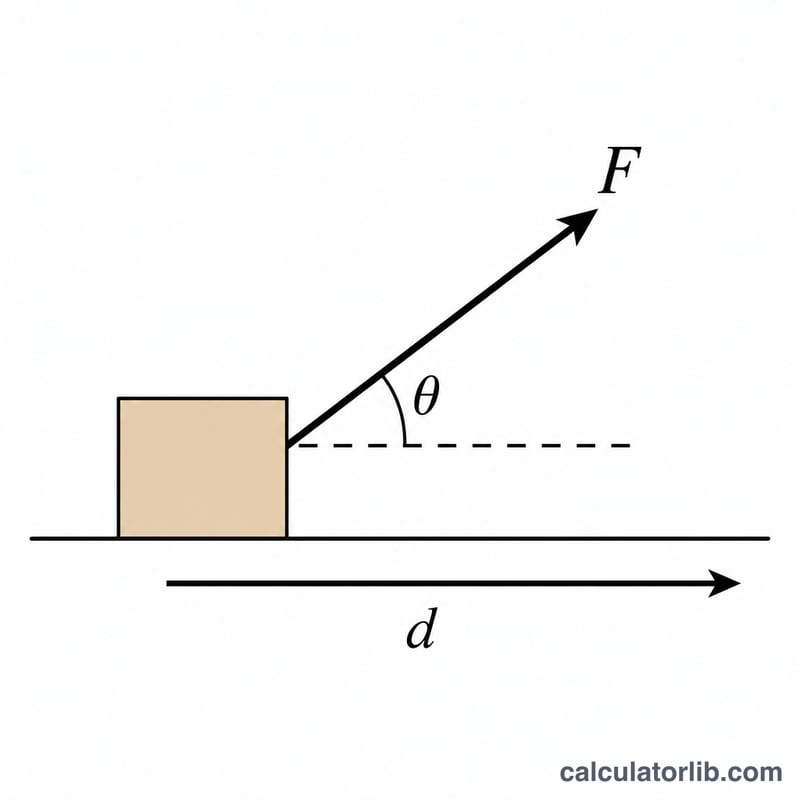
Enter the magnitude of the applied force in newtons (N), the distance the object moves in metres (m), and the angle θ in degrees between the force vector and the direction of motion. Click calculate to get the work done. If the force is in the same direction as motion, use \(\theta = 0°\).
The Formula Explained
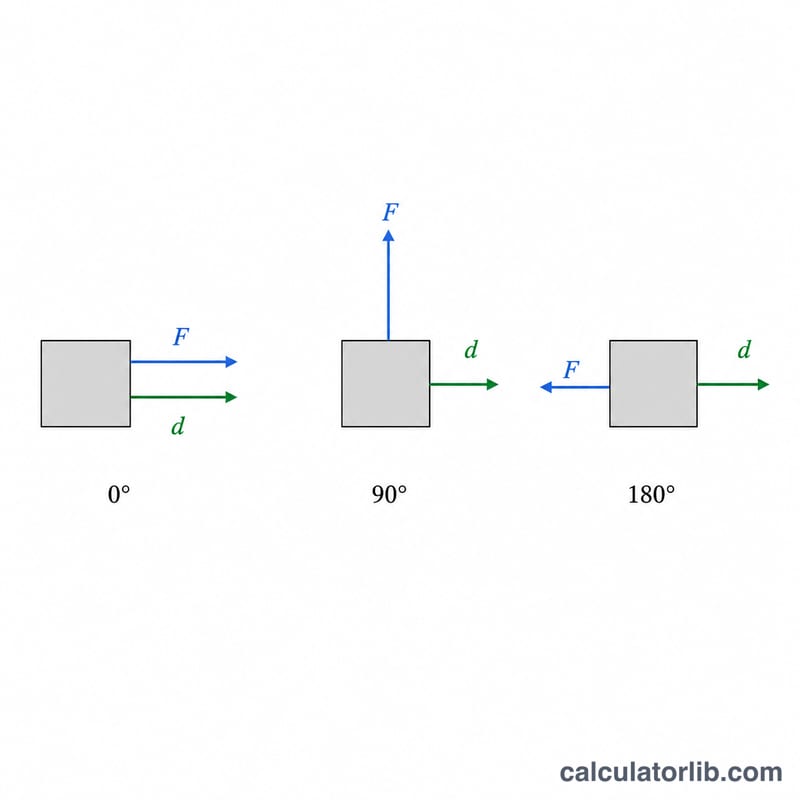
The work equation is $$W = F \cdot d \cdot \cos(\theta)$$ Only the component of the force along the direction of motion does work, which is why we multiply by \(\cos(\theta)\). When \(\theta = 0°\), \(\cos(\theta) = 1\) and all of the force contributes. When \(\theta = 90°\), \(\cos(\theta) = 0\) and no work is done — this is why carrying a bag horizontally while it pushes down on you does no work. When \(\theta\) is between 90° and 180°, work becomes negative, meaning the force removes energy.
Worked Example
Suppose you push a box with a force of 20 N over a distance of 10 m at an angle of 60°. Then $$W = 20 \times 10 \times \cos(60°) = 20 \times 10 \times 0.5 = 100 \text{ J}$$
FAQ
What units does the result use? Joules (J), assuming force in newtons and distance in metres.
Can work be negative? Yes. If the angle exceeds 90°, the force opposes the motion and work is negative, indicating energy is taken away from the object.
Why include the cosine term? Force is a vector. Only its component aligned with the displacement performs work, captured by \(\cos(\theta)\).