What Is the Monthly Work Hours Calculator?
This tool tells you how many hours you work in a month based on the number of working days and the hours you put in each day. It also estimates your gross monthly pay if you enter an hourly rate. It's perfect for hourly employees, freelancers, contractors, and managers planning schedules or budgets.
How to Use It
Enter the number of working days in the month (commonly 20–23 for a standard Monday–Friday schedule), your typical hours per day (such as 8), and optionally your hourly pay rate. The calculator instantly multiplies the values to show total monthly hours and an estimated gross pay.
The Formula Explained
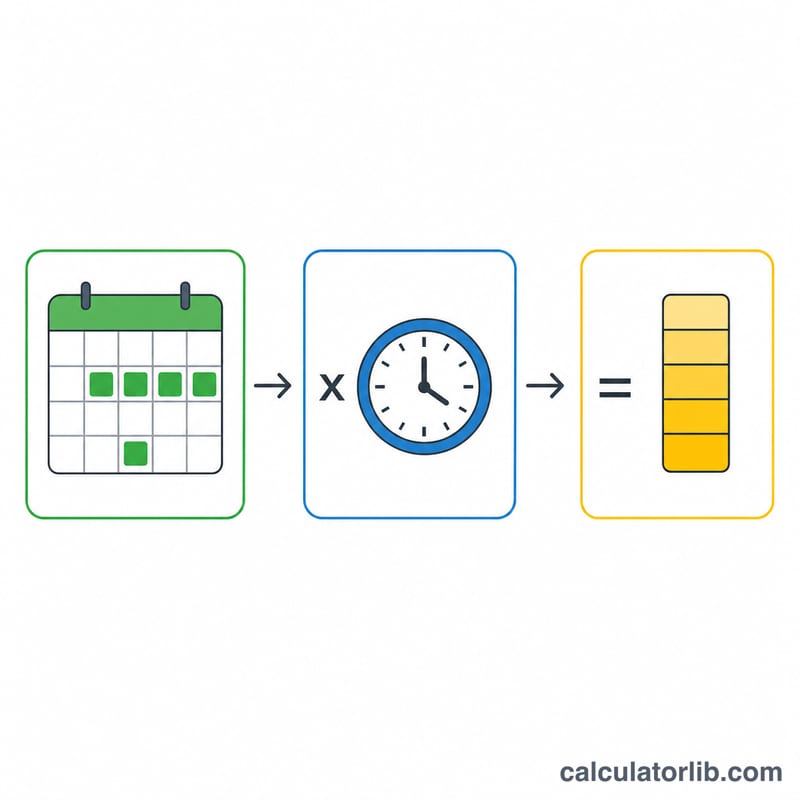
The math is simple multiplication. Total monthly hours equals working days multiplied by hours per day: $$\text{Monthly Hours} = \text{Working Days} \times \text{Hours per Day}$$. If you supply an hourly rate, estimated pay is calculated as $$\text{Pay} = \text{Monthly Hours} \times \text{Rate}$$. The result is gross (before tax and deductions).
Worked Example
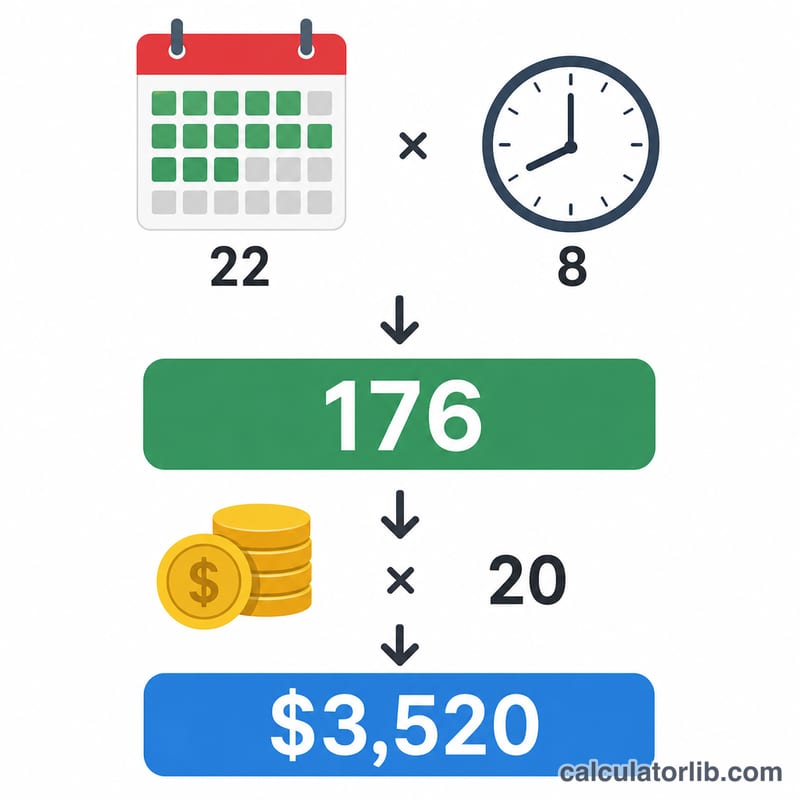
Suppose a month has 22 working days and you work 8 hours per day at $25/hour. Monthly hours = $$22 \times 8 = 176 \text{ hours}$$ 176 hours. Estimated pay = $$176 \times \$25 = \$4{,}400$$ $4,400 gross.
Working Days and Monthly Hours by Month
A standard Monday–Friday month contains between 20 and 23 working days, depending on which weekday the month starts on. The table below shows the Mon–Fri weekday count for each month of 2026 (a non-leap year beginning on a Thursday) together with the resulting hours at 8 hours per day, plus the typical range that month can take in any year. These counts are before public holidays — every public holiday that falls on a weekday must be subtracted from the working-day figure before you enter it into the calculator.
| Month | Mon–Fri days (2026) | Hours at 8 h/day | Typical range (any year) |
|---|---|---|---|
| January | 22 | 176 | 21–23 |
| February | 20 | 160 | 20–21 |
| March | 22 | 176 | 21–23 |
| April | 22 | 176 | 20–22 |
| May | 21 | 168 | 21–23 |
| June | 22 | 176 | 20–22 |
| July | 23 | 184 | 21–23 |
| August | 21 | 168 | 21–23 |
| September | 22 | 176 | 20–22 |
| October | 22 | 176 | 21–23 |
| November | 21 | 168 | 20–22 |
| December | 23 | 184 | 21–23 |
| Full year 2026 | 261 | 2,088 | 260–262 |
The conventional planning year used in payroll and budgeting is 52 weeks × 5 days = 260 working days, which at 8 hours per day gives 2,080 hours per year. Dividing by 12 gives the standardized average month:
$$\text{Average month} = \frac{260}{12} \approx 21.67\ \text{days} \qquad \frac{2080}{12} \approx 173.33\ \text{hours}$$Because a calendar year contains 365 or 366 days — 52 weeks plus one or two leftover days — the actual weekday count is 260, 261 or 262 depending on the year, and each month shifts by one or two days from year to year. Always check a calendar for the specific month and year, then subtract the public holidays that apply where you work.
Monthly Hours and Pay Across Common Schedules
All rows below are computed directly from the calculator's formula, \(\text{Monthly Hours} = \text{Working Days} \times \text{Hours per Day}\), with gross pay as \(\text{Monthly Hours} \times \text{Hourly Rate}\). The rate used is $25 per hour for comparison only; substitute your own.
| Schedule | Working days / month | Hours / day | Monthly hours | Monthly gross at $25/h |
|---|---|---|---|---|
| Full-time, 5-day week | 22 | 8 | 176 | $4,400 |
| Standardized average month | 21.67 | 8 | 173.33 | $4,333.33 |
| Compressed 4-day week | 17.4 | 8 | 139.2 | $3,480 |
| 4-day week, 10 h days | 17.4 | 10 | 174 | $4,350 |
| Part-time, half days | 22 | 4 | 88 | $2,200 |
| 12-hour shift rotation | 15 | 12 | 180 | $4,500 |
| 6-day week | 26 | 8 | 208 | $5,200 |
Two observations follow from the arithmetic. First, a compressed four-day week at 10 hours per day (174 h) reaches almost exactly the same monthly total as a five-day week at 8 hours (176 h) — the hours are redistributed, not reduced. Second, schedules built on long shifts can produce more monthly hours than a standard week despite having far fewer working days: 15 twelve-hour shifts is 180 hours, above the 176-hour five-day month.
Interpreting Your Monthly Hours Result
The 173.33-hour benchmark. Payroll systems and annual-salary conversions commonly treat a full-time month as 173.33 hours, which comes from the 2,080-hour work year divided evenly across twelve months:
$$\frac{2080\ \text{h/year}}{12\ \text{months}} = 173.\overline{3}\ \text{h/month}$$No individual calendar month actually contains 173.33 working hours — real months range from roughly 160 to 184 hours at 8 hours per day. The figure is an average used so that monthly salary stays constant while the number of working days varies.
Monthly hours do not determine overtime. In the United States, the Fair Labor Standards Act (FLSA) bases overtime on hours worked over 40 in a single workweek — a fixed, recurring 168-hour period — not on a monthly total. An employee can work 176 hours in a month with no overtime owed, or work the same 176 hours unevenly and be owed overtime for the weeks that exceeded 40 hours. Rules differ by country and often by state or province, and some jurisdictions add daily overtime thresholds (California, for example, uses an 8-hour daily trigger for covered employees). Check the law that applies where you work.
Scheduled hours, not paid hours. The result is a schedule total. Unpaid meal breaks are normally excluded from paid time, so a 9-hour shift with a 1-hour unpaid break should be entered as 8 hours per day. Conversely, paid leave — holidays, vacation, sick days — may still be paid even though it is not worked; if you want a paid-hours figure, include those days, and if you want hours actually worked, exclude them. Enter the working days you will actually be present, after subtracting public holidays and planned absences.
Estimated pay is gross. The pay figure is hours × hourly rate before any deductions. For example, 22 working days at 8 hours with a $22 hourly rate gives:
$$22 \times 8 = 176\ \text{h} \qquad 176 \times \$22 = \$3{,}872$$That $3,872 is gross pay. Income tax, payroll or social-insurance contributions, health insurance premiums, pension or retirement contributions, and any other withholding are not included, so take-home pay will be lower. The calculator also applies one flat rate to every hour: it does not apply overtime premiums, shift differentials, bonuses, or unpaid time. This section is general information, not professional financial, tax or legal advice.
FAQ
How many working days are in a month? A typical full-time month has 20 to 23 working days depending on the calendar and weekends. The yearly average is about 21.7 working days per month \((260 \div 12)\).
Does this include overtime? No. It assumes a consistent number of hours per day. For overtime, add those hours separately or increase the hours-per-day value.
Is the pay before or after tax? The estimated pay is gross — before income tax, insurance, and other deductions.