
What this calculator does
The Time Difference Across Time Zones Calculator tells you how many hours apart two time zones are, based purely on their UTC (Coordinated Universal Time) offsets. A positive result means Zone A is ahead of Zone B; a negative result means Zone A is behind. This is useful for scheduling international calls, coordinating remote teams, planning travel, and knowing what the clock reads "over there" right now.
How to use it
Enter the UTC offset for each zone in hours. For example, Central European Time is UTC+1 (enter 1), US Eastern Time is UTC−5 (enter -5), and India Standard Time is UTC+5.5 (enter 5.5). Half- and quarter-hour offsets such as 5.5, 9.5, and 5.75 are fully supported. The calculator returns both the signed difference (Zone A minus Zone B) and the absolute gap.
The formula explained
Any local clock time equals UTC plus that zone's offset. When you subtract the two clocks, the shared UTC term cancels out, leaving simply:
$$\Delta t = \left| \text{Offset A (h)} - \text{Offset B (h)} \right|$$
So you never need to know the actual time — only the offsets. If daylight saving time is in effect for a zone, use its summer offset (e.g. New York becomes UTC−4 during EDT).
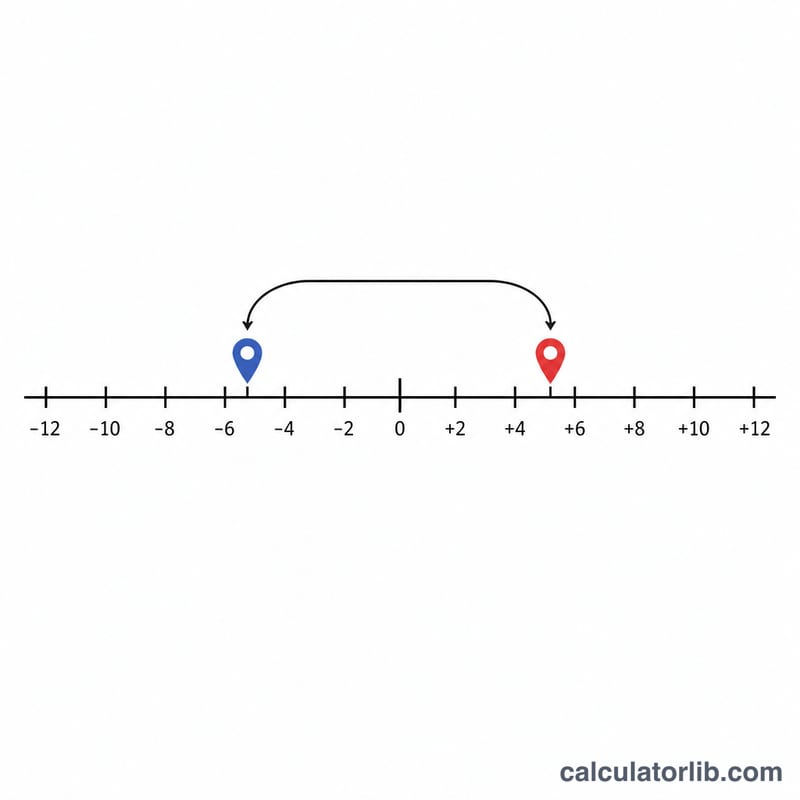
Worked example
Suppose Zone A is London in summer (UTC+1) and Zone B is New York in summer (UTC−4). $$\Delta t = \left| 1 - (-4) \right| = 5 \text{ hours}$$ London is 5 hours ahead of New York, so when it is 6 PM in London it is 1 PM in New York.

FAQ
Does this account for daylight saving time? Not automatically. Enter each zone's current offset, switching to the summer offset when DST applies.
How do I enter a half-hour zone? Use a decimal — India (UTC+5:30) is \(5.5\) and Nepal (UTC+5:45) is \(5.75\).
What does a negative result mean? A negative difference means Zone A is behind Zone B by that many hours.