
What This Calculator Does
The Meeting Time Across Time Zones Calculator converts a scheduled time in one city (City A) into the equivalent local time in another city (City B). It works for any pair of zones worldwide because it relies on each zone's offset from Coordinated Universal Time (UTC), so it is universal and not tied to any single country.
How to Use It
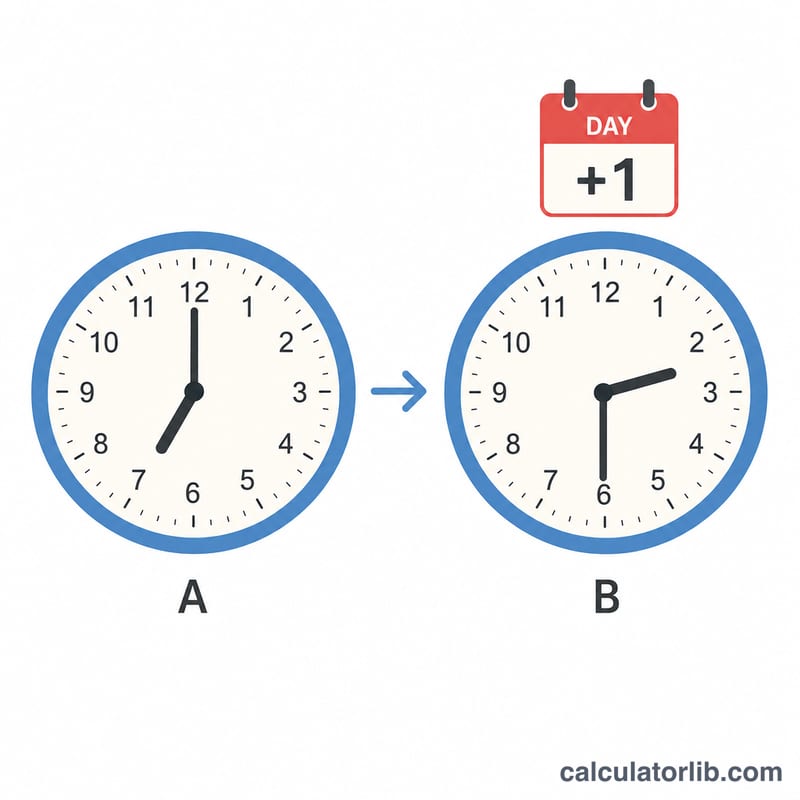
Enter the meeting hour (0-23) and minute as they appear on City A's clock. Then enter each city's UTC offset in hours — for example New York in winter is -5, London is 0, Paris is +1, and India uses +5.5. Half-hour and quarter-hour zones are supported via the 0.25 step. The result shows City B's local time plus whether it lands on the same day, the next day, or the previous day.
The Formula Explained
The core relationship is \(\text{local\_time}_B = \text{local\_time}_A + (\text{offset}_B - \text{offset}_A)\). We convert City A's time to total minutes, add the offset difference (in minutes), and then normalize back into a 24-hour clock. Any overflow or underflow of 1440 minutes (24 hours) becomes a day shift.
$$ T_B = \left(\,T_A + 60\cdot(\text{Offset}_B - \text{Offset}_A)\,\right) \bmod 1440 $$ $$ \text{where}\quad \left\{ \begin{aligned} T_A &= 60\cdot\text{Hour} + \text{Minute} \\ \text{Offset}_A &= \text{City A UTC Offset} \\ \text{Offset}_B &= \text{City B UTC Offset} \end{aligned} \right. $$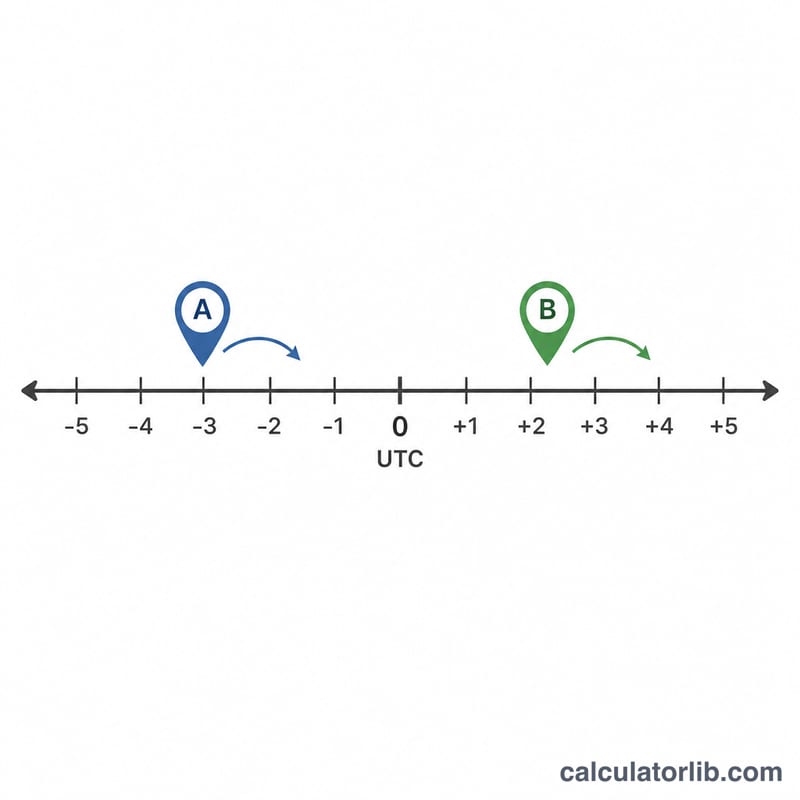
Worked Example
A call is set for 9:00 in New York (offset -5). What time is it in Paris (offset +1)? The difference is \(1 - (-5) = 6\) hours. So Paris time =
$$ 9{:}00 + 6{:}00 = 15{:}00 $$the same day. The calculator returns 15:00 with a day shift of 0.
FAQ
Do I need to account for daylight saving time? Yes — DST changes a city's offset (e.g. New York moves from -5 to -4). Enter the offset that is in effect on the meeting date.
How are half-hour zones handled? Enter decimals like 5.5 for India or 5.75 for Nepal; the step is 0.25 so quarter-hour zones work too.
What does "next day" mean? If adding the offset difference pushes the time past midnight, the meeting falls on the following calendar day in City B; "previous day" means it falls earlier.