
What is the Travel Time Between Two Cities Calculator?
This tool computes the true elapsed duration of a trip — a flight, train, or ship voyage — between two cities that may be in different time zones. You enter the local departure date and time at the origin city and the local arrival date and time at the destination city, plus each city's UTC offset. The calculator converts both wall-clock instants to a common reference (UTC) and reports the real elapsed time. It is a universal time/calendar tool; only the city list and their offset/DST rules are region specific.
Why time zones matter
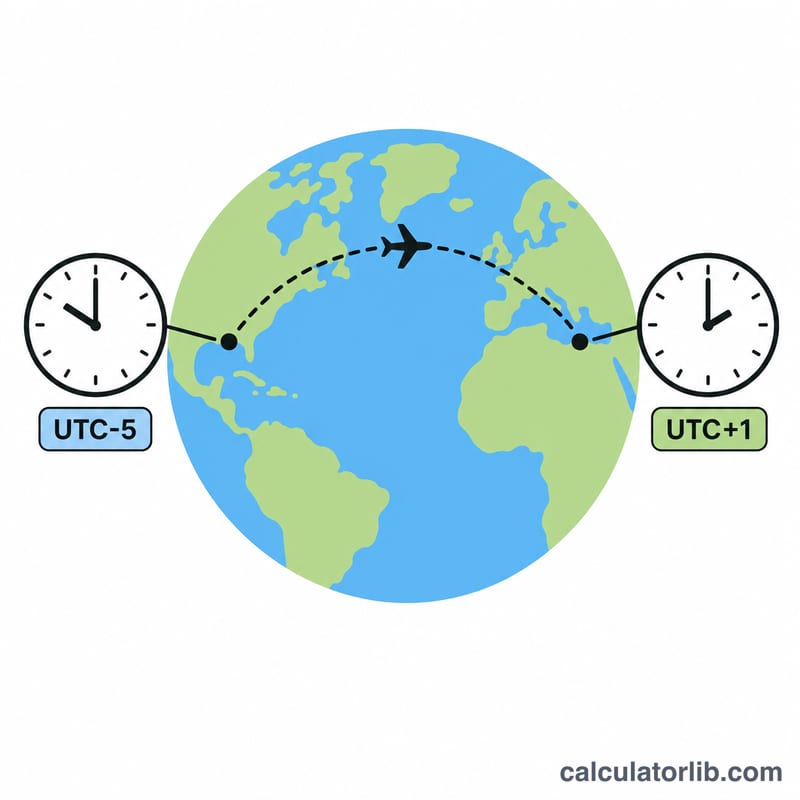
A flight that "departs Tokyo 11:00 and arrives New York 09:55 the same day" looks like it took a negative amount of time on a raw clock. That is an illusion caused by the time-zone gap. Tokyo is UTC+9 and New York (on summer time) is UTC-4 — a 13-hour difference. Once both instants are converted to UTC, the genuine duration emerges.
How to use it
1. Enter the departure city's UTC offset in hours (e.g. Tokyo = 9). Include daylight-saving time if it is active on that date. 2. Enter the departure local date and time. 3. Do the same for the arrival city and its arrival local date/time. Fractional offsets are allowed — India 5.5, Nepal 5.75, Newfoundland -3.5. Read the elapsed travel time below.
The formula
Each local time is turned into a continuous minute count: \( \text{localMinutes} = \text{daysFromEpoch} \times 1440 + \text{hour} \times 60 + \text{minute} \). Subtract the offset to reach UTC: \( \text{utcMinutes} = \text{localMinutes} - \text{offsetHours} \times 60 \). Then \( \text{elapsedMinutes} = \text{destUtcMinutes} - \text{originUtcMinutes} \). Days, hours and minutes are derived by division and modulo. A year is leap if divisible by 4 and (not by 100 or by 400), which keeps the day count exact across February.
$$\Delta t = \text{UTC}_{\text{arr}} - \text{UTC}_{\text{dep}}$$ $$\text{where}\quad \left\{ \begin{aligned} \text{UTC}_{\text{dep}} &= L_{\text{dep}} - 60\cdot\text{Dep. UTC offset} \\ \text{UTC}_{\text{arr}} &= L_{\text{arr}} - 60\cdot\text{Arr. UTC offset} \\ L_{\text{dep}} &= 1440\,D_{\text{dep}} + 60\,\text{Hour} + \text{Min} \\ L_{\text{arr}} &= 1440\,D_{\text{arr}} + 60\,\text{Hour} + \text{Min} \end{aligned} \right.$$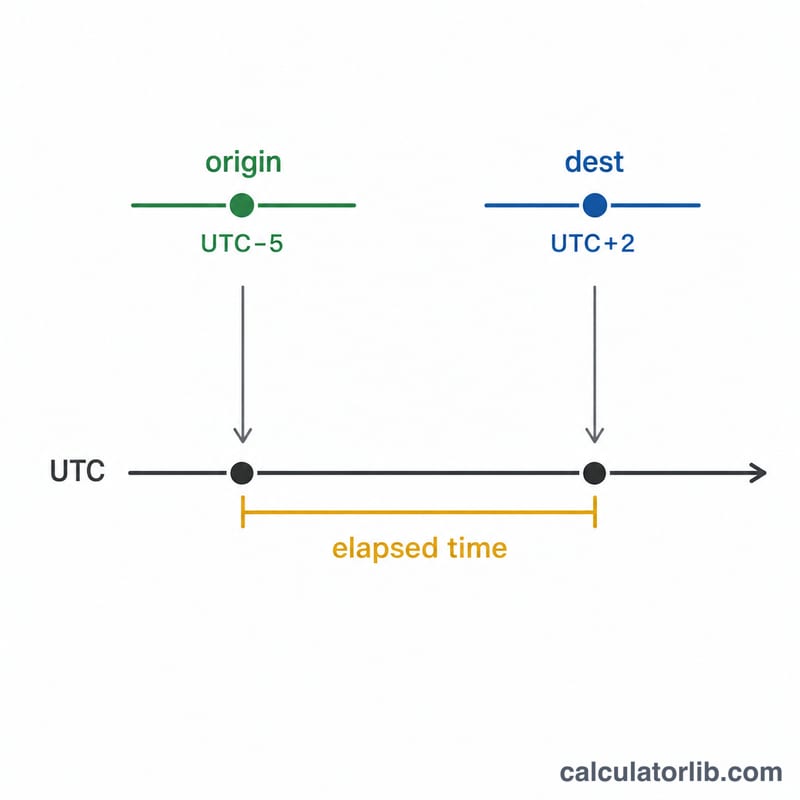
Worked example (defaults)
Tokyo (+9), depart 2026-06-15 11:00 → UTC 02:00. New York (-4, DST), arrive 2026-06-15 09:55 → UTC 13:55. Elapsed = \( 13{:}55 - 02{:}00 = 11\text{ h } 55\text{ min} = 715 \text{ minutes} = 11.92 \text{ h} \). Time difference = \( (-4) - (+9) = -13 \text{ h} \).
FAQ
Does it handle crossing midnight or the date line? Yes. All instants are placed on one continuous UTC timeline before subtracting, so no special date-line logic is needed.
How do I handle daylight saving time? Enter the offset that is actually in effect on the relevant date — the departure date for the origin and the arrival date for the destination.
Why might I get a negative result? If arrival precedes departure in UTC you likely swapped the dates or offsets; the tool will flag it so you can recheck.