
What Is the Lever Calculator?
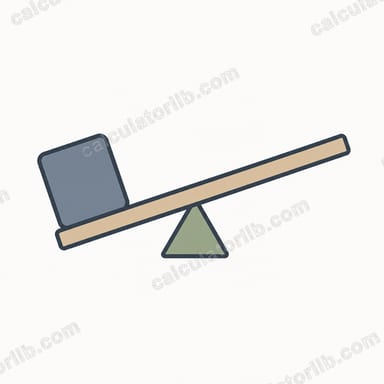
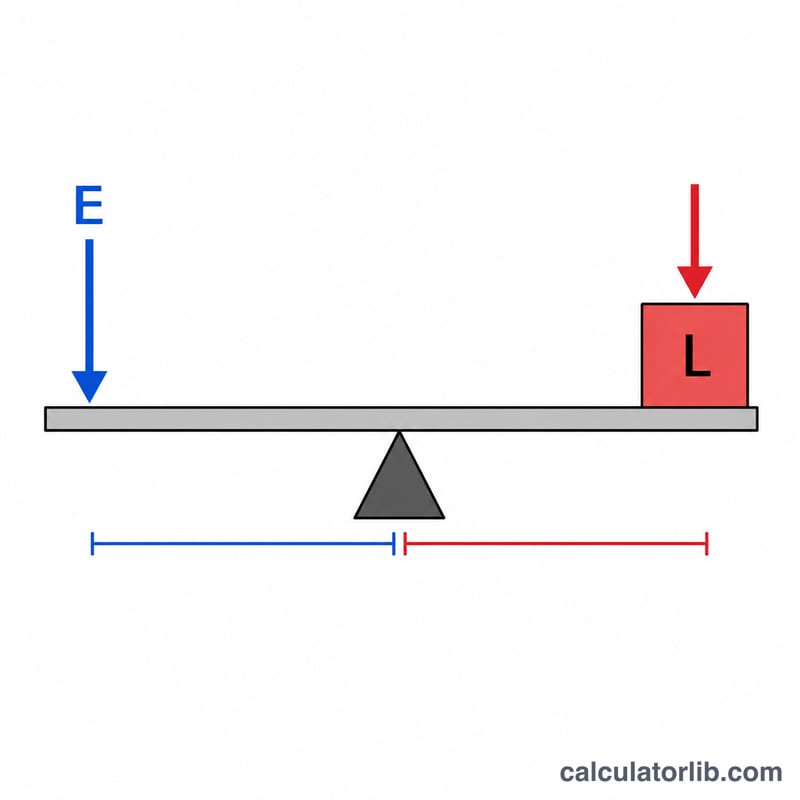
This calculator applies the universal law of the lever (the principle of moments): for a balanced lever, the turning effect of the effort equals the turning effect of the load. It works for any class of lever and any consistent set of units. Enter any three of the four quantities — effort force, load force, effort arm, and load arm — leave the unknown force blank, and the tool solves for it.
The Formula
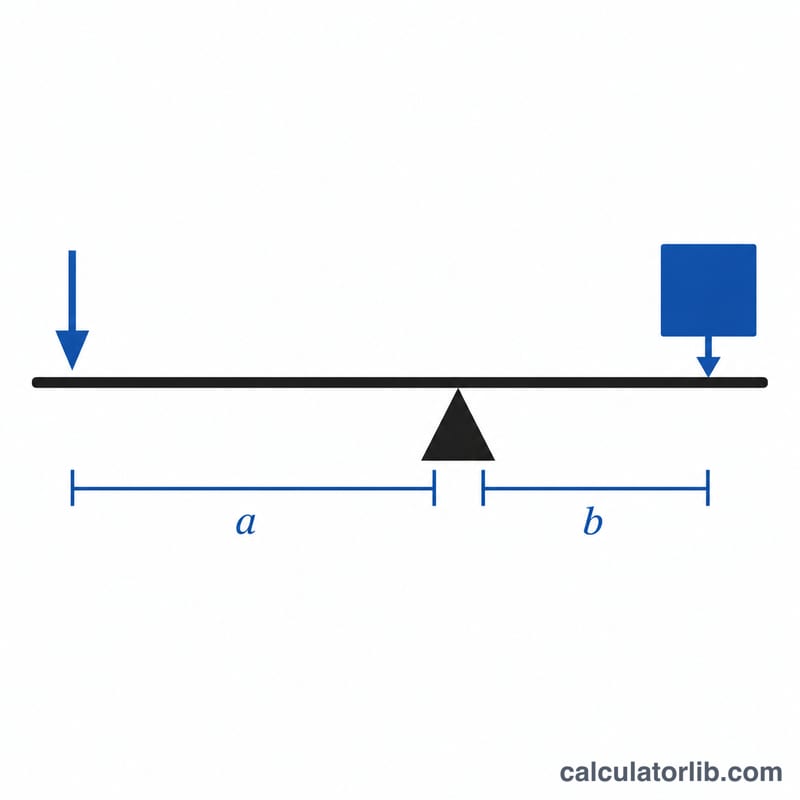
The governing equation is $$\text{Effort} \times \text{Effort Arm} = \text{Load} \times \text{Load Arm}$$. Rearranged, the unknown force is found by dividing the known moment by its arm. The mechanical advantage (MA) of the lever is the ratio of the effort arm to the load arm: \(\text{MA} = \text{Effort Arm} \div \text{Load Arm}\). An MA greater than 1 means the lever multiplies your force.
How to Use It
1. Enter both arm lengths (required). 2. Enter one known force. 3. Leave the force you want to find blank. The result panel shows the solved force, both moments (which should match in equilibrium), and the mechanical advantage.
Worked Example
Suppose a load force of 100 N acts on a load arm of 0.5 m, and the effort acts on an effort arm of 2 m. To find the load that a known effort balances, or to find the effort:
$$\text{Effort} = \frac{100 \times 0.5}{2} = 25 \text{ N}$$Conversely, with an effort of 25 N on a 2 m arm against a 0.5 m load arm:
$$\text{Load} = \frac{25 \times 2}{0.5} = 100 \text{ N}$$The mechanical advantage is \(2 \div 0.5 = 4\).
FAQ
What units should I use? Any consistent units. Forces in newtons and arms in metres give moments in newton-metres, but pounds and inches work too.
What is mechanical advantage? It is how many times the lever multiplies the input force. \(\text{MA} = \text{Effort Arm} \div \text{Load Arm}\).
Why must the moments be equal? A lever is in rotational equilibrium when clockwise and anticlockwise moments balance — that is the principle of moments.