

What this calculator does
When you fly between cities in different time zones, the clock on the wall at your destination rarely matches simple arithmetic. This tool tells you the exact local clock time you will land, plus whether you arrive the same day, the next day, or even arrive "earlier" than you left. It works for any pair of UTC offsets worldwide, so it is not tied to a single country.
How to use it
Enter your departure time in the origin city's local clock (hour and minute), the scheduled flight duration in hours and minutes, and the UTC offsets for both cities. Offsets are written as hours from UTC: New York winter is −5, London winter is 0, Tokyo is +9, and India is +5.5. Half-hour and 45-minute zones are supported. The result shows the destination local time and a day offset.
The formula explained
The core relation is arrival_local = depart_local + flight_duration + (dest_offset − origin_offset). The flight duration moves the clock forward by real elapsed time; the offset difference then re-labels that instant into the destination's local clock. We convert everything to minutes, add them, then divide by 1440 (minutes per day) to separate the day offset from the time of day.
$$\text{Arrival} = \left[\, T_{dep} + T_{flight} + \Delta_{tz} \,\right] \bmod 1440$$ $$\text{where}\quad \left\{ \begin{aligned} T_{dep} &= 60\,\text{Depart hr} + \text{Depart min} \\ T_{flight} &= 60\,\text{Flight hr} + \text{Flight min} \\ \Delta_{tz} &= 60\left(\text{Dest UTC} - \text{Origin UTC}\right) \end{aligned} \right.$$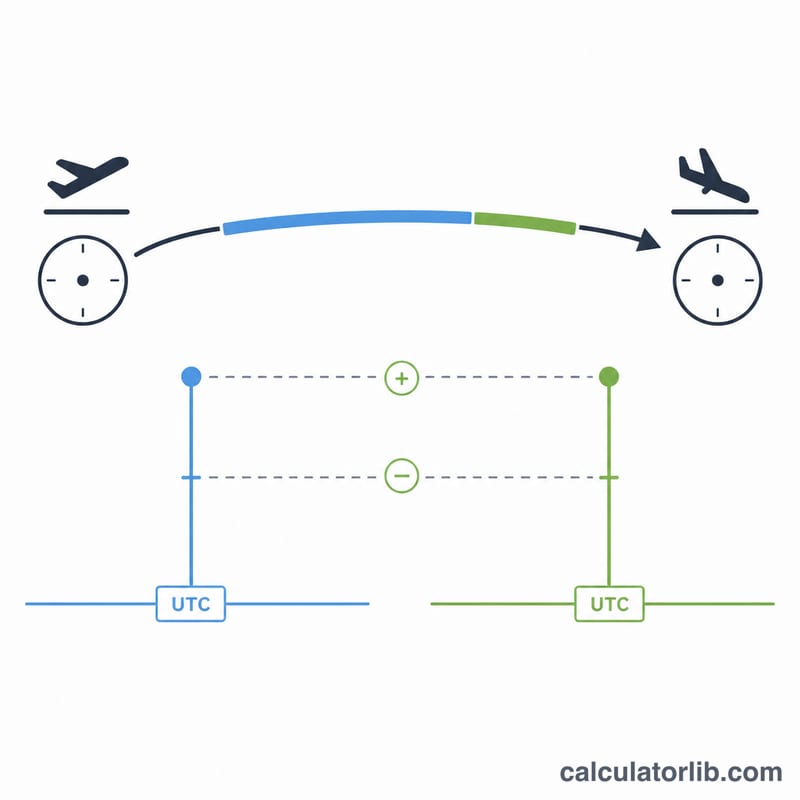
Worked example
Depart New York (UTC−5) at 09:30 on a 7h 45m flight to London (UTC+1, illustrative). Depart = 570 min. Flight = 465 min. Offset diff = \((1 - (-5)) \times 60 = 360\) min. Total = \(570 + 465 + 360 = 1395\) min = 23.25 h, so arrival is 23:15 the same day.
$$570 + 465 + 360 = 1395 \text{ min} = 23.25 \text{ h} \rightarrow 23\!:\!15$$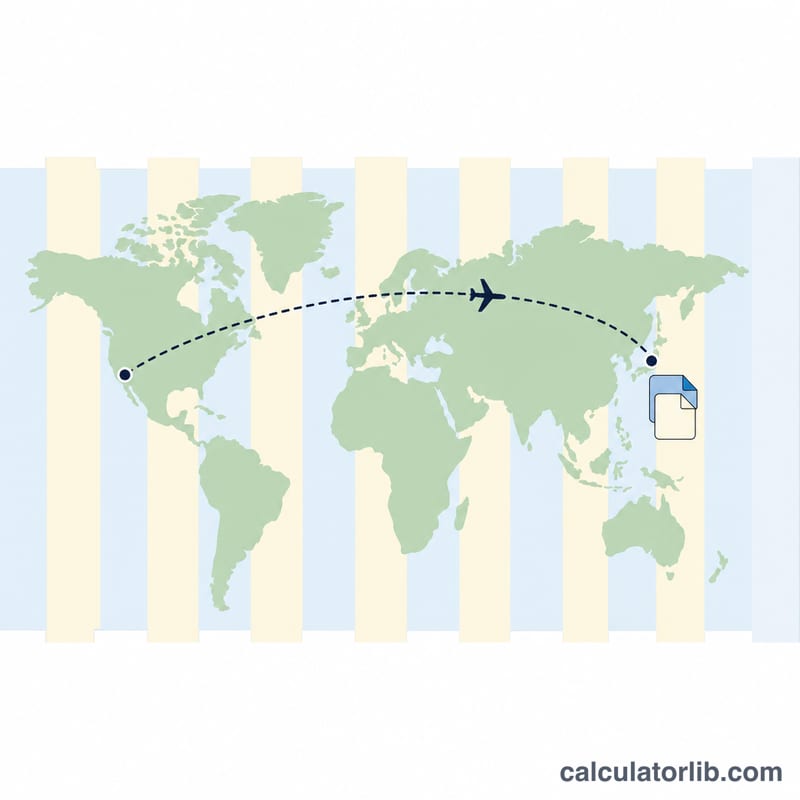
FAQ
Do I need to account for daylight saving time? Yes — enter the UTC offset that is actually in effect on the travel date (e.g. −4 for New York in summer instead of −5).
What does a negative day offset mean? You "gain" time and arrive on an earlier calendar moment, common on eastbound-to-westbound crossings of the date line; a −1 means the previous day.
Can I use this for any country? Yes. It is purely based on UTC offsets, so any two locations work.