
What is the ETA Calculator?
The Time of Arrival (ETA) Calculator estimates when you will reach your destination based on the distance you need to cover, your average travel speed, your departure time, and any planned stops or breaks. It is ideal for road trips, deliveries, cycling, running, or any journey where you want a realistic arrival time on a 24-hour clock.
How to use it
Enter the total distance in kilometres, your average speed in km/h, the hour and minute you depart (24-hour format), and the total minutes you expect to spend stopped (fuel, food, rest). The calculator returns your ETA, the pure driving time, and the total trip duration including stops. If the trip crosses midnight, it shows how many days later you arrive.
The formula explained
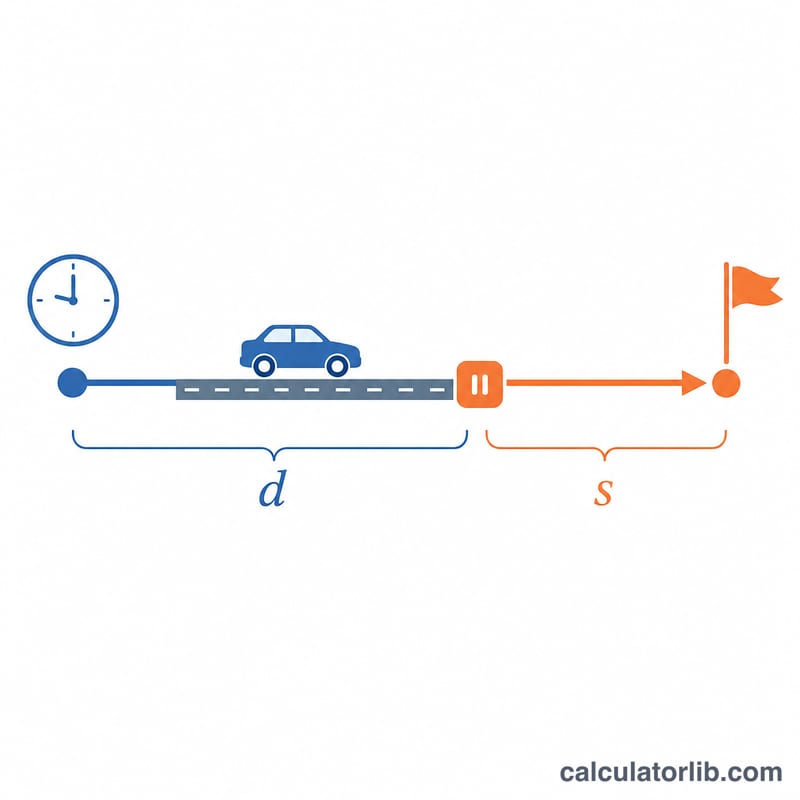
Travel time equals distance divided by speed: $$t = \frac{d}{s}$$ This is converted to minutes and added to your stop time and your departure time. The arrival is taken modulo 1440 (minutes in a day) to give a clock time, and the number of whole days that elapse is the floor of the total minutes divided by 1440.
$$\begin{gathered} \text{ETA} = \left( T_{dep} + \frac{\text{Distance (km)}}{\text{Speed (km/h)}} \times 60 + \text{Stops (min)} \right) \bmod 1440 \\[1.5em] \text{where}\quad \left\{ \begin{aligned} T_{dep} &= \text{Dep. Hour} \times 60 + \text{Dep. Minute} \\ \text{ETA} &\text{ is in minutes past midnight} \end{aligned} \right. \end{gathered}$$
Worked example
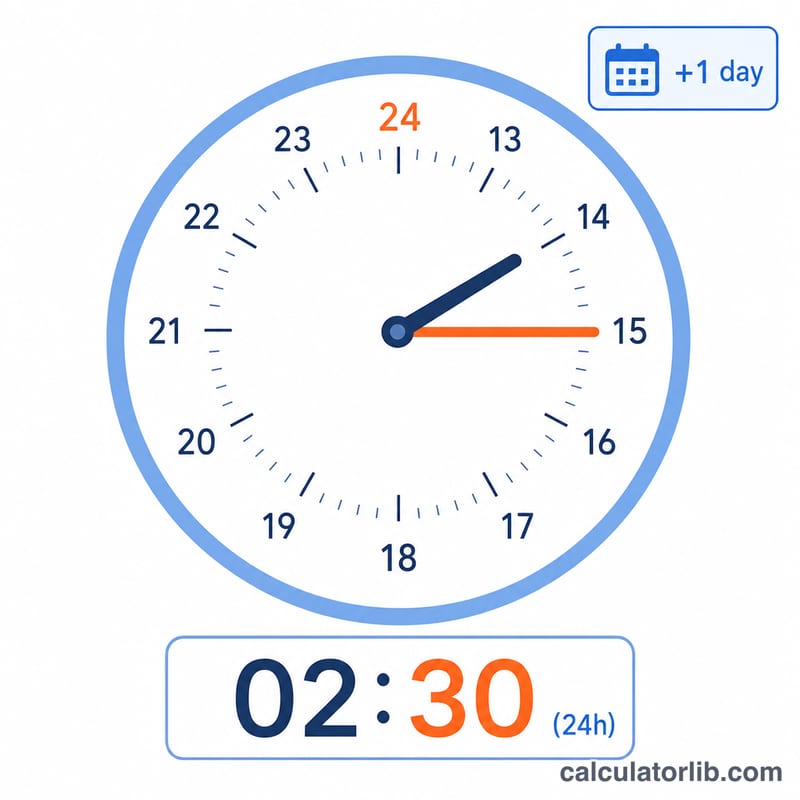
Driving 500 km at 80 km/h gives \(\frac{500}{80} = 6.25\) hours = 375 minutes of driving. Add 45 minutes of stops for 420 minutes total. Leaving at 22:00 (1320 minutes), the arrival is \(1320 + 420 = 1740\) minutes. Dividing by 1440 gives 1 full day over, with a remainder of 300 minutes = 05:00. So you arrive at 05:00 the next day.
Typical Average Speeds by Mode of Travel
These are approximate average speeds you can realistically sustain over a trip, not top speeds. Posted speed limits, terrain, weather and traffic differ by country and region, so treat the ranges as starting points and adjust for your own route.
| Mode | Typical average (km/h) | Typical average (mph) |
|---|---|---|
| Walking | 4–5 | 2.5–3.1 |
| Running | 8–12 | 5.0–7.5 |
| Recreational cycling | 15–25 | 9.3–15.5 |
| City driving | 30–50 | 19–31 |
| Mixed highway driving | 70–90 | 43–56 |
| Motorway / freeway | 100–120 | 62–75 |
| Long-distance bus / coach (including stops) | about 60–90 | about 37–56 |
| Passenger train: conventional intercity | about 80–130 | about 50–80 |
| Passenger train: high-speed rail (including stops) | about 150–250 | about 93–155 |
Tip: for a long trip, use an average that already accounts for slow sections such as towns, roadworks and congestion. Enter fuel, meal and rest breaks separately in the stops field instead of lowering your speed.
ETA Scenarios Compared
All scenarios cover 500 km and depart at 22:00 (1,320 minutes after midnight). Driving time is \(\frac{500}{\text{speed}} \times 60\) minutes. The ETA is \((1320 + \text{driving} + \text{stops}) \bmod 1440\).
| Average speed | Driving time | Stops | Total duration | ETA (24h) | Days over |
|---|---|---|---|---|---|
| 100 km/h | 5 h 00 min (300 min) | 0 min | 5 h 00 min | 03:00 | +1 |
| 100 km/h | 5 h 00 min (300 min) | 45 min | 5 h 45 min | 03:45 | +1 |
| 80 km/h | 6 h 15 min (375 min) | 45 min | 7 h 00 min | 05:00 | +1 |
| 60 km/h | 8 h 20 min (500 min) | 0 min | 8 h 20 min | 06:20 | +1 |
| 60 km/h | 8 h 20 min (500 min) | 90 min | 9 h 50 min | 07:50 | +1 |
Worked check for the 80 km/h row: \(1320 + \frac{500}{80} \times 60 + 45 = 1320 + 375 + 45 = 1740\). Then \(1740 \bmod 1440 = 300\) minutes after midnight, which is 05:00 the next day.
Notice that dropping from 100 to 60 km/h with no stops moves arrival back by 3 h 20 min, and a 90-minute stop adds another 90 minutes on top of that.
Unit Conversions: km, miles, km/h and mph
Distance and speed must use the same unit system. Use km with km/h, or miles with mph. Mixing them (for example 300 miles at 100 km/h) gives a wrong travel time.
- 1 mile = 1.609344 km
- 1 km = 0.621371 mi
- 1 mph = 1.609344 km/h
- 1 km/h = 0.621371 mph
Common speeds
| km/h | mph (approx.) |
|---|---|
| 50 | 31.07 |
| 60 | 37.28 |
| 80 | 49.71 |
| 100 | 62.14 |
| 120 | 74.56 |
Common distances
| Kilometres | Miles (approx.) |
|---|---|
| 10 km | 6.21 mi |
| 100 km | 62.14 mi |
| 500 km | 310.69 mi |
| 160.93 km | 100 mi |
| 402.34 km | 250 mi |
Minutes to decimal hours
| Minutes | Decimal hours |
|---|---|
| 15 | 0.25 |
| 30 | 0.5 |
| 45 | 0.75 |
Example: 6 h 45 min = \(6 + \frac{45}{60} = 6.75\) h. To convert decimal hours back, multiply the fraction by 60: \(0.75 \times 60 = 45\) min.
FAQ
Does it account for traffic? No — it uses a constant average speed. Lower your average speed to model congestion.
What if I arrive the same day? The "+days" indicator shows "same day" when no midnight is crossed.
Can I use miles? The labels say km, but the math is unit-agnostic: enter miles and mph and the time result is identical.