
What is First Pass Yield (FPY)?
First Pass Yield (FPY), also called first time yield, is a quality metric that tells you what fraction of units pass through a process correctly on the first attempt — without any rework, repair, or scrap. It is a more honest measure of process health than final yield, because final yield can hide hidden factory costs created by rework loops. A process can ship 100% of units while quietly reworking half of them; FPY exposes that waste.
How to use this calculator
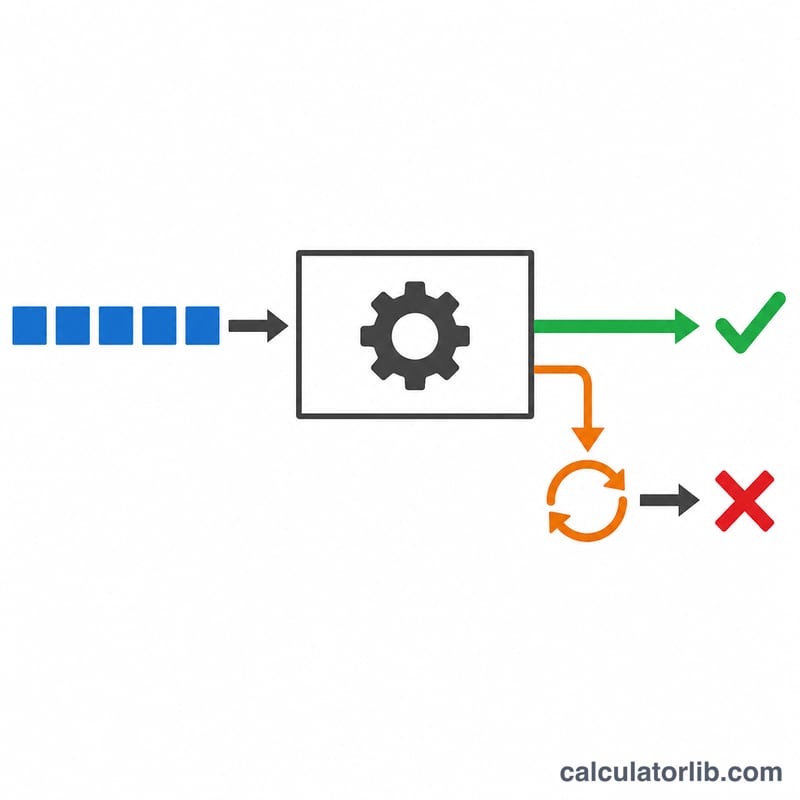
Enter the number of units that entered the process step and the number of units that passed the first time (good units that needed no rework). The calculator returns your FPY as a percentage and ratio, the number of defective or reworked units, and the defect rate. Count a unit as "passed first time" only if it required no rework whatsoever.
The formula explained
FPY = Units passed first time ÷ Units entering. Multiply by 100 for a percentage.
$$\text{FPY} = \frac{\text{Units Passed}}{\text{Units Entered}} \times 100\%$$For a multi-step process, the Rolled Throughput Yield (RTY) is the product of each step's FPY: \(\text{RTY} = \text{FPY}_1 \times \text{FPY}_2 \times \ldots \times \text{FPY}_n\). Because yields multiply, even high individual yields can compound into a low overall RTY across many steps.

Worked example
A line starts with 1,000 units. 920 pass the first time; 80 needed rework or were scrapped.
$$\text{FPY} = \frac{920}{1{,}000} = 0.92 = 92\%$$with an 8% defect rate. If a later step has FPY of 95%, the RTY for both steps is \(0.92 \times 0.95 = 0.874 = 87.4\%\).
FAQ
How is FPY different from final yield? Final yield counts units shipped after rework; FPY counts only units right the first time, so \(\text{FPY} \le \text{final yield}\).
What is a good FPY? It varies by industry, but higher is better. Many manufacturers target 95%+; world-class processes approach Six Sigma levels.
Can FPY exceed 100%? No. Passed units can never exceed entered units, so FPY is always between 0% and 100%.