
What is the Concrete Bag Yield Calculator?
This tool estimates how many bags of pre-mixed concrete you need to pour a slab, pad, or footing. It works out the project volume from your dimensions, adds an optional waste allowance, and divides by the cubic-foot yield printed on the bag. Because you can't buy a fraction of a bag, the final count is rounded up.
How to use it
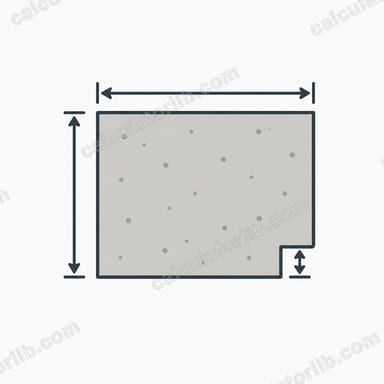
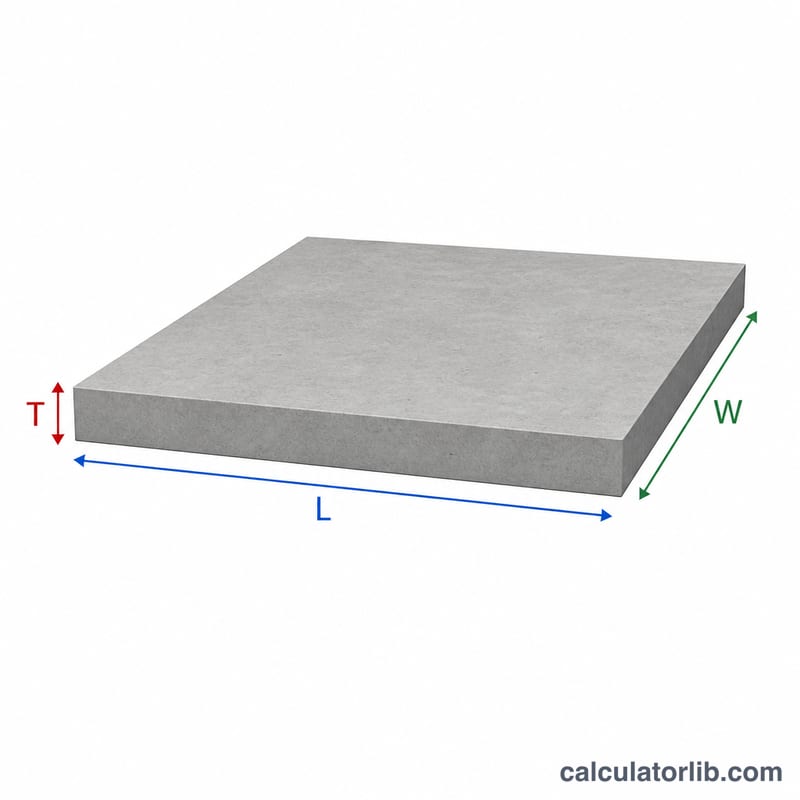
Enter the length and width of the pour in feet and the thickness in inches. Enter the yield per bag in cubic feet — a typical 80 lb bag yields about 0.6 ft³, a 60 lb bag about 0.45 ft³, and a 40 lb bag about 0.30 ft³ (check your product). Add a waste allowance (5–10% is common) to cover spillage and uneven subgrade. The calculator returns the rounded-up bag count plus the underlying volumes.
The formula explained
First the volume is computed as \(V = L \times W \times (T \div 12)\), converting thickness from inches to feet. Waste is applied with \(V \times (1 + w)\), then the result is divided by the per-bag yield and rounded up:
$$\text{bags} = \left\lceil \frac{V \times (1 + w)}{\text{yield}} \right\rceil$$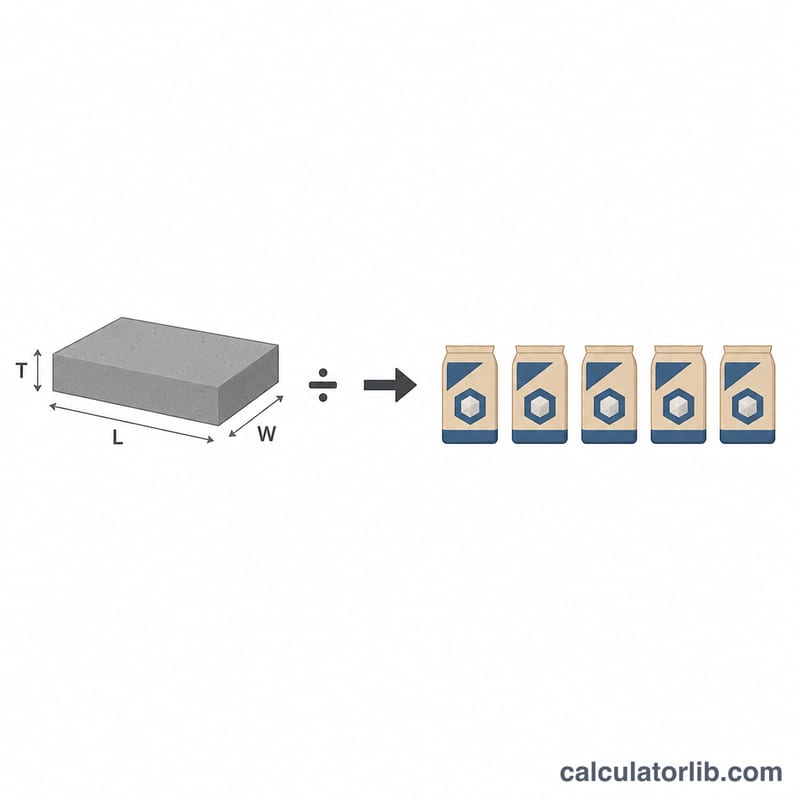
Worked example
A 10 ft \(\times\) 10 ft slab, 4 in thick, with 0.6 ft³ bags and 10% waste.
$$V = 10 \times 10 \times \left(\frac{4}{12}\right) = 33.33\ \text{ft}^3$$With waste:
$$33.33 \times 1.10 = 36.67\ \text{ft}^3$$Bags:
$$\text{Bags} = \frac{36.67}{0.6} = 61.1$$rounded up to 62 bags.
FAQ
Why round up? You cannot buy a partial bag, and running short mid-pour ruins the job, so always round up.
What yield should I use? Use the value on your bag's label. The figures here (0.30/0.45/0.60 ft³) are typical defaults only.
How much waste should I add? 5–10% covers spillage and ground irregularities; rough or sloped subgrade may justify more.