
What is a caffeine cutoff time?
Caffeine is a stimulant with a half-life of roughly 5–6 hours, meaning half of it is still in your system that long after your last sip. A caffeine cutoff time is the latest point in the day you can safely have coffee, tea, energy drinks or soda without it interfering with your sleep. This calculator finds that moment by subtracting a cutoff window from your planned bedtime.
How to use it
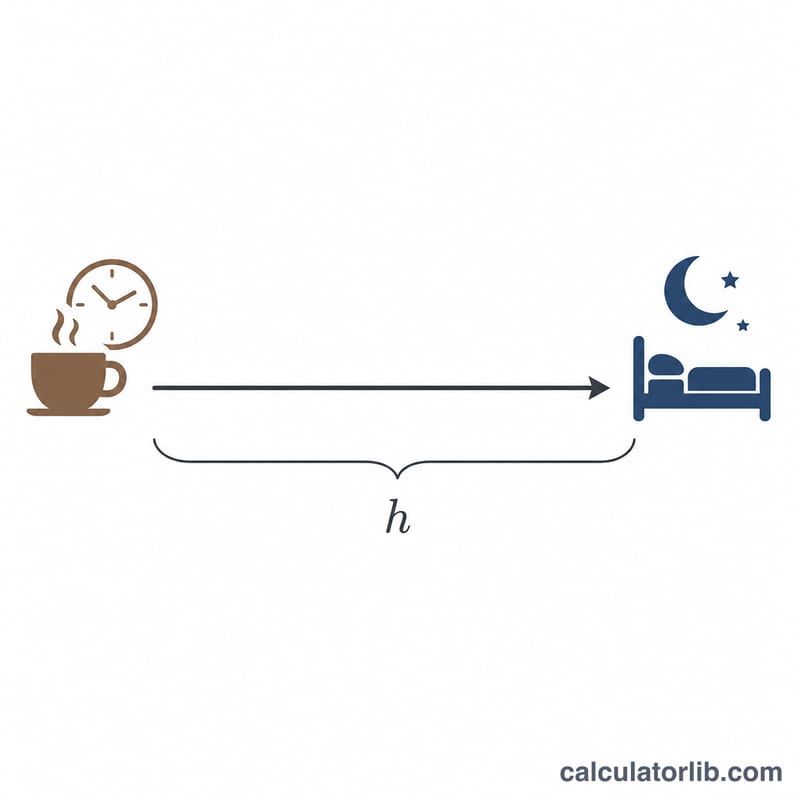
Enter the hour and minute you plan to go to bed using a 24-hour clock (for example, 23:00 for 11 PM). Then choose how many hours before bed you want to stop consuming caffeine — 6 hours is a common, evidence-informed default, though caffeine-sensitive people may prefer 8 or more. The calculator returns the latest clock time you should have your last caffeinated drink.
The formula explained
The math is simple time subtraction:
$$\text{LastCaffeineTime} = \text{BedTime} - \text{CutoffHours}$$
Times are converted to minutes-from-midnight, the cutoff is subtracted, and the result wraps around the 24-hour clock if it crosses midnight. So a 23:00 bedtime with a 6-hour cutoff gives 17:00 (5 PM).
Worked example
Suppose you go to bed at 22:30 and want an 8-hour buffer. That's 22:30 = 1350 minutes. 8 hours = 480 minutes. \(1350 - 480 = 870\) minutes = 14:30. So your last coffee should be by 2:30 PM.
What Your Cutoff Time Means
Your cutoff time is the latest moment to take your last caffeinated drink so that, by the time you go to bed, enough has been cleared from your system to avoid disrupting sleep. It is not a hard biological switch — it is a practical buffer based on how slowly caffeine leaves the body.
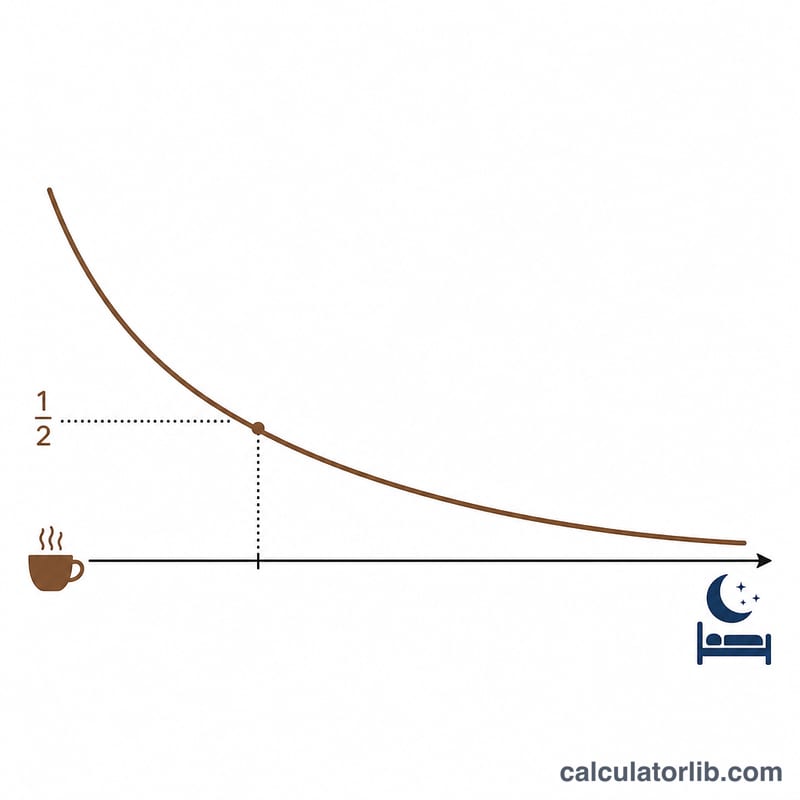
Caffeine is eliminated according to its half-life: in healthy adults this averages roughly 5–6 hours, meaning about half of a dose still remains after that time. So a 6-hour cutoff leaves you with roughly half of your last drink's caffeine at bedtime, an 8–10 hour cutoff with closer to a third or a quarter. This is why a single afternoon coffee can still measurably affect sleep many hours later.
Several factors shift your effective cutoff earlier or later:
- Sensitivity and genetics: variation in the CYP1A2 enzyme makes some people "fast" and others "slow" metabolizers, changing clearance speed substantially.
- Dose: a large or double serving takes proportionally longer to fall to a harmless level, so bigger drinks need an earlier cutoff.
- Age: caffeine metabolism tends to slow with age, lengthening the effective half-life.
- Medications and pregnancy: oral contraceptives, some antibiotics (e.g. ciprofloxacin) and pregnancy can dramatically slow elimination, sometimes doubling the half-life or more.
- Smoking: speeds caffeine metabolism, shortening its half-life.
Published sleep research supports a conservative cutoff. A widely cited 2013 study in the Journal of Clinical Sleep Medicine found that 400 mg of caffeine taken even 6 hours before bed significantly reduced total sleep time and sleep quality, while participants often did not perceive the impairment. That "6 hours before bed" finding is the basis for the common default window — and a strong reason to err on the earlier side if you are caffeine-sensitive or chasing better sleep.
This is general information, not medical advice. If caffeine consistently disrupts your sleep or you take medications that affect its metabolism, consult a healthcare professional.
FAQ
Why 6 hours? Research suggests caffeine taken even 6 hours before bedtime can measurably reduce sleep quality, so 6 hours is a sensible baseline.
Does this apply to tea and soda? Yes — any caffeine source counts. Adjust the cutoff window upward for stronger doses like espresso or energy drinks.
I'm very sensitive to caffeine. What should I set? Try 8–10 hours, and consider switching to decaf in the early afternoon.