
What is the Angular to Linear Velocity Calculator?
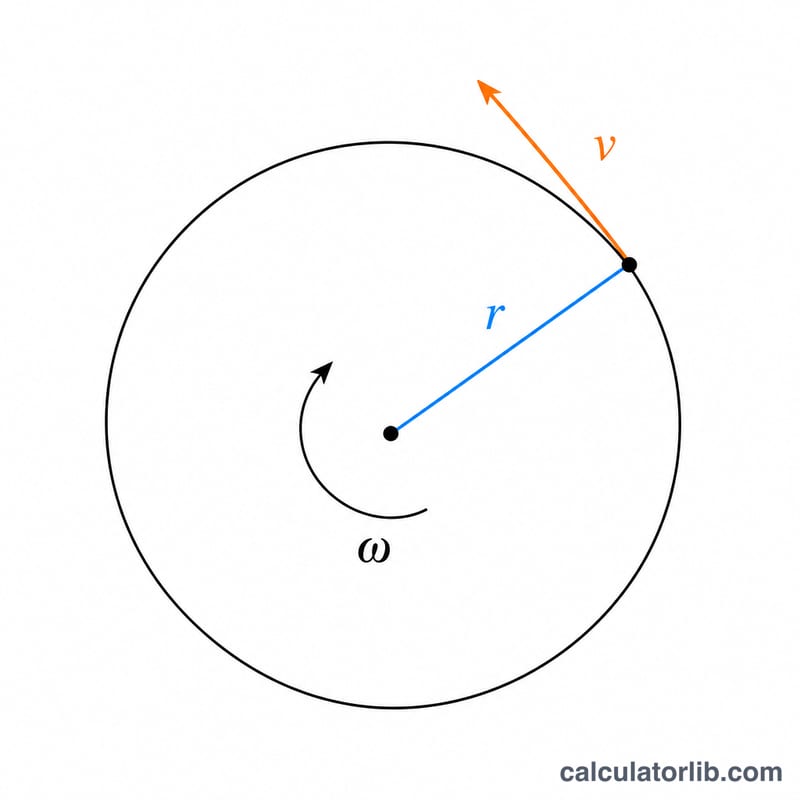
This calculator converts the angular velocity of a rotating object into its linear (tangential) velocity. Any point on a spinning body moves along a circular path, and the speed at which it travels depends on both how fast the object rotates and how far that point sits from the axis of rotation. The relationship is captured by the simple equation \(v = \omega \cdot r\).
How to use it
Enter the angular velocity \(\omega\) in radians per second (rad/s) and the radius \(r\) in meters (m). The tool multiplies the two values to give the linear velocity \(v\) in meters per second (m/s). If your angular speed is given in revolutions per minute (RPM), convert it first: \(\omega = \text{RPM} \times 2\pi / 60\).
The formula explained
The equation \(v = \omega \cdot r\) follows from the definition of angular velocity. Angular velocity \(\omega\) is the rate of change of angle (in radians) per second. Over one second the object sweeps an arc, and the arc length equals the angle in radians multiplied by the radius. That arc length per second is exactly the linear speed, so $$v = \omega \cdot r.$$ Note that \(\omega\) must be in radians per second for the formula to work directly.
Worked example
Suppose a wheel rotates at \(\omega = 10\ \text{rad/s}\) and a point sits at radius \(r = 0.5\ \text{m}\). Then $$v = 10 \times 0.5 = 5\ \text{m/s}.$$ A point twice as far out (\(r = 1\ \text{m}\)) at the same spin rate would move at 10 m/s — twice as fast — illustrating that linear speed grows with radius.
Key Terms & Variables
- Angular velocity (\(\omega\), rad/s)
- The rate at which an object rotates about an axis, measured as the angle swept per unit time. In SI units it is expressed in radians per second. It is the same for every point on a rigid rotating body, regardless of distance from the axis.
- Linear (tangential) velocity (\(v\), m/s)
- The instantaneous speed of a point on the rotating body measured along its circular path, directed tangent to the circle. It increases with distance from the axis according to \(v = \omega \times r\), so points farther out move faster.
- Radius (\(r\), m)
- The straight-line distance from the axis of rotation to the point of interest. A larger radius produces a larger tangential velocity for the same angular velocity.
- Radian (rad)
- The SI unit of angle, defined as the angle subtended at the center of a circle by an arc equal in length to the radius. A full circle is \(2\pi \approx 6.2832\) radians, and one radian \(\approx 57.2958^\circ\). Because it is a ratio of two lengths, the radian is dimensionless, which is why \(\omega \cdot r\) yields units of m/s.
- Axis of rotation
- The fixed straight line about which a body rotates. Every point on the body moves in a circle centered on this axis, in a plane perpendicular to it.
FAQ
What units should I use? Use rad/s for \(\omega\) and meters for \(r\) to get m/s. Consistent SI units keep the result clean.
How do I convert RPM to rad/s? Multiply RPM by \(2\pi\) and divide by 60. For example, 60 RPM = 6.283 rad/s.
Does this work for any point on a rotating body? Yes. Just use the distance of that specific point from the rotation axis as the radius.