
What Is the HVAC Compression Ratio?
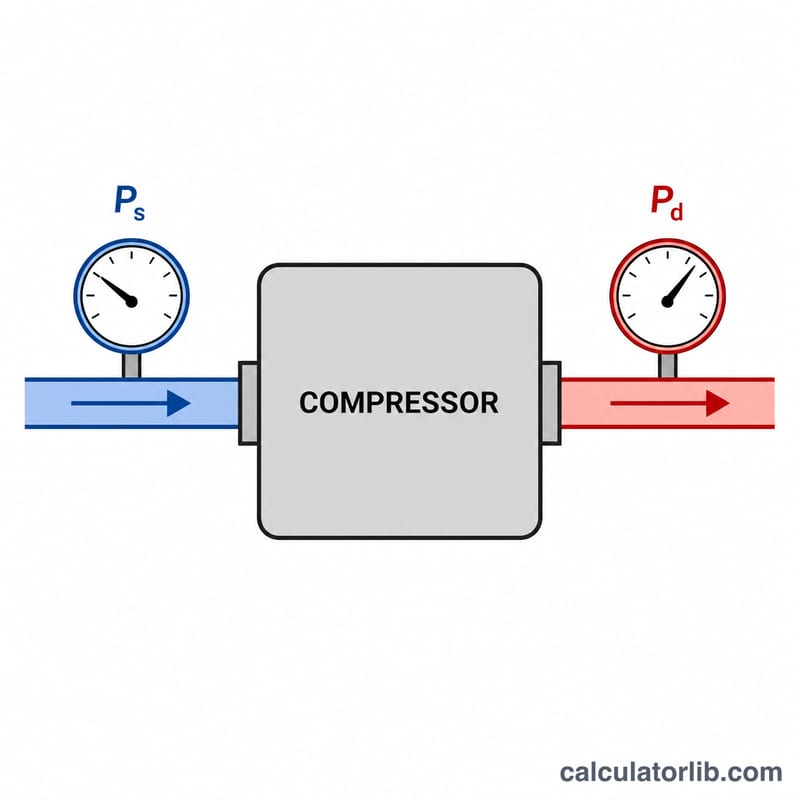
The compression ratio of an HVAC or refrigeration compressor is the ratio of the absolute discharge (high-side) pressure to the absolute suction (low-side) pressure. It tells you how hard the compressor is working to raise the refrigerant from the evaporating pressure to the condensing pressure. A higher ratio means more work, higher discharge temperatures, lower volumetric efficiency, and greater wear. Typical air-conditioning systems run a ratio around 2:1 to 4:1, while low-temperature refrigeration can climb well above 10:1.
How to Use This Calculator
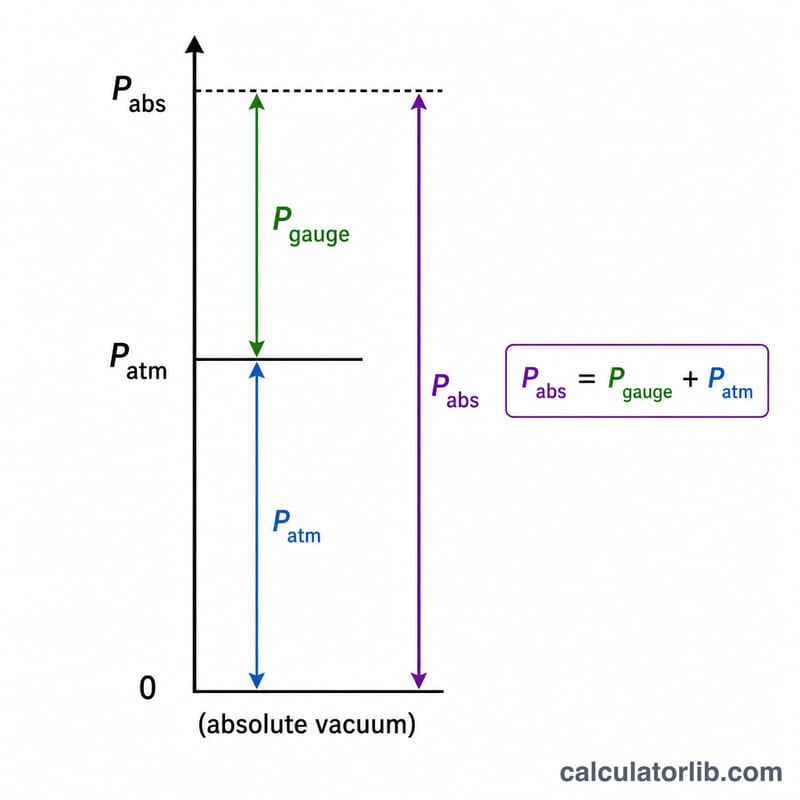
Enter the discharge (head) pressure and the suction pressure. Choose whether your readings are gauge (psig, what a service gauge shows) or already absolute (psia). If gauge, the tool adds atmospheric pressure to convert to absolute before dividing. You can adjust the atmospheric pressure for altitude; sea level is about \(14.7\) psi.
The Formula
The compression ratio uses absolute pressures, where \(P_{atm}\) = atmospheric pressure:
$$CR = \frac{P_{discharge,abs}}{P_{suction,abs}} = \frac{P_{discharge,gauge} + P_{atm}}{P_{suction,gauge} + P_{atm}}$$Here \(P_{discharge,gauge}\) and \(P_{suction,gauge}\) are gauge readings in psig, and \(P_{atm}\) is atmospheric pressure in psi.
Worked Example
Suppose discharge pressure is \(260\) psig and suction pressure is \(70\) psig at sea level (\(P_{atm}=14.7\)):
$$CR = \frac{260 + 14.7}{70 + 14.7} = \frac{274.7}{84.7} = 3.24$$So this compressor operates at a compression ratio of about \(3.24:1\), normal for an air-conditioning application.
FAQ
Why use absolute pressure instead of gauge? Compression ratio is a true pressure ratio, so both pressures must be referenced to a perfect vacuum (absolute). Using gauge values gives a wrong, inflated ratio.
What is a high compression ratio? Above roughly 10:1 you risk excessive discharge temperatures, oil breakdown, and reduced efficiency. Low-temp systems often need two-stage compression to manage this.
Does altitude matter? Yes. At higher elevations atmospheric pressure drops, which slightly changes the absolute conversion. Enter your local atmospheric pressure for best accuracy.