
What this calculator does
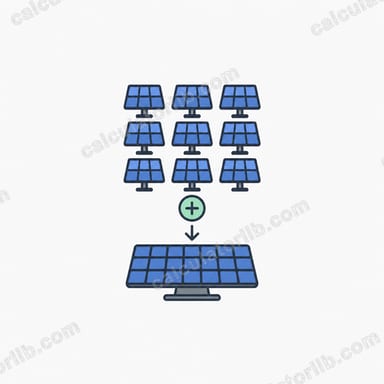
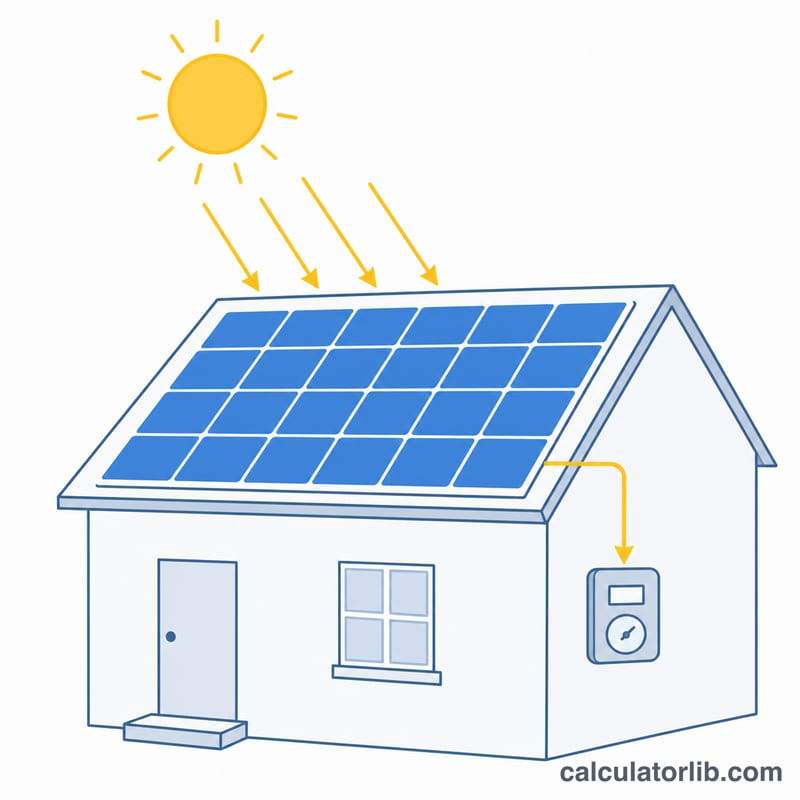
The Home Solar Panel Calculator estimates how large a rooftop solar system you need and how many panels it takes to cover your electricity use. It is a universal sizing tool — it works in any country as long as you know your monthly consumption in kilowatt-hours (kWh) and the average peak sun hours for your location.
How to use it
Enter your average monthly electricity usage in kWh (find it on your utility bill), the peak sun hours per day for your area (typically 3–6), the wattage of the panels you plan to buy (commonly 350–450 W), and an estimated system efficiency to account for inverter, wiring and temperature losses (75–85% is realistic). The tool returns the required array size, the number of panels, and the expected energy production.
The formula
First the daily energy need is the monthly usage spread over 30 days. The required array size in kilowatts is:
$$S_{kW} = \frac{E_m / 30}{H \times \eta}$$where \(E_m\) = monthly usage in kWh, \(H\) = peak sun hours per day, and \(\eta\) = system efficiency as a decimal. The number of panels is the size in watts divided by each panel rating \(P\), rounded up:
$$N = \left\lceil \frac{S_{kW} \times 1000}{P} \right\rceil$$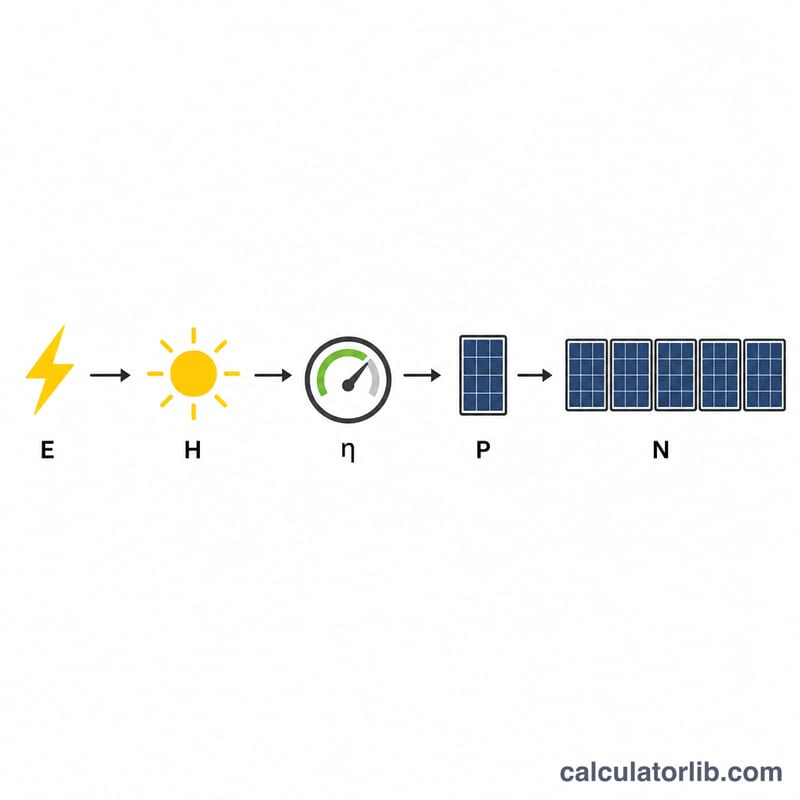
Worked example
Suppose you use 900 kWh per month, have 5 peak sun hours, 400 W panels, and 80% efficiency. Daily usage is \(900 / 30 = 30\) kWh. The system size is:
$$S_{kW} = \frac{30}{5 \times 0.8} = 7.5\,\text{kW}$$Panels needed:
$$N = \left\lceil \frac{7.5 \times 1000}{400} \right\rceil = \lceil 18.75 \rceil = 19$$FAQ
What are peak sun hours? They are the number of hours per day when sunlight averages 1,000 W/m² — a way to convert variable daily sunlight into a usable figure. Sunny regions get 5–6; cloudier ones 3–4.
Why include efficiency? Real systems lose energy to inverter conversion, heat, dust and wiring. Multiplying by 75–85% gives a realistic estimate instead of a theoretical maximum.
Does this account for battery storage or roof space? No — it sizes the panels to your consumption. Check that your roof has room for the panel count and consult an installer for storage and shading details.