
What Is the Solar Panel Payback Period?
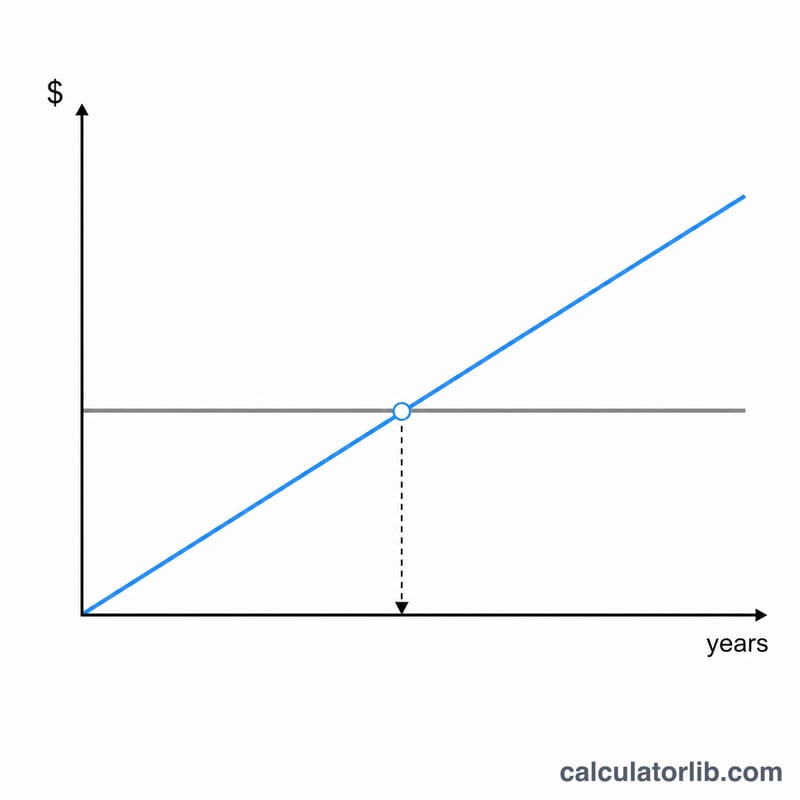
The solar panel payback period is the number of years it takes for the electricity savings from your solar system to equal what you originally paid to install it. After this break-even point, the energy your panels generate is essentially free, delivering pure savings for the remaining 15–25 years of the system's life. It is one of the most important numbers to understand before investing in solar.
How to Use This Calculator
Enter three values: the net system cost (after any rebates, tax credits, or incentives), the amount of electricity your panels are expected to produce each year in kilowatt-hours (kWh), and the price you currently pay for electricity per kWh. The calculator divides the cost by your annual savings to show how many years — and months — until the system pays for itself.
The Formula Explained
The core equation is simple:
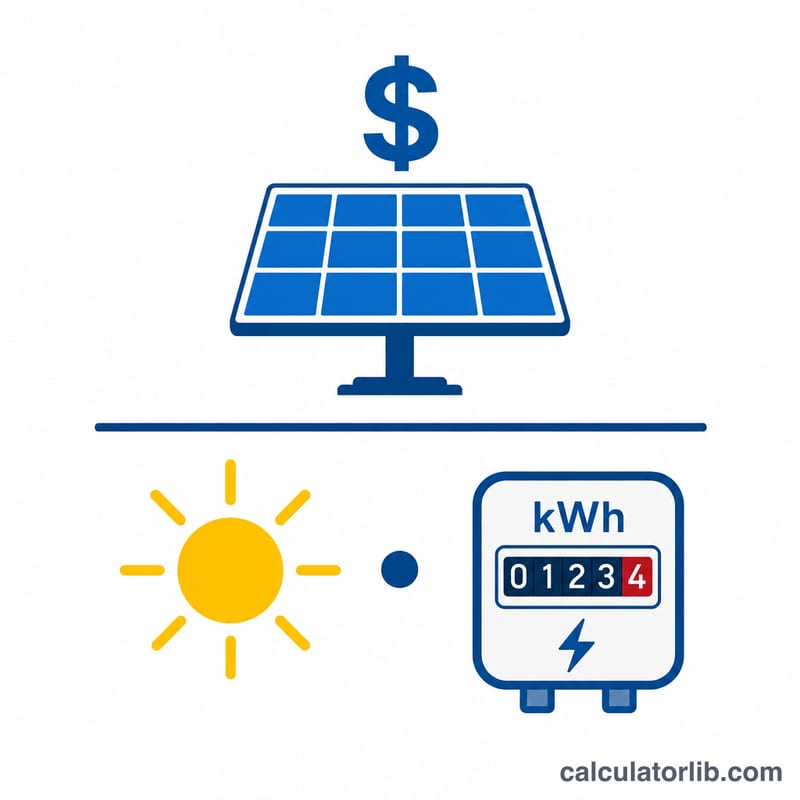
$$\text{Payback Years} = \frac{\text{System Cost}}{\text{Annual kWh} \times \text{Price per kWh}}$$
The denominator represents your annual electricity savings: every kilowatt-hour your panels produce is one you don't have to buy from the utility. Dividing the upfront cost by this yearly saving gives the time to recoup your investment.
Worked Example
Suppose a system costs $20,000 after incentives, produces 10,000 kWh per year, and your electricity costs $0.15/kWh. Annual savings = \(10{,}000 \times 0.15 = \$1{,}500\). Payback:
$$\text{Payback} = \frac{20{,}000}{1{,}500} \approx 13.33 \text{ years} \ (\text{about } 160 \text{ months})$$After roughly 13 years and 4 months, the system has paid for itself.
FAQ
Does this account for rising electricity prices? No — it uses a constant rate. In reality, utility prices tend to rise, which usually shortens the real payback period.
Should I include the federal tax credit in the cost? Yes. Enter your net out-of-pocket cost after all credits and rebates for the most accurate result.
What about panel degradation? Panels lose roughly \(0.5\%\) output per year. For a quick estimate this is minor, but it can extend payback slightly over time.