
What is the EV Charging Time Calculator?
This tool estimates how long it will take to charge an electric vehicle (EV) from its current battery level to a target level. It accounts for your battery capacity, the power of the charger you are using, and real-world charging efficiency losses. It is useful whether you are planning an overnight home charge or a quick top-up on the road.
How to Use It
Enter your battery capacity in kilowatt-hours (kWh), the charger's power output in kilowatts (kW), your starting and target state of charge as percentages, and an estimated charging efficiency. The calculator returns the approximate time in hours and minutes, plus the energy that must be delivered to the pack.
The Formula Explained
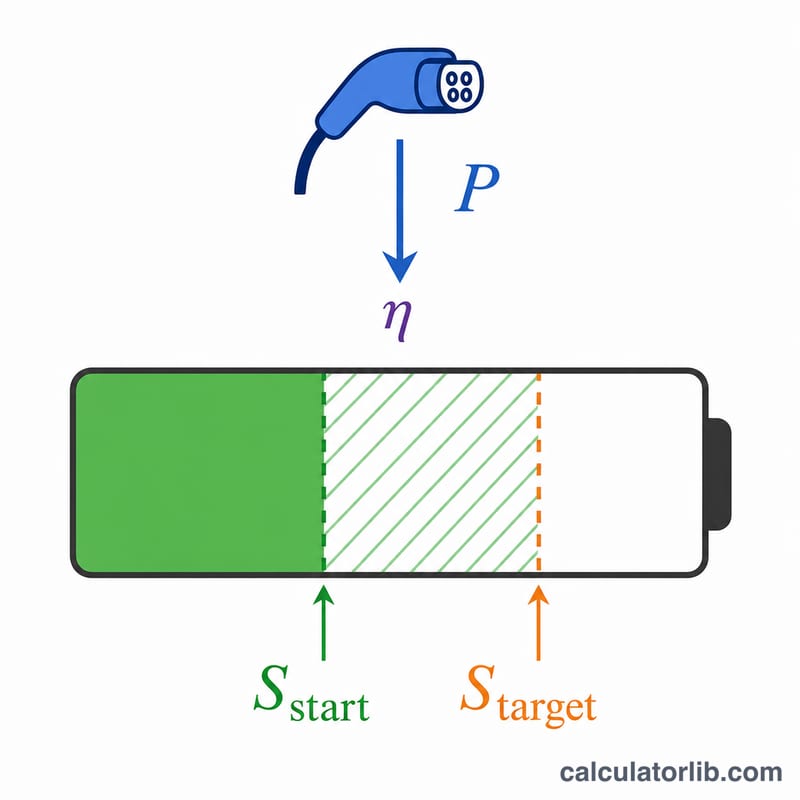
First the energy needed is found: $$E = C \times \frac{S_{\text{target}} - S_{\text{start}}}{100}$$. Then the time is the energy divided by the effective power: $$t = \frac{E}{P \times \eta}$$, where \(\eta\) is efficiency expressed as a decimal. Efficiency below 100% accounts for heat and conversion losses, so the real-world time is longer than the ideal.
Worked Example
Suppose you have a 60 kWh battery, a 7.4 kW home charger, charging from 20% to 80% at 90% efficiency. Energy needed = $$60 \times \frac{80 - 20}{100} = 36 \text{ kWh}.$$ Effective power = \(7.4 \times 0.90 = 6.66\) kW. Time = $$\frac{36}{6.66} \approx 5.41 \text{ hours},$$ or about 5 hours 24 minutes.
FAQ
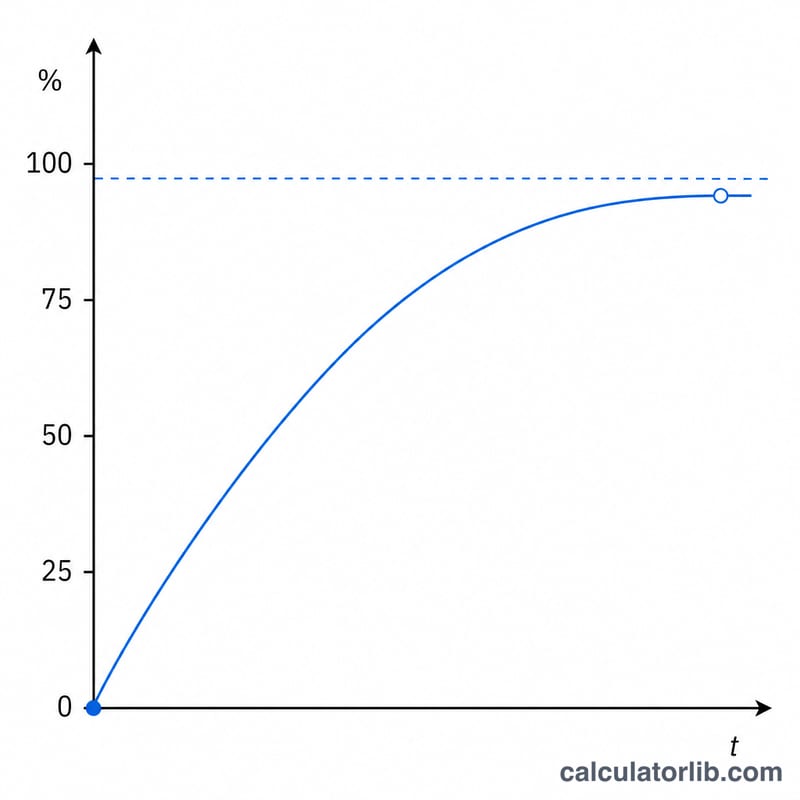
Why is the estimate longer than expected? Charging slows as the battery fills (the taper above ~80%), and chargers rarely deliver their full rated power. This calculator gives a linear estimate, so treat fast-charge results as a lower bound.
What efficiency should I use? AC home charging is typically 85–92% efficient; DC fast charging is often 90–95%. If unsure, 90% is a reasonable default.
Can the charger be faster than my car accepts? Yes. Use the lower of your charger's output and your vehicle's maximum accepted charge rate as the "Charger Power" value.