
What Is the Battery Runtime Calculator?
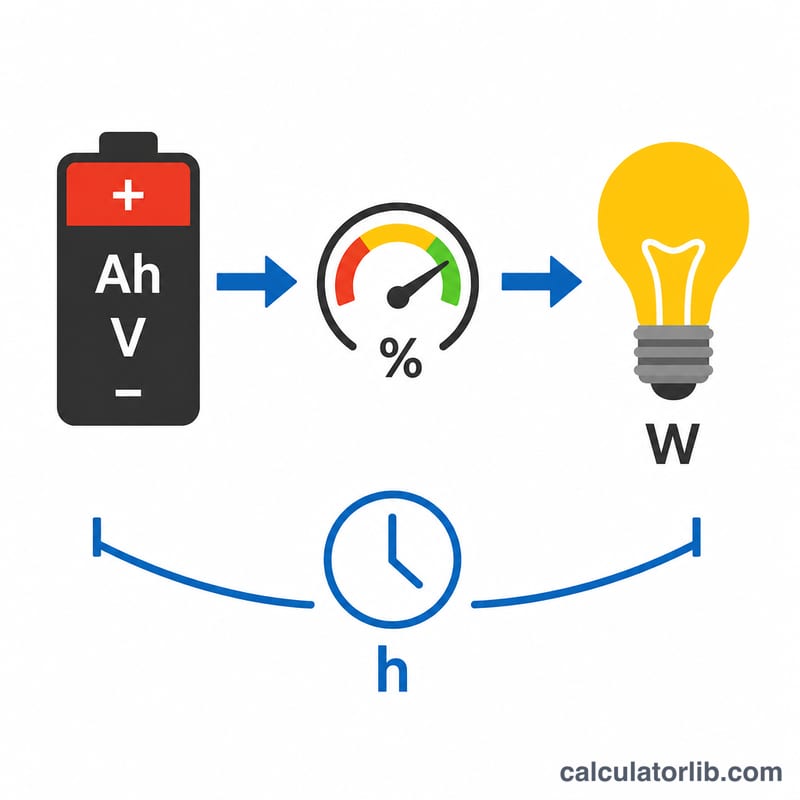
This calculator estimates how many hours a battery can power an appliance or device. It converts the battery's amp-hour (Ah) capacity into usable watt-hours using the battery voltage and a system efficiency factor, then divides by the appliance load measured in watts. It works for any battery chemistry and any 12V, 24V, or 48V system as long as you know the load.
How to Use It
Enter the battery capacity in amp-hours, the nominal battery voltage, the power draw of the appliance in watts, and a system efficiency percentage. Efficiency accounts for inverter losses, wiring losses, and the fact that you should not fully discharge most batteries — a typical value is 80–90%. The result shows total runtime in hours and a friendly hours-and-minutes breakdown.
The Formula Explained
$$\text{Runtime (hours)} = \frac{\text{Ah} \times \text{Voltage} \times \text{Efficiency}}{\text{Load Watts}}$$ The numerator \(\text{Ah} \times \text{Voltage}\) gives the nominal stored energy in watt-hours; multiplying by efficiency gives the energy you can actually deliver to the load. Dividing usable watt-hours by the appliance's wattage gives the time it can sustain that draw.
Worked Example
A 100 Ah, 12V battery powers a 60W appliance at 85% efficiency. Usable energy = $$100 \times 12 \times 0.85 = 1{,}020 \text{ Wh}.$$ Runtime = $$1{,}020 \div 60 = 17 \text{ hours}.$$ So the appliance runs for about 17 hours, or 17 h 0 min.
Runtime Across Common Battery & Load Scenarios
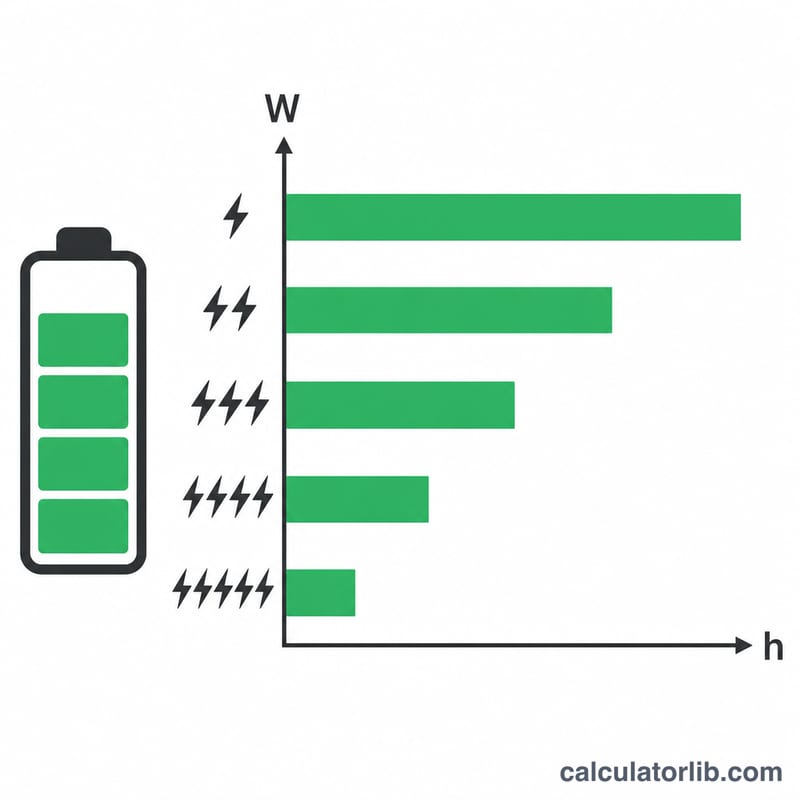
The table below shows estimated runtime in hours using the formula \(\text{Runtime} = \dfrac{\text{Ah} \times \text{V} \times (\text{Efficiency}/100)}{\text{Load (W)}}\), with efficiency fixed at 85%. Each block lists the usable energy of the battery (Ah × V × 0.85) and the runtime for four common loads. Note that runtime depends only on total watt-hours and load — a 100Ah/12V bank and a 50Ah/24V bank both store the same energy and last the same time.
| Battery | Usable Wh (85%) | 60 W | 150 W | 500 W | 1000 W |
|---|---|---|---|---|---|
| 50 Ah @ 12 V | 510 Wh | 8.5 h | 3.4 h | 1.0 h | 0.5 h |
| 100 Ah @ 12 V | 1020 Wh | 17.0 h | 6.8 h | 2.04 h | 1.02 h |
| 200 Ah @ 12 V | 2040 Wh | 34.0 h | 13.6 h | 4.08 h | 2.04 h |
| 100 Ah @ 24 V | 2040 Wh | 34.0 h | 13.6 h | 4.08 h | 2.04 h |
| 200 Ah @ 24 V | 4080 Wh | 68.0 h | 27.2 h | 8.16 h | 4.08 h |
| 100 Ah @ 48 V | 4080 Wh | 68.0 h | 27.2 h | 8.16 h | 4.08 h |
| 200 Ah @ 48 V | 8160 Wh | 136.0 h | 54.4 h | 16.32 h | 8.16 h |
These figures assume you can draw the full usable capacity; for lead-acid batteries you should apply a depth-of-discharge limit (see the chemistry table below), which reduces real-world runtime.
Typical Power Draw of Common Appliances
Use these typical running-wattage figures to estimate the Load (W) input. Actual draw varies by model, size and settings; appliances with motors or heating elements (fridges, pumps, microwaves, heaters) can briefly surge to several times their running wattage at startup. When several devices run at once, add their wattages together.
| Appliance / Device | Typical Running Power |
|---|---|
| LED light bulb | 8–12 W |
| Wi-Fi router / modem | 10–20 W |
| Phone charger | 5–20 W |
| Laptop | 40–80 W |
| LED TV (40–55") | 60–120 W |
| Ceiling fan | 50–75 W |
| Mini fridge | 50–100 W |
| Full-size refrigerator | 100–200 W (running) |
| Desktop computer | 150–300 W |
| CPAP machine | 30–60 W |
| Microwave oven | 800–1200 W |
| Coffee maker | 800–1200 W |
| Toaster | 800–1500 W |
| Space heater | 1000–1500 W |
| Hair dryer | 1200–1875 W |
| Window air conditioner | 500–1500 W |
For example, running a 100 W mini fridge plus two 10 W LED bulbs gives a 120 W load. On a 100 Ah, 12 V battery at 85% efficiency that lasts about 8.5 hours.
Typical Efficiency & Depth-of-Discharge Values
Two factors reduce how much of a battery's nameplate capacity you can actually use for runtime: depth of discharge (DoD) — how far the chemistry can be safely drained without shortening its life — and conversion efficiency — losses in the inverter, wiring and battery itself when delivering power.
| Battery Chemistry | Recommended Usable DoD | Notes |
|---|---|---|
| Flooded lead-acid | ~50% | Discharging below 50% sharply shortens cycle life. |
| AGM / sealed lead-acid | ~50–60% | Slightly deeper discharge tolerated than flooded. |
| Gel | ~50–60% | Similar to AGM; sensitive to high charge rates. |
| LiFePO4 (lithium iron phosphate) | ~80–90% | Can be deeply cycled with minimal life impact. |
| Conversion Stage | Typical Efficiency |
|---|---|
| Pure sine-wave inverter (DC→AC) | 85–92% |
| Modified sine-wave inverter | 80–85% |
| DC-to-DC (no inverter, e.g. 12 V loads) | 90–95% |
Combining the two factors: The Efficiency (%) field in this calculator should reflect the conversion losses for your setup (around 85–90% for a typical inverter). To account for DoD, multiply your battery's rated capacity by the usable fraction before entering it. For example, a 100 Ah flooded lead-acid battery used to 50% DoD behaves like a 50 Ah usable battery; entered with 85% inverter efficiency at 12 V powering a 150 W load it lasts about 3.4 hours, versus a LiFePO4 battery at 90% DoD (90 Ah usable) which would run roughly twice as long. Using the full 100 Ah in the calculator gives the theoretical maximum, not the recommended real-world runtime.
This is general guidance; always follow the manufacturer's specifications for your specific battery and inverter.
FAQ
Why use an efficiency factor? Inverters and wiring waste some energy as heat, and deep discharge can damage batteries. Efficiency captures these losses so the estimate is realistic.
What voltage should I enter? Use the battery's nominal voltage — 12V for a single lead-acid/LiFePO4 battery, 24V or 48V for series banks.
Is the runtime exact? No. Real runtime varies with temperature, battery age, and discharge rate (Peukert effect). Treat the result as a solid planning estimate.