
What is a summation (sigma) calculator?
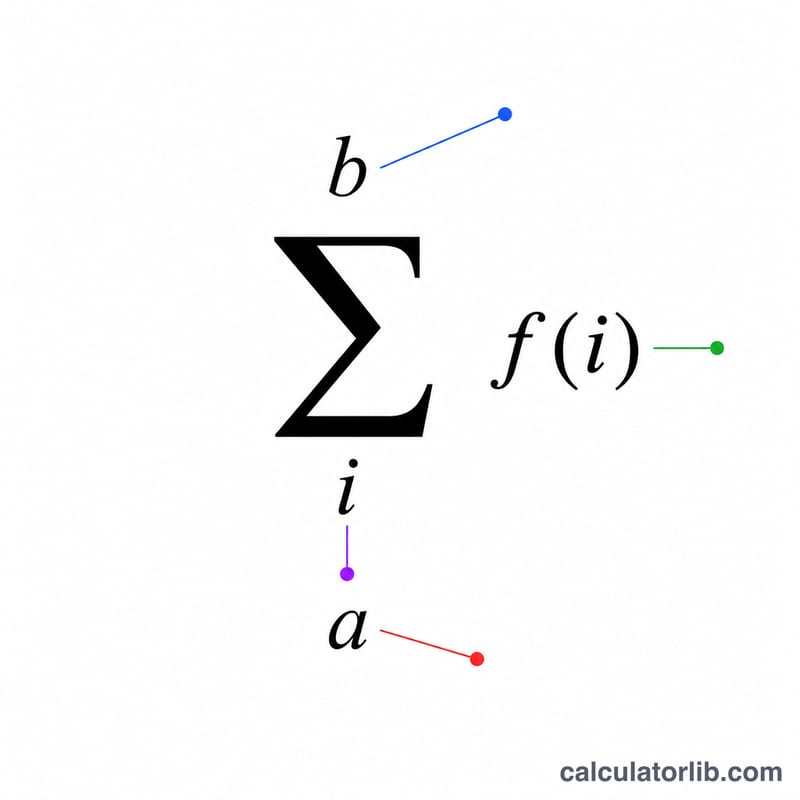
Sigma notation, written Σ, is a compact way to express the sum of many terms. The expression \( \sum_{i=a}^{b} f(i) \) means: evaluate \( f(i) \) for every integer \( i \) starting at the lower limit \( a \) and ending at the upper limit \( b \), then add all those values together. This calculator evaluates that sum for several common expressions — \( i \), \( i^2 \) (squares), \( i^3 \) (cubes), \( c \cdot i \), and a constant \( c \) — so you can check homework, verify formulas, or get a quick total without writing every term by hand.
How to use it
Pick the expression type for \( f(i) \). If you choose \( c \cdot i \) or \( c \), enter the constant \( c \). Then set the lower limit \( a \) and upper limit \( b \) (both integers, with \( b \ge a \)). The calculator loops through each integer \( i \) in that range, computes \( f(i) \), and reports the total along with the number of terms it added.
The formula explained
The general definition is $$ \sum_{i=a}^{b} f(i) = f(a) + f(a+1) + \dots + f(b). $$ Closed-form shortcuts exist for the most common cases: the sum of the first \( n \) integers is \( \frac{n(n+1)}{2} \), the sum of squares is \( \frac{n(n+1)(2n+1)}{6} \), and the sum of cubes is \( \left[\frac{n(n+1)}{2}\right]^2 \). This tool computes the result by direct iteration, which matches those formulas exactly.
Worked example
Compute \( \sum_{i=1}^{5} i^2 \). The terms are $$ 1 + 4 + 9 + 16 + 25 = 55. $$ Using the closed form: $$ \frac{5 \cdot 6 \cdot 11}{6} = \frac{330}{6} = 55. $$ The calculator returns 55 with 5 terms.
FAQ
Can the limits be negative? Yes — \( a \) and \( b \) can be any integers as long as \( b \ge a \). The loop simply runs from \( a \) up to \( b \).
What does the "constant" type do? Choosing \( c \) sums the same value \( c \) once for each integer in the range, so the result is \( c \times (\text{number of terms}) \).
Why is the result 0? If \( b \) is less than \( a \) there are no terms to add, so the sum is 0.