
What is a Linear Equation Solver?
A linear equation in one variable has the standard form \(ax + b = c\), where a, b and c are known numbers and x is the unknown you want to find. This solver takes those three coefficients and returns the exact value of x. It works for any real numbers — positive, negative, whole or decimal — as long as the coefficient a is not zero.
How to use it
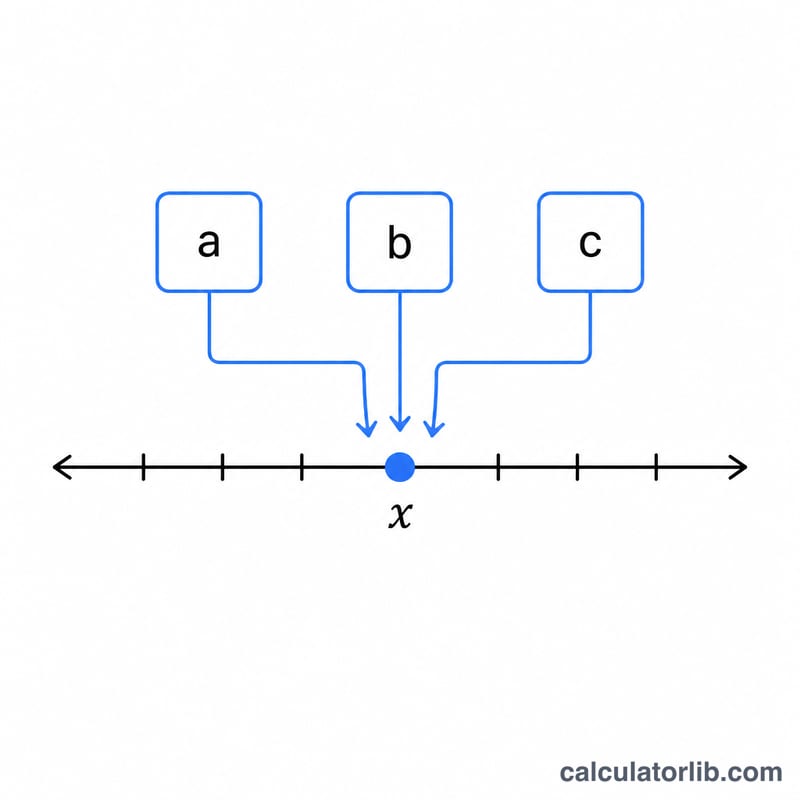
Enter the three values from your equation: a (the number multiplying x), b (the constant added on the left), and c (the value on the right of the equals sign). Press calculate and the tool returns x. If your equation isn't yet in standard form, rearrange it first so that all the x terms are on the left and the plain numbers are on the right.
The formula explained
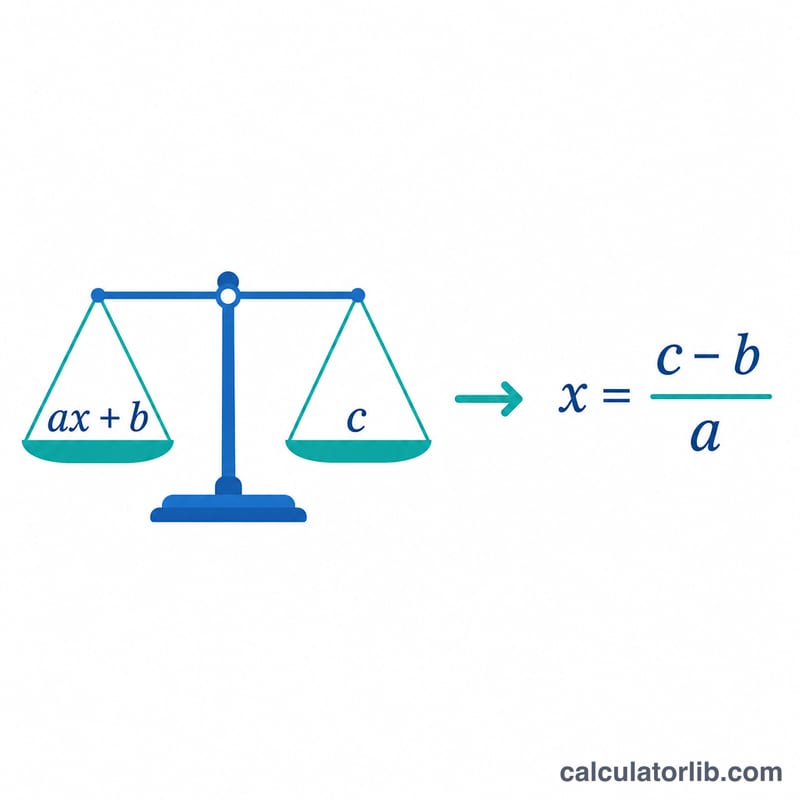
Starting from \(ax + b = c\), subtract b from both sides to get \(ax = c - b\). Then divide both sides by a, giving the formula:
$$x = \frac{c - b}{a}$$Division by a is only valid when \(a \neq 0\). If \(a = 0\) the equation is no longer linear in x: it is either always true (when \(b = c\)) or has no solution.
Worked example
Solve \(2x + 3 = 11\). Here \(a = 2\), \(b = 3\), \(c = 11\). Subtract 3: \(2x = 8\). Divide by 2: \(x = 4\). The calculator confirms $$x = \frac{11 - 3}{2} = 4.$$
FAQ
What if a is zero? The equation is no longer a standard linear equation in x — there is either no unique solution or infinitely many, so the solver returns 0 as a placeholder.
Can I use negative or decimal values? Yes. Any real numbers work for a, b and c.
How do I handle \(ax - b = c\)? That's the same as \(ax + (-b) = c\), so just enter b as a negative number.