
What is the rule of three?
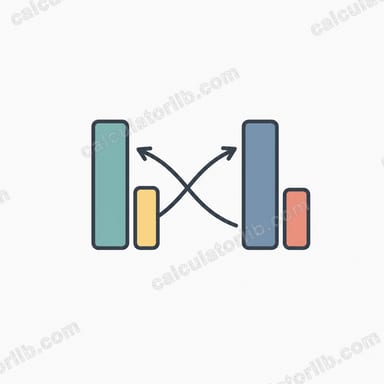
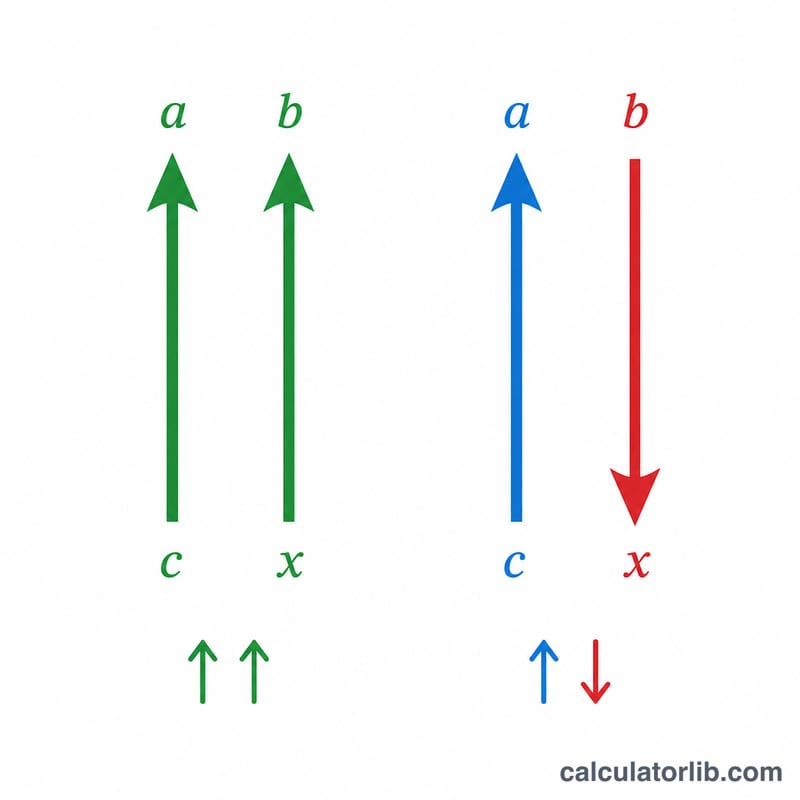
The rule of three is a classic method for solving proportions: given three known values, you find a fourth unknown. It comes in two flavours. In a direct proportion the two quantities grow or shrink together — more apples cost more money. In an inverse proportion one quantity rises while the other falls — more workers means less time to finish a job.
How to use this calculator
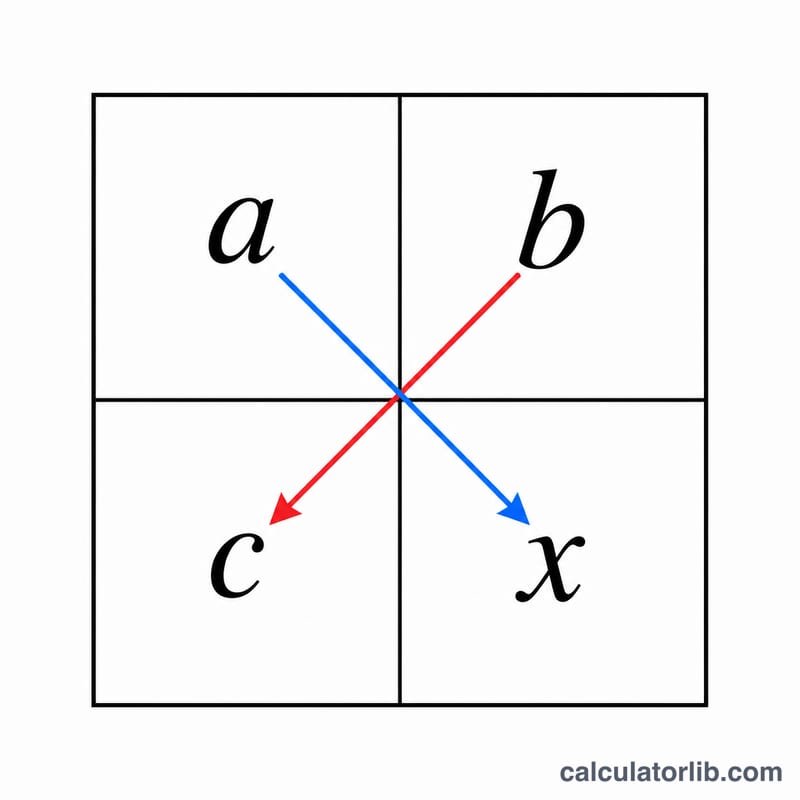
Set up your statement as "a corresponds to b, and c corresponds to x". Enter the three known numbers a, b and c, choose Direct or Inverse, and the calculator returns x instantly.
The formula explained
For a direct proportion the ratios stay equal: \(a/b = c/x\), which rearranges to $$x = \frac{b \cdot c}{a}$$ For an inverse proportion the products stay equal: \(a \cdot b = c \cdot x\), giving $$x = \frac{a \cdot b}{c}$$ Choosing the correct relationship is the only modelling decision you have to make.
Worked example
If 2 kg of flour makes 10 loaves, how many loaves come from 5 kg? This is direct: \(a=2\), \(b=10\), \(c=5\), so $$x = \frac{10 \cdot 5}{2} = 25 \text{ loaves}$$ Now an inverse case: 4 workers finish a wall in 6 hours; how long for 3 workers? \(a=4\), \(b=6\), \(c=3\), so $$x = \frac{4 \cdot 6}{3} = 8 \text{ hours}$$
FAQ
How do I know if it's direct or inverse? Ask: if c increases, should x increase too? If yes, it's direct; if x should decrease, it's inverse.
Can I use decimals? Yes, any positive or negative real numbers work.
Why do I get 0? The denominator (a for direct, c for inverse) cannot be zero — division by zero is undefined, so the calculator returns 0 as a guard.