
What is the PERC Rule?
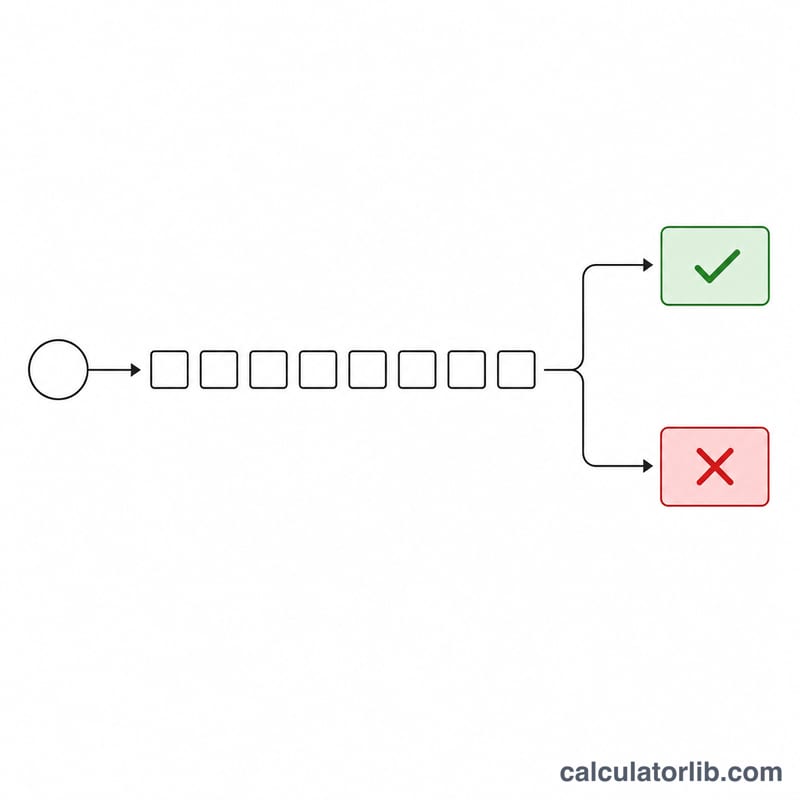
The Pulmonary Embolism Rule-out Criteria (PERC) is a clinical decision tool used in patients who are already judged to be at low pre-test probability for pulmonary embolism (PE). If a low-risk patient satisfies all eight PERC criteria, PE can be safely ruled out without further testing such as D-dimer or CT angiography, avoiding unnecessary radiation, cost, and false positives.
The 8 criteria
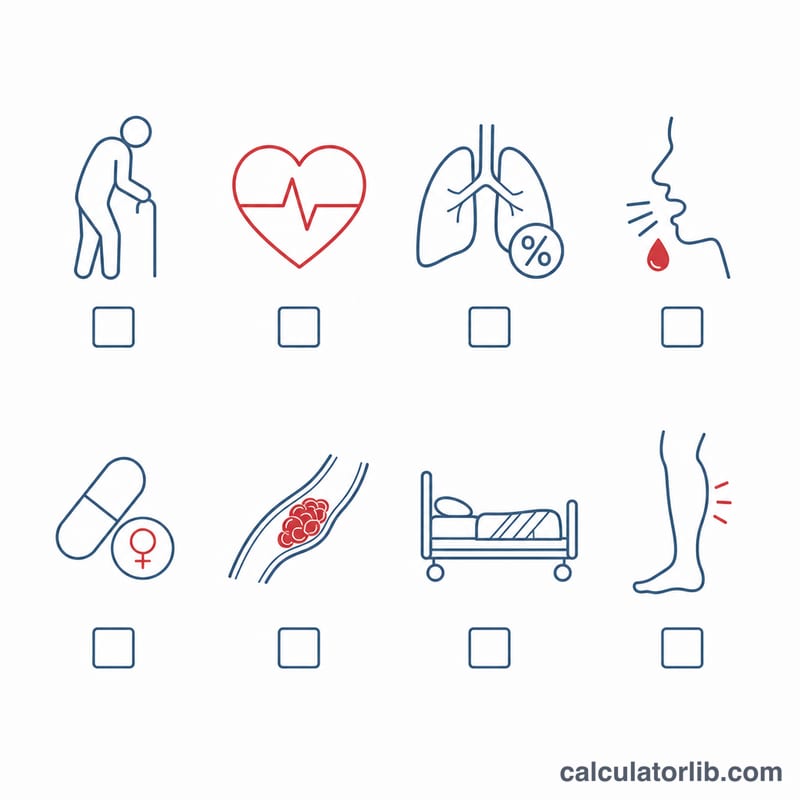
A criterion is considered negative (good) when: age is under 50, heart rate is under 100 bpm, oxygen saturation on room air is at least 95%, there is no hemoptysis, no estrogen use (oral contraceptives or HRT), no prior DVT or PE, no surgery or trauma requiring hospitalization within the last 4 weeks, and no unilateral leg swelling. All eight must be negative for the rule to be satisfied.
$$\text{PERC failed} = \sum \left[ \begin{gathered} \text{Age} \geq 50 \;+\; \text{HR} \geq 100 \;+\; \text{SpO}_2 < 95 \\[0.4em] +\; \text{Hemoptysis} \;+\; \text{Estrogen} \;+\; \text{Prior VTE} \\[0.4em] +\; \text{Surgery/Trauma} \;+\; \text{Leg swelling} \end{gathered} \right]$$
How to use it
Enter the patient's age, heart rate, and room-air SpO2, then answer the five yes/no questions. The calculator counts how many criteria are positive. Zero positive means PERC negative — PE excluded. One or more positive means PERC positive — the rule cannot exclude PE and further workup should be considered.
Worked example
A 42-year-old with heart rate 78, SpO2 98%, and no risk factors: all 8 criteria are negative, so the result is PERC negative and PE is ruled out. If that same patient were 55 with a heart rate of 105, two criteria become positive, making the result PERC positive.
$$\text{PERC failed} = (\text{Age} \geq 50) + (\text{HR} \geq 100) = 1 + 1 = 2$$
FAQ
Does PERC diagnose PE? No. It only rules out PE in low-risk patients; it never confirms a diagnosis.
Can I use PERC if the patient is high-risk? No. PERC is validated only for patients with low pre-test probability assessed clinically (e.g. gestalt or Wells low).
What if one criterion is positive? The rule fails — proceed with D-dimer or imaging as clinically appropriate. This tool is educational and not a substitute for clinical judgement.