
What Is the Rule of 72?
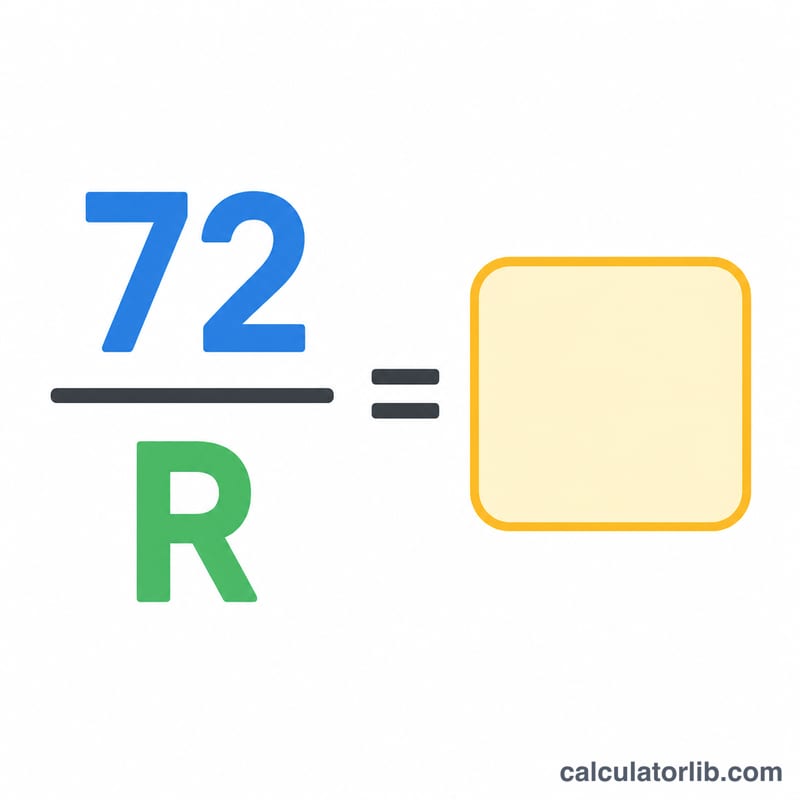
The Rule of 72 is a quick mental-math shortcut for estimating how long it takes an investment to double at a fixed annual compound rate of return. You simply divide 72 by the annual percentage rate. At 8% a year, money doubles in roughly \(72 / 8 = 9\) years. The rule is pure finance math, so it works in any country and currency. This calculator also computes the exact compound-interest answer so you can see how close the approximation is.
How to Use This Calculator
Pick a Solve For direction. Choose "Years to double" and enter your expected Annual Interest / Return Rate as a whole percent (8 means 8%). Or choose "Rate to double" and enter the Number of Years you have, and the tool returns the annual return you would need. The optional Rule Number lets you swap 72 for 70 (popular for inflation and demographics) or 69.3 (mathematically closest to \(\ln(2)\cdot 100\)).
The Formula Explained
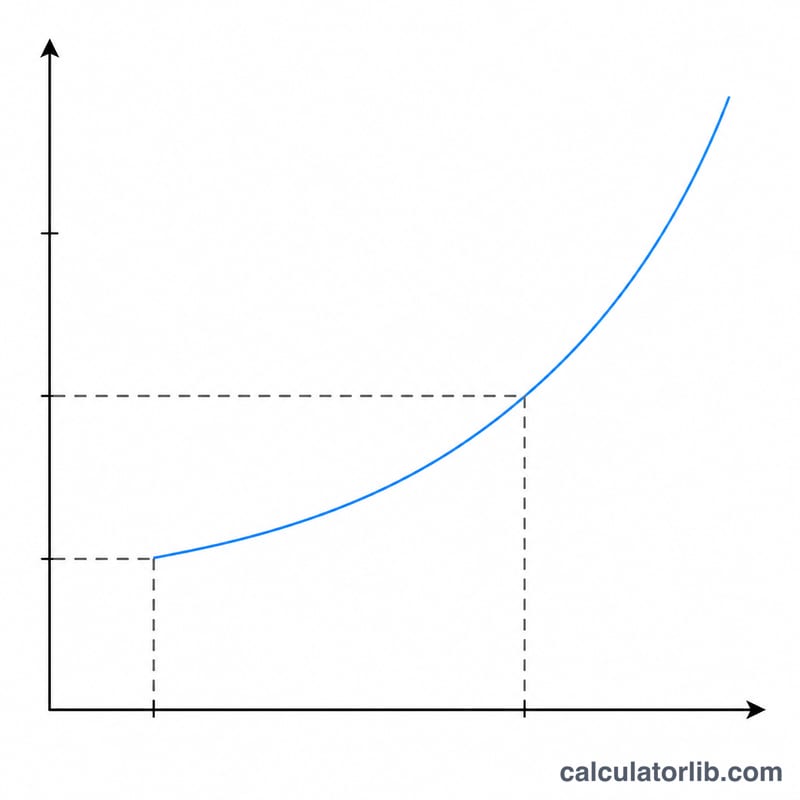
For compound growth the exact doubling time is $$t = \frac{\ln 2}{\ln(1 + r)},$$ where \(r\) is the rate as a decimal. Because \(\ln 2\) is about 0.693, for small rates this simplifies to $$t \approx \frac{69.3}{R}$$ when \(R\) is a percent. The number 72 is used instead of 69.3 because it divides cleanly by 2, 3, 4, 6, 8, 9 and 12, and it is slightly more accurate in the typical 6-10% investment range.
Worked Example
Suppose your portfolio earns 8% per year. $$\text{Years to double} = \frac{72}{8} = 9.00 \text{ years}.$$ The exact compound answer is $$\frac{\ln 2}{\ln(1.08)} = \frac{0.693147}{0.076961} = 9.01 \text{ years}$$ - the approximation is excellent here. To double in 6 years instead, the rule says you need \(72 / 6 = 12\%\) a year (exact: \(2^{1/6} - 1 = 12.25\%\)).
FAQ
How accurate is the Rule of 72? It is most accurate for rates between about 6% and 10%. Far outside that band it drifts from the exact value, which is why this tool always shows the precise compound figure for comparison.
When should I use the Rule of 70? Use 70 (or 69.3) for very small rates such as inflation or population growth, where it tracks the exact logarithmic value more closely.
What if the rate is 0%? An investment with 0% growth never doubles, so the doubling time is infinite. The same applies to negative rates, which shrink rather than grow your money.