
What Is the Rule of 70?
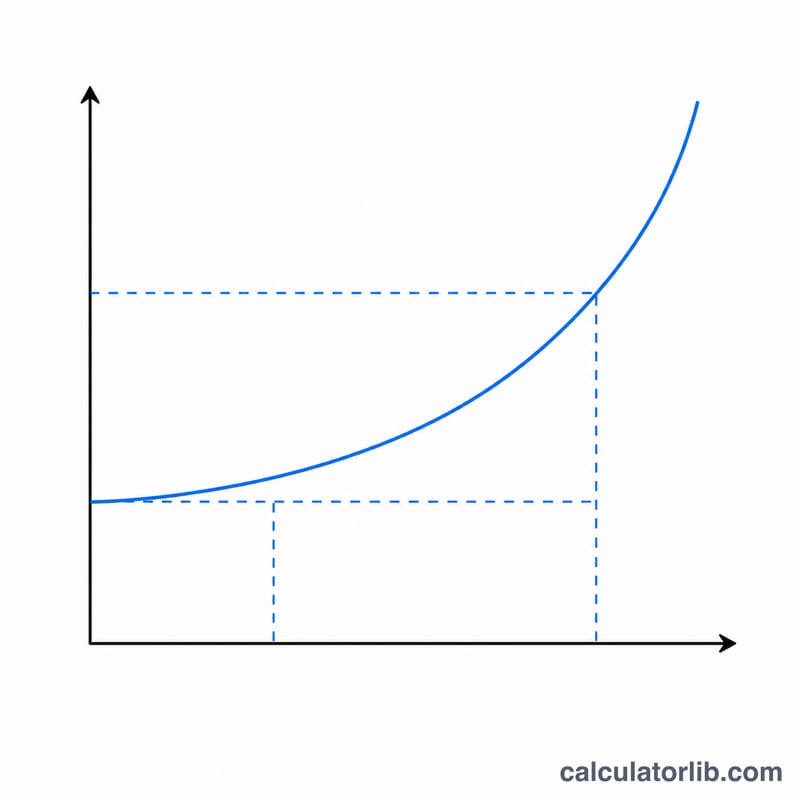
The Rule of 70 is a quick mental-math shortcut for estimating how long it takes a quantity that grows at a constant rate to double in size. Divide 70 by the percentage growth rate per period and the result is the approximate number of periods needed to double. It is widely used in finance to gauge investment growth, in economics to study GDP and population, and anywhere compound growth applies.
How to Use This Calculator
Enter the constant growth rate per period as a percentage — for example, enter 7 for 7% annual return. The calculator divides 70 by that rate and returns the doubling time in the same period units (usually years). The smaller the rate, the longer it takes to double.
The Formula Explained
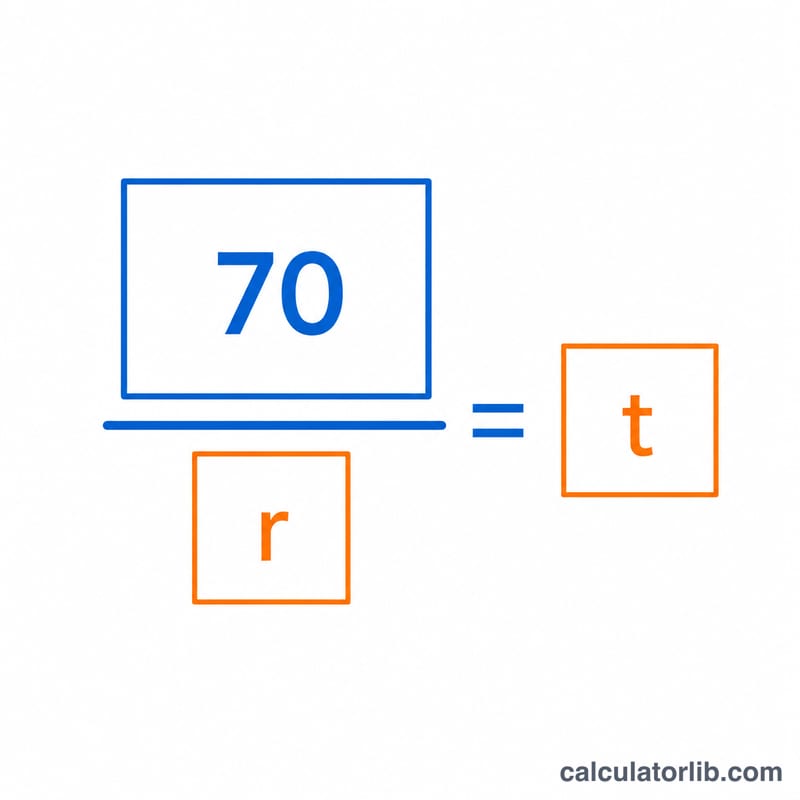
The formula is $$t = \frac{70}{r}$$ where t is the doubling time and r is the growth rate in percent. It is derived from the natural log of 2 (≈0.693) divided by the growth rate; multiplying by 100 and rounding 69.3 up to 70 gives an easy, memorable number. Related shortcuts include the Rule of 72 (better for typical interest rates) and the Rule of 69.3 (most accurate for continuous compounding).
Worked Example
Suppose your savings earn 5% per year. Doubling time $$= \frac{70}{5} = 14 \text{ years}$$ At 10%, it would be \( \frac{70}{10} = 7 \) years. So doubling the return roughly halves the time to double your money.
FAQ
Is the Rule of 70 exact? No, it is an approximation. It works best for growth rates between about 2% and 10%.
Should I use the Rule of 70 or 72? Both are estimates; 72 has more divisors and is slightly more accurate for common interest rates, while 70 is closer for continuous growth.
Can I use it for any growth? Yes — any constant compound growth such as inflation, population, or revenue, as long as the rate is positive.