
What is the Rule of 72?
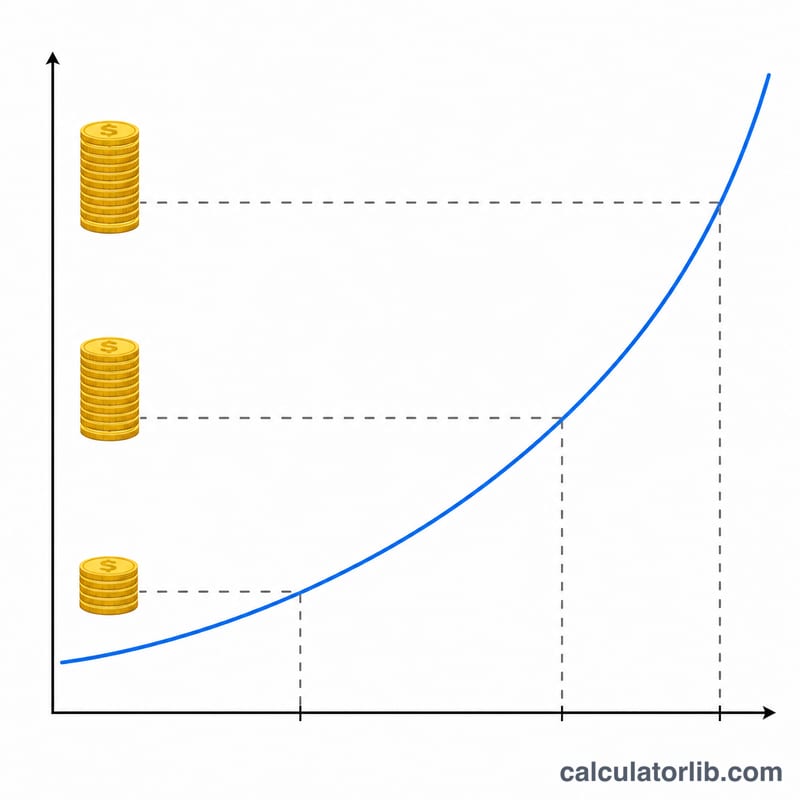
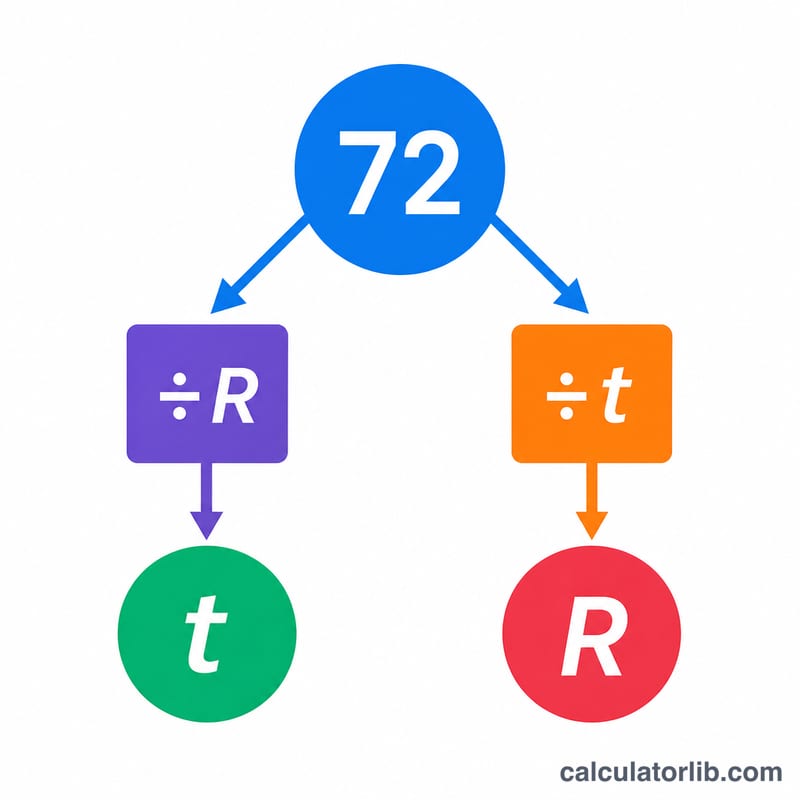
The Rule of 72 is a fast mental shortcut for estimating how long it takes an investment to double at a fixed compound interest rate. You simply divide 72 by the annual interest rate (as a percentage). For example, at 8% a year your money doubles in roughly \(72 / 8 = 9\) years. The same relationship works in reverse: divide 72 by the number of years to find the rate you would need to double in that time.
How to use this calculator
Pick what you want to solve for in the "Calculate:" dropdown. Choose Number of Years and enter your annual rate to find the doubling time, or choose The Interest Rate and enter a number of years to find the rate required to double. The tool shows both the quick Rule-of-72 estimate and the exact compound-interest answer so you can see how close the shortcut is.
The formula explained
The Rule of 72 comes from the relation \(R \times t = 72\), where \(R\) is the rate per period as a percentage and \(t\) is the number of periods. Solving gives
$$t = \frac{72}{R} \qquad R = \frac{72}{t}$$The exact result instead solves the true doubling equation \(2 = (1 + r)^t\), where \(r = R / 100\). That yields
$$t = \frac{\ln 2}{\ln(1 + r)} \qquad R = (2^{1/t} - 1)\times 100$$for time and rate respectively. The Rule of 72 is most accurate for rates around 6 to 10 percent.
Worked example
At a rate of 5.25%, the Rule of 72 gives
$$\frac{72}{5.25} = 13.71 \text{ years}$$to double. The exact compound calculation gives
$$\frac{\ln 2}{\ln(1.0525)} = 13.55 \text{ years}$$The estimate is within about two months of the precise answer, illustrating why the rule is so popular.
FAQ
Why 72 and not another number? 72 has many small divisors (2, 3, 4, 6, 8, 9, 12) making division easy, and it closely matches the exact math for typical interest rates.
Does the period have to be years? No. As long as the rate compounds once per period, the "years" can be any consistent unit such as months or quarters; the rate must match that period.
Why show an exact value too? The Rule of 72 is an approximation. At very high or very low rates the shortcut drifts, so the exact compound value keeps you honest.