What this sales calculator does
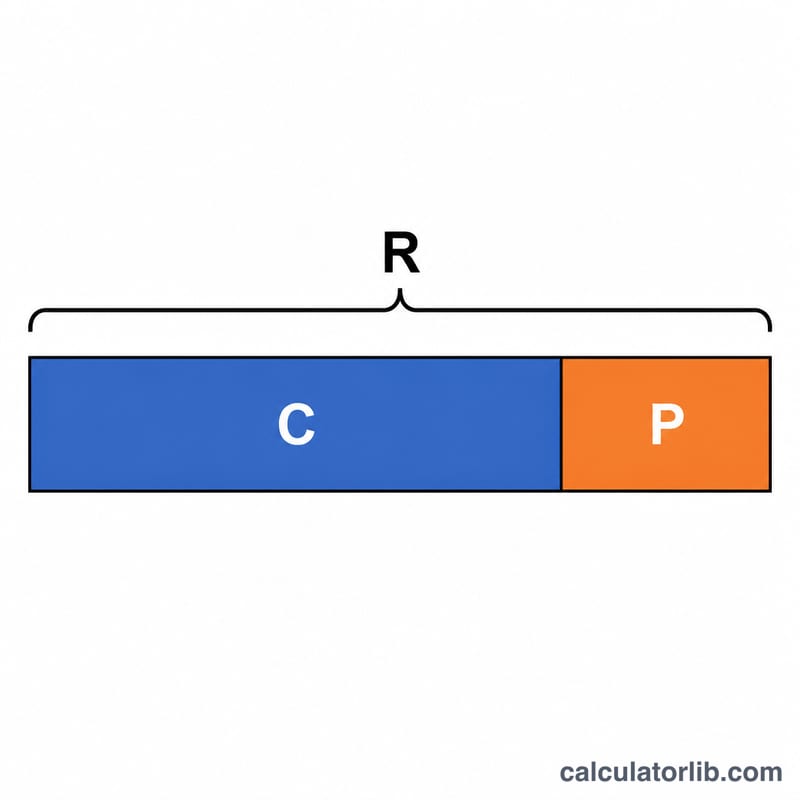
This tool works with the five core figures of any single sale or product line: Cost (\(C\)), Revenue or selling price (\(R\)), Gross Profit (\(P\)), Gross Margin (\(G\), a percent of revenue) and Mark Up (\(M\), a percent of cost). Supply any two of them — as long as at least one is a dollar amount — and the calculator instantly returns the other three, so you always see all five together.
How to use it
Pick the pair you already know from the dropdown, for example "Cost and Margin." Enter your first value in field A and your second in field B (dollar fields are plain amounts, percent fields are entered as numbers like 25 for 25%). Press calculate and read off the full breakdown. Margin and markup cannot be combined on their own because two percentages never pin down an actual dollar figure.
The formulas explained
Everything follows from three relations: profit is revenue minus cost (\(P = R - C\)), gross margin is profit divided by revenue (\(G = \frac{P}{R}\)), and markup is profit divided by cost (\(M = \frac{P}{C}\)). Percentages are converted to fractions first (\(g = G/100\), \(m = M/100\)). A handy rearrangement: if you know cost and margin, \(R = \frac{C}{1 - g}\); if you know revenue and markup, \(C = \frac{R}{1 + m}\).
Worked example
Suppose your cost is $100 and you want a 25% gross margin. Then \(g = 0.25\), $$R = \frac{100}{1 - 0.25} = \frac{100}{0.75} = \$133.33$$ Gross profit $$P = 133.33 - 100 = \$33.33$$ and markup $$M = \frac{33.33}{100} = 33.33\%$$ So a 25% margin corresponds to a 33.33% markup on cost.
Margin to Markup Conversion Table
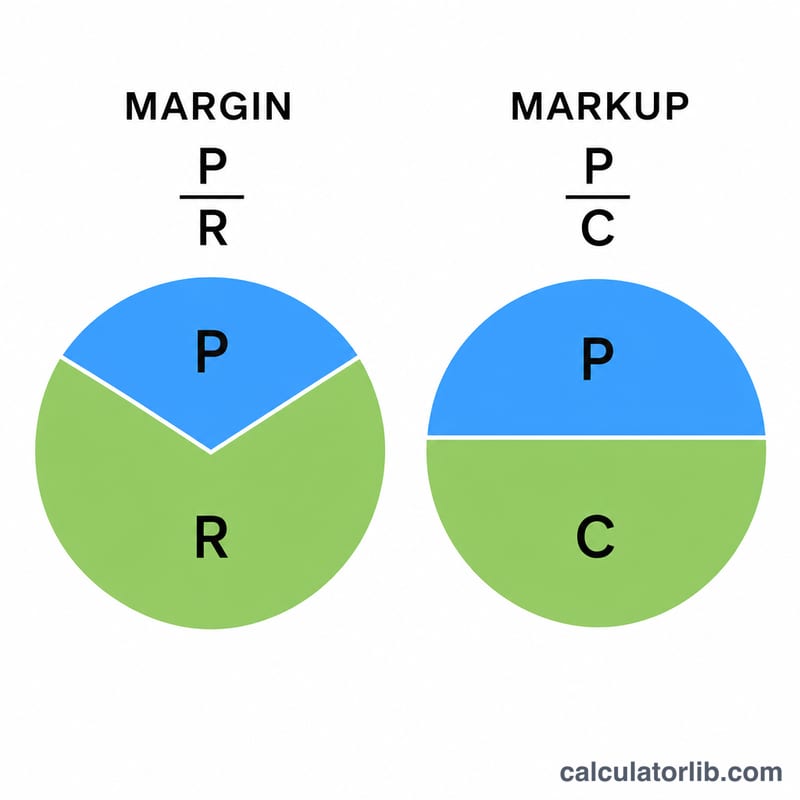
Gross margin and markup describe the same profit from two different bases. Margin divides profit by revenue, and markup divides profit by cost. Because cost is always smaller than revenue, markup is always larger than margin for the same sale.
Conversion formulas, with margin \(G\) and markup \(M\) as decimals:
$$M = \frac{G}{1-G} \qquad G = \frac{M}{1+M} \qquad \text{Price multiplier on cost} = \frac{1}{1-G} = 1+M$$
| Gross margin | Equivalent markup | Multiplier on cost (1/(1−g)) |
|---|---|---|
| 10% | 11.11% | 1.1111 |
| 20% | 25% | 1.25 |
| 25% | 33.33% | 1.3333 |
| 30% | 42.86% | 1.4286 |
| 40% | 66.67% | 1.6667 |
| 50% | 100% | 2 |
| 60% | 150% | 2.5 |
| 75% | 300% | 4 |
Example: a 40% margin gives \(M = \frac{0.40}{1-0.40} = 0.6667\), which is a 66.67% markup. Going back, \(G = \frac{0.6667}{1+0.6667} = 0.40\). A margin can never reach 100%, but a markup can exceed 100%.
Scenario Comparison: Same Cost, Different Margins
Cost is fixed at $100. Revenue is \(R = \frac{C}{1-g}\), profit is \(R - C\), and markup is \(\frac{\text{Profit}}{C}\).
| Cost | Target margin | Revenue | Gross profit | Markup |
|---|---|---|---|---|
| $100.00 | 20% | $125.00 | $25.00 | 25% |
| $100.00 | 30% | $142.86 | $42.86 | 42.86% |
| $100.00 | 40% | $166.67 | $66.67 | 66.67% |
| $100.00 | 50% | $200.00 | $100.00 | 100% |
Worked check for the 40% row: \(R = \frac{100}{1-0.40} = \frac{100}{0.60} = 166.67\), profit \(= 166.67 - 100 = 66.67\), markup \(= \frac{66.67}{100} = 66.67\%\).
Using revenue and profit as the known pair
| Revenue | Profit | Cost (R − profit) | Margin | Markup |
|---|---|---|---|---|
| $250.00 | $100.00 | $150.00 | 40% | 66.67% |
| $80.00 | $20.00 | $60.00 | 25% | 33.33% |
Each 10-point rise in margin needs a progressively larger rise in markup, so going from 40% to 50% margin means moving markup from 66.67% to 100%.
Key Terms: Cost, Revenue, Gross Profit, Margin, Markup
- Cost
- What it costs you to obtain or produce the item: unit cost or cost of goods sold (COGS). It typically includes materials, direct labor and inbound freight, but not overhead.
- Revenue
- The amount the customer pays, i.e. the selling price (per unit) or total sales (for many units), before any costs are subtracted.
- Gross profit
- Revenue minus cost: \(\text{Profit} = R - C\). It is calculated before overhead, operating expenses, interest and taxes.
- Gross margin
- Gross profit as a share of revenue: \(g = \frac{\text{Profit}}{R}\). A 30% margin means 30 cents of every revenue dollar is gross profit.
- Markup
- Gross profit as a share of cost: \(m = \frac{\text{Profit}}{C}\). A 50% markup means the price is cost plus half of cost.
Gross versus net: all of these figures are gross. They exclude operating expenses (rent, wages, marketing), interest and taxes, so they are higher than net profit. A healthy gross margin must be large enough to cover those expenses and still leave a net profit.
FAQ
What is the difference between margin and markup? Margin measures profit against the selling price (revenue), while markup measures the same profit against your cost. Markup is always the larger percentage.
Why can't I enter only margin and markup? Two percentages describe the relationship between cost and price but contain no actual money, so no dollar figures can be derived. At least one of cost, revenue or profit is required.
Can profit be negative? Yes. If revenue is below cost the calculator returns a negative profit, margin and markup, representing a loss.