
What this calculator does
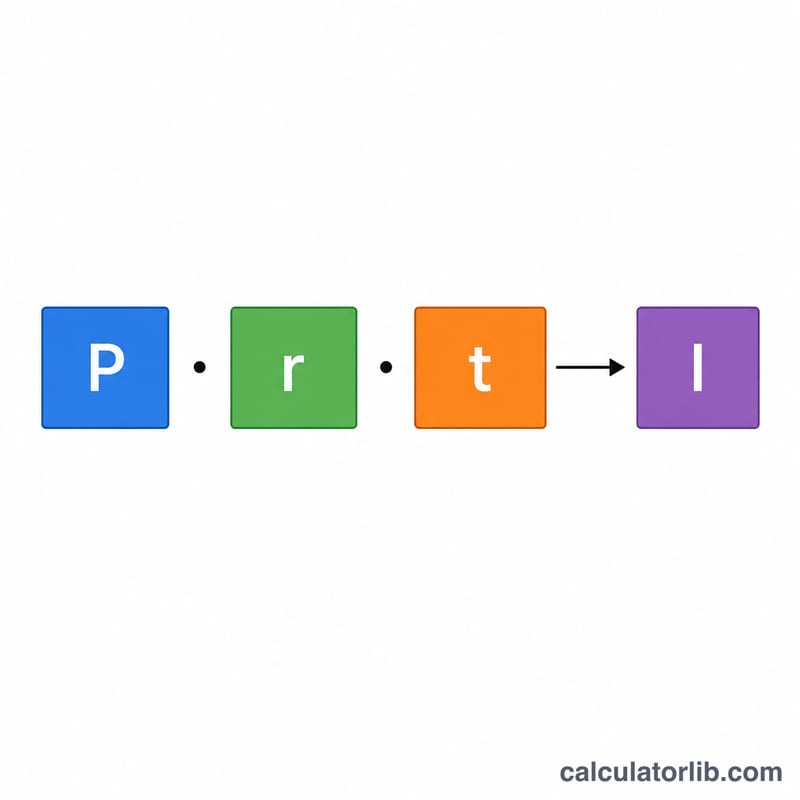
This tool works the simple-interest equation \(I = P \cdot r \cdot t\) in any direction. Pick which of the four quantities you want to find — Interest (I), Principal (P), Rate (R) or Time (t) — enter the other three, and the calculator returns the missing value. Simple interest is non-compounding: interest is charged only on the original principal, never on previously accrued interest. The math is universal, so it applies anywhere; the only regional convention exposed is the day-count basis (360-day vs 365-day year), which you select.
How to use it
Choose what to "Calculate". Enter the principal in currency units, the annual rate as a percent (type 1.5 for 1.5%), and the time as a number with its unit. Because the rate is annual, the time is always converted to years before computing: days are divided by 360 or 365, weeks by 52, months by 12, quarters by 4, and years left unchanged. The field for the quantity you are solving for is ignored.
The formula explained
Internally the rate becomes a decimal, \(r = R / 100\), and time becomes years, \(t = \text{entered\_time} / \text{divisor}\). Then: Interest $$I = P \cdot r \cdot t$$ Principal $$P = \frac{I}{r \cdot t}$$ Rate $$R = \frac{I}{P \cdot t} \cdot 100$$ Time t (years) $$t = \frac{I}{P \cdot r}$$ When solving for time, the result is converted back into the unit you picked.
Worked example
Lend $5,000 at 1.5% per year for 2 years. Convert: \(r = 1.5/100 = 0.015\), \(t = 2\) years. Then $$I = 5000 \cdot 0.015 \cdot 2 = \$150.00$$ Using days instead: $10,000 at 6% for 90 days on a 360-day basis gives \(t = 90/360 = 0.25\), so $$I = 10000 \cdot 0.06 \cdot 0.25 = \$150.00$$
FAQ
Does this compound? No. Simple interest is calculated once on the original principal only. For compounding use a compound-interest calculator.
Why does 360 vs 365 matter? The same number of days converts to a slightly different fraction of a year, changing the interest. Banks and money-market instruments often use 360; many consumer loans use 365.
How do I enter the rate? As a percent, not a decimal: enter 5 for 5%, and the tool divides by 100 for you.