

What this calculator does
The Salary to Hourly Wage Calculator turns an annual salary into the equivalent hourly rate and breaks that same salary down into weekly, biweekly, semi-monthly, monthly, quarterly and annual pay. It is pure arithmetic, so it applies anywhere; the dollar sign is cosmetic. You can also exclude paid time off (PTO) to see your "effective" hourly rate based on the hours you actually work.
How to use it
Enter your annual salary, then set your usual hours per week (default 40) and weeks per year (default 52). Tick "Exclude paid time off" to enter vacation days, holidays and other paid days off; the tool then computes your hourly rate on hours actually worked. Tick "Compare with and without PTO" to view both the standard and effective rates side by side.
The formula explained
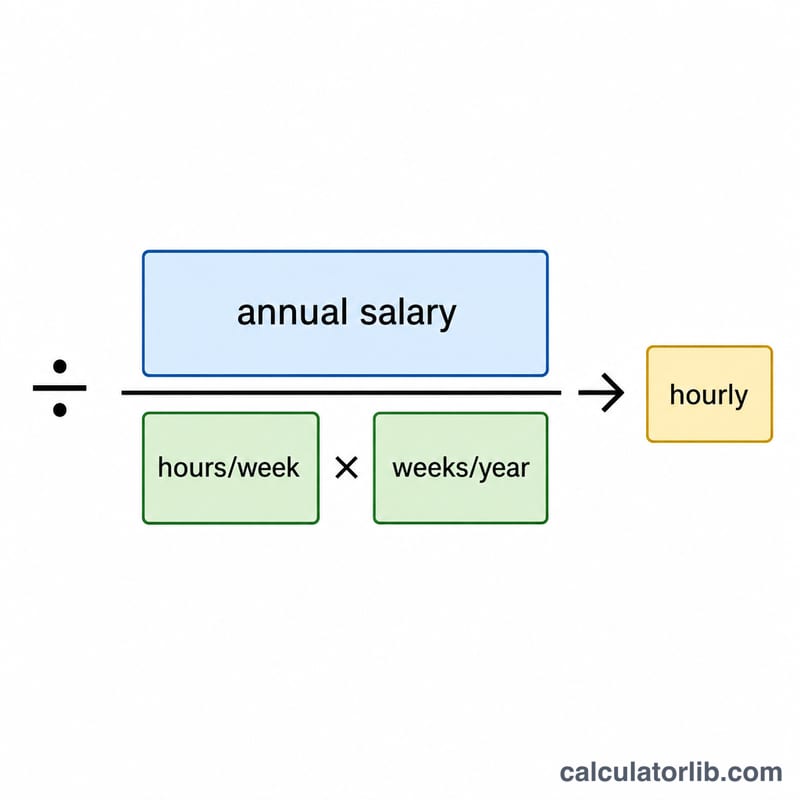
The standard hourly wage is simply salary ÷ (hours per week × weeks per year):
$$\text{Hourly} = \dfrac{\text{Annual Salary}}{\text{Hours/Week} \times \text{Weeks/Year}}$$
To handle PTO, each day off is converted to hours using hours per day = hours per week ÷ 5, assuming a five-day work week. Those PTO hours are subtracted from your scheduled hours, leaving the hours you actually work. Dividing salary by that smaller number gives a higher effective rate, because your pay is spread across fewer working hours:
$$\text{Effective} = \dfrac{\text{Salary}}{(\text{Hours/Week} \times \text{Weeks/Year}) - \text{PTO days} \times \frac{\text{Hours/Week}}{5}}$$
Worked example
A $50,000 salary at 40 hours/week and 52 weeks/year gives 2,080 hours, so the standard hourly wage is \(50{,}000 \div 2{,}080 = \$24.04\). Add 10 vacation days, 8 holidays and 5 other paid days (\(23 \text{ days} \times 8 \text{ hours} = 184\) PTO hours). Worked hours become \(2{,}080 - 184 = 1{,}896\), so the effective rate is \(50{,}000 \div 1{,}896 = \$26.37\) per hour worked.

FAQ
Why is the effective rate higher than the standard rate? Because PTO hours are paid but not worked, removing them from the denominator raises the value of each hour you actually put in.
Why divide PTO days by 5? A standard work week is five days, so hours per day is hours per week divided by five. This converts whole vacation/holiday days into hours.
Do the pay-period amounts change with PTO? No. Weekly, monthly and other pay-period figures are always based on the full annual salary; only the hourly rate is affected by excluding PTO.