
What is the Bingo Number Generator?
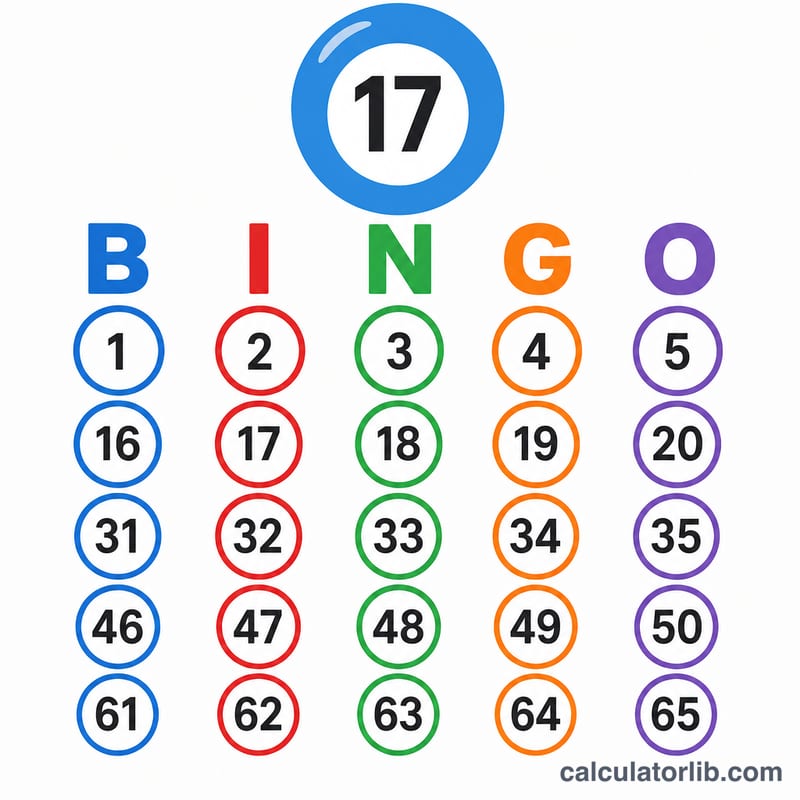
This Bingo Number Generator acts as a virtual Bingo caller. It randomly draws balls one at a time, without replacement, from a pool of either 1 to 75 (American Bingo, with B-I-N-G-O columns) or 1 to 90 (UK and Australian Bingo). Each drawn number is marked on a live call board so you can run a real game of Bingo with friends, classrooms, or events.
How to use it
Pick your number pool: 1 to 75 or 1 to 90. Press Start Game to build a fresh pool and clear the board. Then press Draw Ball to pull one random number. Keep pressing Draw Ball to call the next number; each ball is unique within a game and the board highlights every called number. The remaining-balls count tells you how many are left.
The formula explained
The draw uses uniform sampling without replacement. From the remaining pool of size \(r\), an index is chosen as $$\text{index} = \lfloor \text{random()} \times r \rfloor$$ where \(\text{random()}\) is in \([0,1)\), so the index is \(0 \ldots r-1\). The selected ball is removed from the pool so it cannot repeat. Over a full game this produces a uniform random permutation of \(1 \ldots \text{poolSize}\).
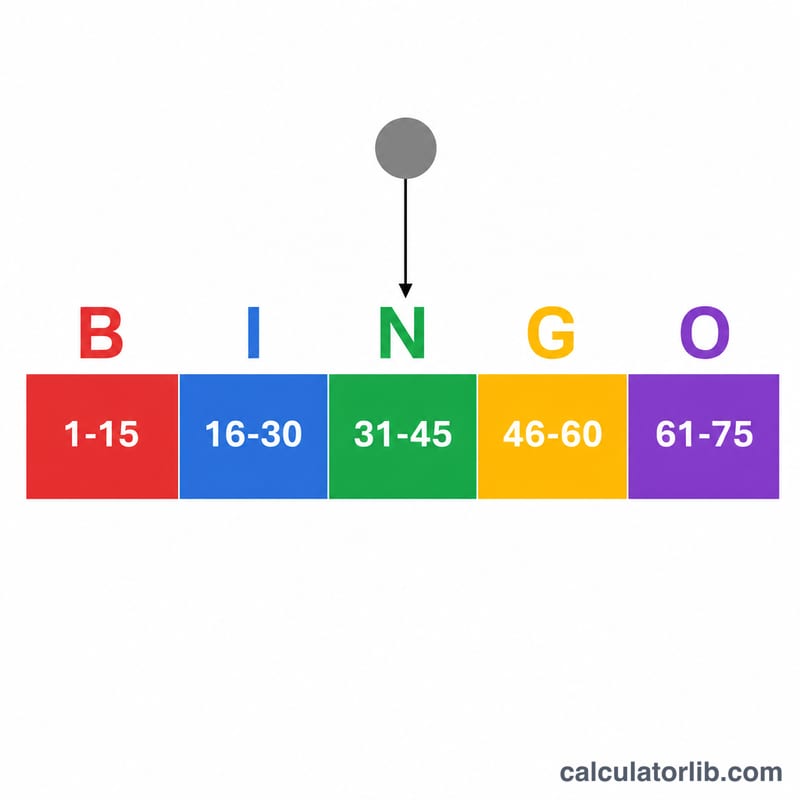
In 75-ball mode the column letter for a number \(n\) is found with $$\text{columnIndex} = \left\lceil \frac{n}{15} \right\rceil,$$ mapping to the letters B (1-15), I (16-30), N (31-45), G (46-60), O (61-75).
Worked example
Start a 75-ball game. Suppose the random index lands on the ball valued 32. Since $$\left\lceil \frac{32}{15} \right\rceil = 3,$$ the letter is N, so the call is "N 32". After this draw, 74 balls remain and 32 can never be drawn again. Draw again and you might get "B 7", leaving 73 balls.
75-Ball B-I-N-G-O Column Ranges
In 75-ball Bingo, the five letters of the word B-I-N-G-O each label a column of the card and a fixed block of 15 numbers. When a ball is drawn, the caller prefixes the number with its letter (for example, "B-7" or "O-68"). The column for any number \(n\) is found with \(\text{columnIndex} = \lceil n/15 \rceil\), giving column 1 for B through column 5 for O.
| Letter | Column | Number range | Count |
|---|---|---|---|
| B | 1 | 1 – 15 | 15 |
| I | 2 | 16 – 30 | 15 |
| N | 3 | 31 – 45 | 15 |
| G | 4 | 46 – 60 | 15 |
| O | 5 | 61 – 75 | 15 |
Worked example: for the number 68, the column index is \(\lceil 68/15 \rceil = \lceil 4.53 \rceil = 5\), so 68 falls in column 5 and is called as "O-68". The full pool spans 75 numbers, so a complete game can draw at most 75 unique balls without replacement.
75-Ball vs 90-Ball Bingo Compared
The two most common Bingo formats differ in their number pool, card layout, and the regions where they dominate. The 75-ball game is standard in the United States and Canada and uses the lettered B-I-N-G-O columns, while the 90-ball game is the staple of the United Kingdom, Ireland and Australia and calls numbers without letters.
| Feature | 75-Ball Bingo | 90-Ball Bingo |
|---|---|---|
| Number pool | 1 – 75 | 1 – 90 |
| Letters used | B, I, N, G, O (one per column) | None (numbers called alone) |
| Typical card layout | 5 × 5 grid (24 numbers + free center space) | 9 × 3 grid (15 numbers, 27 cells) |
| Numbers per column | 15 per letter column | ~10 per column (1–9, 10–19, … 80–90) |
| Common regions | USA, Canada | UK, Ireland, Australia |
| Call format | Letter + number (e.g. "G-52") | Number only, often with nicknames (e.g. "two little ducks, 22") |
| Typical winning patterns | Lines, shapes, full blackout | One line, two lines, full house |
Because both formats draw balls without replacement, each game is equivalent to a shuffle of the whole pool. A full 90-ball game can produce up to 90 distinct calls, while the 75-ball game tops out at 75. For a single fair draw from either pool you can also use a uniform integer generator over the matching range.
FAQ
Can a number repeat? No. Draws are without replacement, so every number appears at most once per game.
What happens when all balls are drawn? The pool is empty and Draw Ball does nothing; start a new game to play again.
Why no letters in 90-ball mode? UK/Australian Bingo uses numbers 1-90 only, with no B-I-N-G-O columns, so just the number is called.